
NEW YORK, August 5, 2026, 08:05 EDT (U.S. premarket)
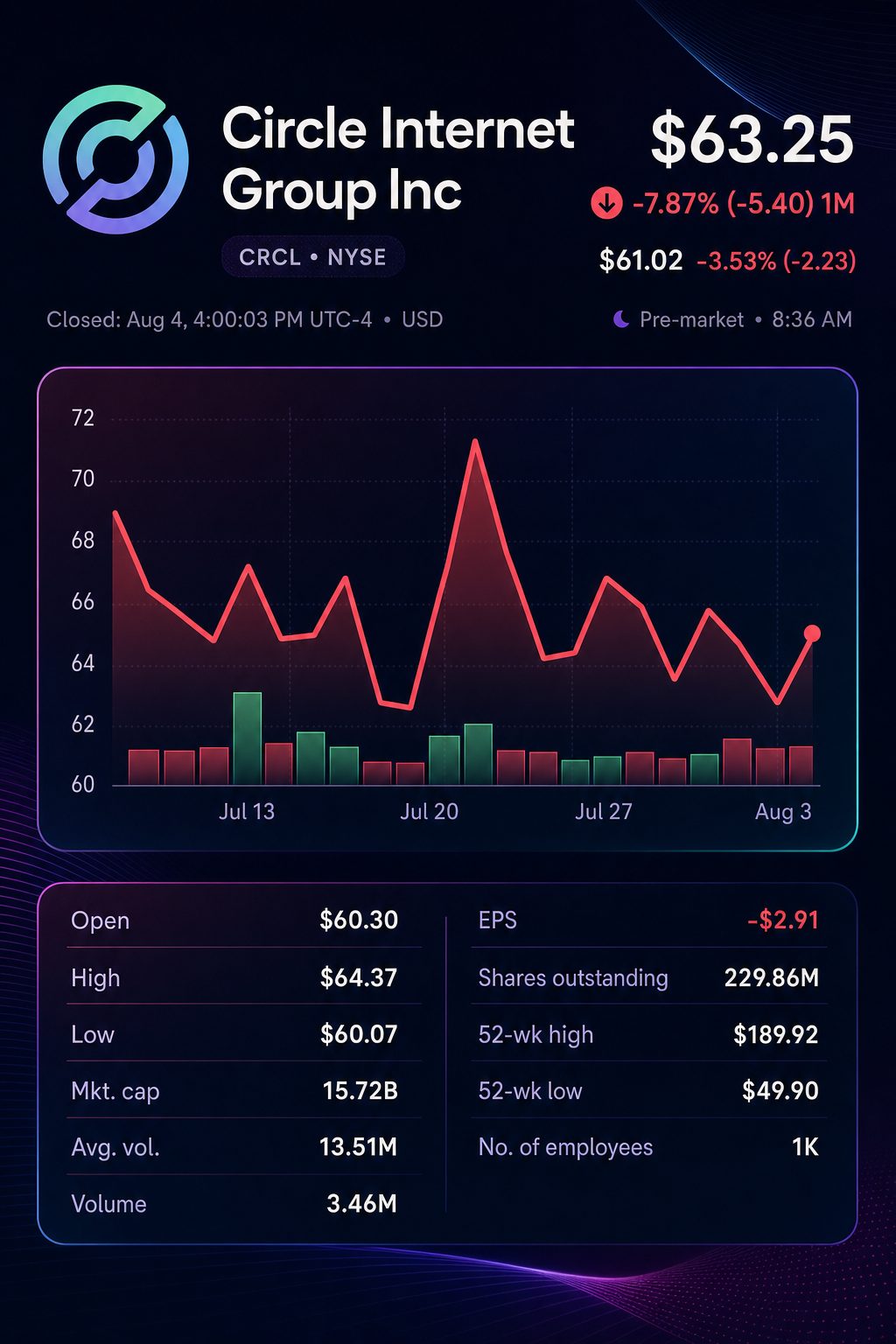
- Before markets opened on Wednesday, shares climbed as much as 7.6% to $68.08.
- Revenue for the second quarter totaled $701.3 million. Diluted earnings per share stood at $0.18.
- According to Reuters calculations using company figures, an increase of 40% in average USDC would counterbalance a one-point fall in yield, prior to accounting for distribution costs.
Shares in Circle Internet Group gained at first after the company reported quarterly earnings above expectations. However, revenue fell short of the FactSet consensus.
The main activity metrics appeared significantly more robust compared to the income statement. USDC onchain volume surged 151%, with total revenue climbing 7%. Nearly 95 cents from every dollar of revenue continued to be sourced from reserves.
Q2 results — company-provided figures; dollar values in millions, per-share amounts stated.
| Metric | Q2 2026 | Q2 2025 | Change |
|---|---|---|---|
| Total revenue and reserve income | $701.3 | $658.1 | +7% |
| Reserve income | $667.7 | $634.3 | +5% |
| Other revenue | $33.6 | $23.8 | +41% |
| Distribution, transaction and other costs | $412.5 | $406.9 | +1% |
| Revenue after distribution costs | $288.8 | $251.1 | +15% |
| RLDC margin | 41.2% | 38.2% | +3.0 points |
| Net income | $48.2 | $(482.1) | n.m. |
| Diluted EPS | $0.18 | $(4.48) | n.m. |
Diluted EPS exceeded expectations set by LSEG’s 17-cent forecast. Revenue missed FactSet’s $713 million consensus by roughly 1.6%. Investors favored the company’s resilience despite the lack of a clear earnings beat.
The durability is closely tied to interest-rate calculations. USDC had an average circulation of $76.5 billion throughout the quarter, while the reserve return rate stood at roughly 3.5%.
The data suggests annual gross reserve income totals $2.68 billion. Annualizing the actual reserve income for the second quarter gives a figure near $2.67 billion.
Reserve-rate sensitivity — reporter calculation keeps yearly gross reserve income at about $2.68 billion, not accounting for distribution expenses or reserve composition.
| Reserve return rate | Average USDC needed | Increase over Q2 average |
|---|---|---|
| 3.5% | $76.5 billion | 0% |
| 3.0% | $89.3 billion | +16.7% |
| 2.5% | $107.1 billion | +40.0% |
| 2.0% | $133.9 billion | +75.0% |
If Circle posts a 2.5% yield, it would require an average USDC balance of $107.1 billion, representing a 40% increase over the second-quarter mean. Circle’s through-cycle circulation target remains at 40% annual growth.
The periods cannot be directly compared. However, the calculation outlines what the target needs to achieve. It serves as both a signal of expected growth and as protection in the event of reduced rates.
Growth continues to fall short of the target. Average USDC saw a 25% year-on-year increase. Circulation at quarter’s end was up 19%, but down 4.8% compared to March.
USDC operational data — disclosed statistics alongside firm growth percentages.
| Indicator | Q2 2026 | Comparison |
|---|---|---|
| Average USDC in circulation | $76.5 billion | Up 25% from the previous year |
| USDC in circulation at quarter’s end | $73.3 billion | 19% higher year-on-year; down 4.8% from prior quarter |
| Return rate from reserves | Roughly 3.5% | Down 66 basis points over the year |
| USDC onchain transaction volume | $14.8 trillion | 151% above the same period last year |
| USDC maintained on Circle’s platform | $12.4 billion | Increase of 106% year-on-year |
| Share of stablecoin market | 27% | 66 basis points lower year-on-year |
| Number of active USDC wallets | 7.0 million | Up 24% from a year ago |
Margins provided the primary buffer for the quarter. Distribution and associated expenses grew just 1%. Net revenue after these expenses climbed 15% to $289 million.
Circle’s filings show Coinbase Global NASDAQ:COIN is still key to its distribution model, with payments increasing alongside reserve income and balances kept at Coinbase.
Additional USDC was shifted to Circle’s proprietary platform, which benefits retained economics. Conversely, Coinbase’s increasing share of the platform exerts an opposing impact.
USDC platform breakdown as of quarter-end — share of circulating supply by percentage.
| Location | Q2 2025 | Q2 2026 | Change |
|---|---|---|---|
| Circle platform | 10% | 17% | up 7 points |
| Coinbase platform | 21% | 30% | up 9 points |
| Off-platform | 69% | 53% | down 16 points |
The net outcome was an annual RLDC margin increase of three points. On a sequential basis, though, margin slipped to 41.2% from 41.4%. The economic picture is gradually getting better.
Management increased its non-reserve projection. Full-year guidance for other revenue nearly doubled. The adjusted expense outlook was left intact.
2026 guidance comparison — company projections.
| Indicator | Previous guidance | Revised guidance |
|---|---|---|
| USDC circulation growth | 40% through-cycle CAGR | 40% through-cycle CAGR |
| Other revenue | $150 million–$170 million | $310 million–$330 million |
| RLDC margin | 38.0%–40.0% | 41.7%–43.7% |
| Adjusted operating expenses | $570 million–$585 million | $570 million–$585 million |
The updated other-revenue midpoint means roughly $245 million is needed in the second half, exceeding triple the other revenue from the first half. Adjustments to revenue and margins have factored in recognized Arc token-presale revenue.
That distinction is important. Revenue from token presales may be less consistent than income from subscriptions. This also helps to account for the particularly notable rise in guidance.
Circle CEO Jeremy Allaire said, “Our quarterly financial results reflect the current rate environment and a crypto market that has slowed. But near-term activity tells a different story.” He pointed to Circle’s federal trust charter and noted Arc’s September 16 mainnet launch. Q4 Capital
Risks: A quicker pace of rate reductions could lead to lower reserve earnings. USDC expansion might not reach the 40% objective. Competition in stablecoins, distribution payouts, and Arc implementation could further impact margins.
The initial rise in share price reflects a quarter marked by lower yields. The bigger challenge ahead is for Circle to accelerate USDC growth to maintain its spread-driven economics.
Related articles: NYSE:CRCL