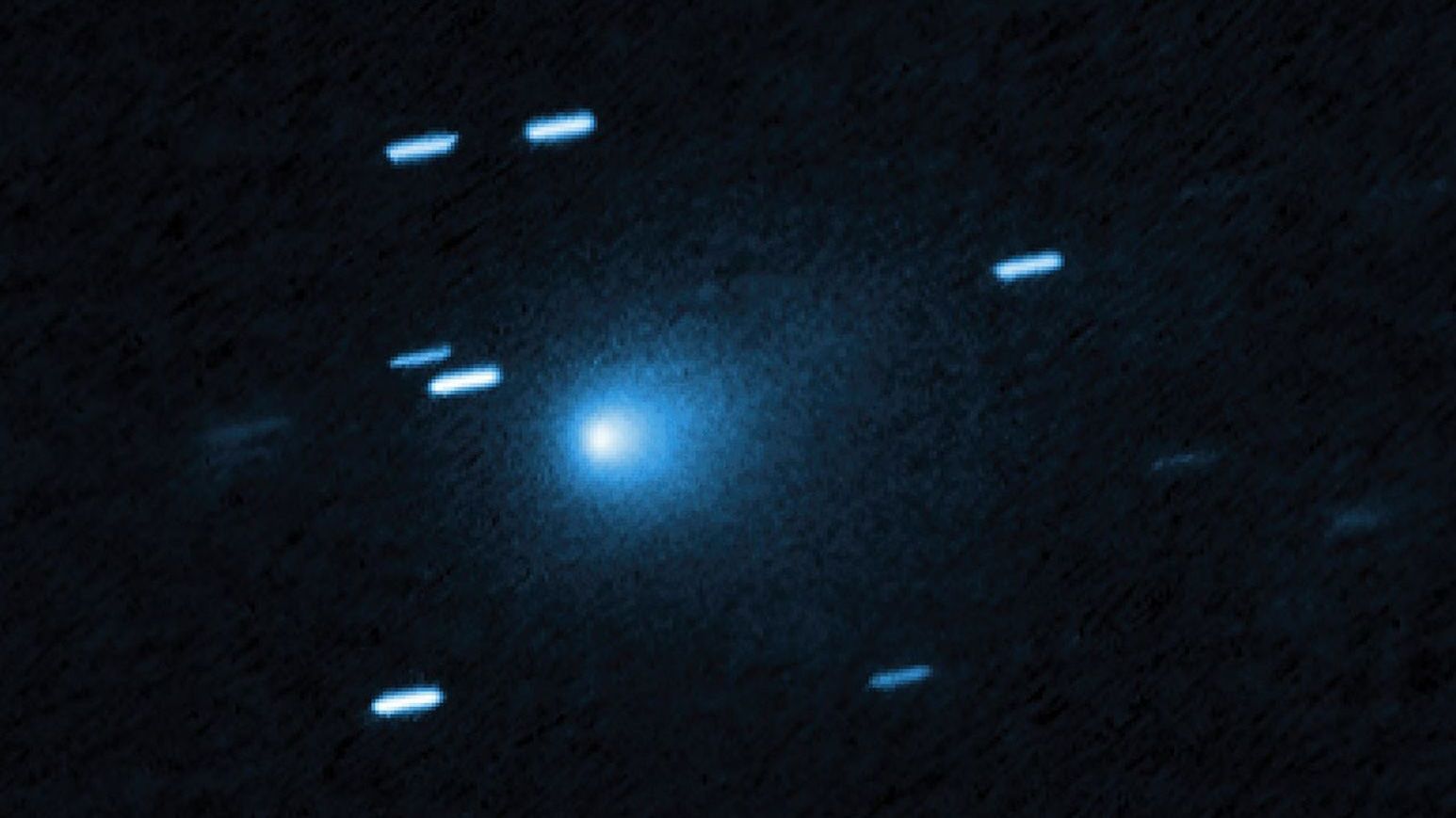

Updated: November 7, 2025 — Interstellar comet 3I/ATLAS (also cataloged as C/2025 N1 [ATLAS]) has re-emerged from behind the Sun and is back on astronomers’ morning watch lists. Fresh coverage today highlights new imagery from Mars orbit, public tools to follow its path, and why agencies are mobilizing to study only the third confirmed interstellar object ever seen.
What’s new today (Nov 7)
- China’s Tianwen‑1 shows 3I/ATLAS from Mars orbit. China released images of the comet captured by Tianwen‑1, adding to ESA’s earlier ExoMars Trace Gas Orbiter GIF. These views were possible because perihelion geometry hid the comet from Earth around Oct 29.
- How to follow its trajectory. A new WIRED guide walks the public through live‑tracking options using JPL Horizons, TheSkyLive, and NASA’s Eyes on the Solar System as the object recedes from the Sun.
- Explainer & context in mainstream press.Al Jazeera published a same‑day explainer on why scientists are racing to observe the comet and what its flybys mean, reaffirming no threat to Earth.
Quick facts at a glance
- What it is: An interstellar comet — only the third known after 1I/ʻOumuamua (2017) and 2I/Borisov (2019). Discovered July 1, 2025 by the ATLAS survey in Chile; named “3I/ATLAS” under IAU conventions. European Space Agency
- Key dates:Perihelion (closest to the Sun) occurred Oct 29, 2025; closest to Earth will be Dec 19, 2025 (~270 million km). It will then head back to interstellar space.
- Speed & path: Roughly 210,000 km/h on a hyperbolic, interstellar trajectory; it never approaches Earth closely and poses no hazard.
Back in our skies: where and how to see 3I/ATLAS
The comet is again observable from Earth in the pre‑dawn sky, very low toward the eastern horizon. It remains a small‑telescope target (not visible to the unaided eye), but experienced observers with a dark site and a clear low east can spot and image it as it brightens briefly post‑perihelion before fading through December. For coordinates and real‑time ephemerides, use JPL Horizons or public dashboards such as TheSkyLive and NASA’s Eyes.
Spacecraft are doing the heavy lifting
Because 3I/ATLAS was behind the Sun at perihelion, Mars‑orbiting spacecraft had the best vantage point:
- ESA’s ExoMars Trace Gas Orbiter (TGO) captured a sequence on Oct 3 as the comet passed ~30 million km from Mars; Mars Express attempted images with shorter exposures.
- China’s Tianwen‑1 added fresh imagery this week from Mars orbit, underscoring the role of multiple agencies in cross‑checking observations.
- Looking outward, ESA notes its JUICE spacecraft plans November observations but, due to communications constraints, data are expected on Earth in early 2026.
What scientists are learning about its chemistry and age
Early JWST spectra (August) revealed a CO₂‑dominated coma with unusually high CO₂/H₂O and significant CO — among the richest measured for any comet. A new late‑October preprint argues that galactic cosmic rays likely transformed the outer 15–20 meters of the nucleus over billions of years, creating an irradiated crust whose gases dominate what we see now. That means the outer layers we’re sampling are processed by deep time in interstellar space, not pristine material from the comet’s birth environment.
Sorting signal from noise: is anything “anomalous”?
Public chatter has included claims of unusual color changes and nongravitational effects. Here’s the state of play:
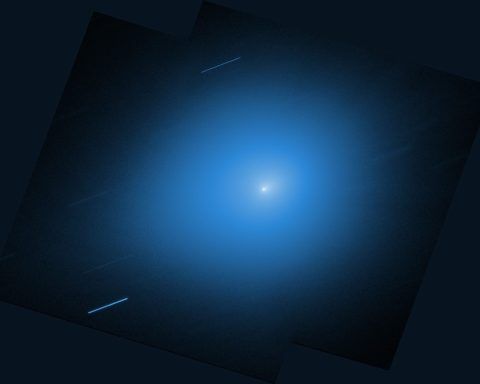
- Color changes: Reports this week note a bluish tint in some images. Color in comets can vary with dust vs. gas dominance and observing setups; more calibrated spectroscopy is needed to pin down persistent changes.
- Nongravitational acceleration & mass loss: Outgassing can produce small course tweaks in comets. Popular science coverage has speculated about post‑perihelion mass loss and slight trajectory adjustments; definitive orbital updates await authoritative fits from JPL/MPC as more data are ingested. Treat strong claims cautiously until official solutions publish.
- Not an alien probe:NASA and ESA stand by the interpretation that 3I/ATLAS is a natural comet, pushing back on online speculation amplified during the U.S. government shutdown.
Why this interstellar comet matters
Interstellar objects are time capsules from other star systems. ESA’s primer stresses that every planet, moon and comet born here shares a common origin — interstellar visitors do not. Sampling their composition, textures, and activity gives us a rare, independent look at how other planetary systems build and weather icy bodies. 3I/ATLAS is only the third such window we’ve had — and it’s larger and chemically richer than ʻOumuamua, offering a deeper dataset.
Timeline: recent milestones & what’s next
- Jul 1, 2025 — Discovery: ATLAS survey (Chile) flags a fast, hyperbolic object; later confirmed as interstellar and designated 3I/ATLAS.
- Oct 3 — Mars pass: ~30 million km; ESA/TGO and Mars Express attempt observations; Tianwen‑1 later shares imagery.
- Oct 29 — Perihelion: Behind the Sun from Earth’s point of view; spacecraft continue monitoring.
- Early November — Reappears for Earth observers: Low pre‑dawn view; track with Horizons/Eyes/TheSkyLive.
- Dec 19 — Closest to Earth (~270 million km): Still far and faint; a target for professional and advanced amateur setups.
- Into 2026: JUICE downlinks expected; comet exits the inner solar system for good.
How to follow along (public resources)
- Live tracking & ephemerides: JPL Horizons and public dashboards (TheSkyLive; NASA’s Eyes).
- Agency fact sheets & imagery:NASA Hubble/JWST pages; ESA’s continuously updated FAQ and mission updates.
- Today’s coverage: Tianwen‑1 Mars‑orbit images; explainers and viewing tips.
Bottom line
As of Nov 7, 2025, 3I/ATLAS is a natural, CO₂‑rich interstellar comet that just rounded the Sun and is now creeping back into Earth’s dawn skies. New Mars‑orbiter images and public tracking tools make it easier than ever to follow — and the science payoff is growing as teams compare pre‑ and post‑perihelion data to test how billions of years in deep space altered its surface. Expect more calibrated results over the next few weeks as observatories resume full operations and fresh astrometry tightens the orbit.
Sources and further reading
ESA FAQ and mission updates on 3I/ATLAS; NASA Hubble/JWST pages and object overview; WIRED tracking guide (Nov 7); Al Jazeera explainer (Nov 7); Space.com on Tianwen‑1 images (Nov 6); Heise report on Tianwen‑1/TGO (Nov 6); LiveScience coverage of JWST‑based cosmic‑ray processing (Oct 31) and recent color reports.
Editorial note: This article synthesizes today’s developments with recent peer‑reviewed and preprint work; where claims are preliminary (e.g., color shifts, nongravitational effects), we frame them as working interpretations pending official orbit updates and additional spectroscopy.
Related articles: Space Exploration