
CrowdStrike Holdings, Inc. NASDAQ:CRWD is back in the spotlight on Wednesday, December 17, 2025, as investors weigh fresh product momentum tied to enterprise AI security against a rich valuation and mixed near-term sentiment signals from options and institutional positioning.
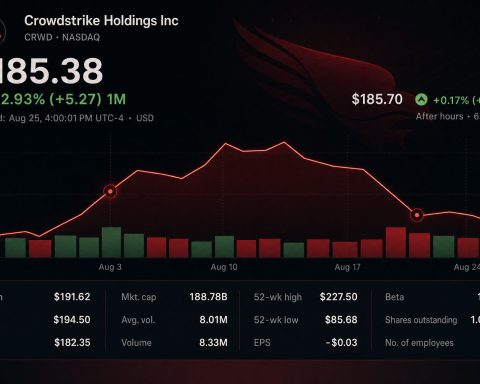
At the time of publication, CRWD shares were trading around $474.62, down about 2.85% on the day, after opening near $489.08 and touching an intraday high near $492.75 and a low around $473.67.
What’s driving the conversation isn’t a single earnings headline (CrowdStrike last reported on Dec. 2), but a cluster of developments hitting the tape today—including coverage of a new AI-era security capability, updated institutional ownership stories, a credit-rating note, and multiple fresh analyst-style rundowns focused on the company’s platform expansion strategy.
CrowdStrike stock price check: CRWD trades lower as the market weighs growth vs. valuation
CrowdStrike stock’s dip on Dec. 17 is notable because it comes amid continued optimism about cybersecurity demand and the company’s positioning in AI-related security workflows—but also as investors remain sensitive to premium software multiples and the “priced for perfection” dynamic common across high-growth security names.
Today’s move also comes with steady volume (roughly 1.2M shares at the latest snapshot), suggesting active two-way trading rather than a quiet drift.
Today’s biggest CrowdStrike catalyst: Falcon AIDR targets the “AI prompt and agent” attack surface
A major theme in CrowdStrike coverage today is the company’s push to secure what it calls the AI “interaction layer”—the area where prompts, responses, and autonomous agents can be manipulated by attackers.
CrowdStrike’s announcement (made earlier this week) confirmed the general availability of Falcon AI Detection and Response (AIDR), extending the Falcon platform into AI prompt/agent security. The company frames this layer as one of the fastest-growing enterprise attack surfaces in the AI era, with risks like prompt injection and unsafe agent actions becoming a frontline issue for security teams.
Key details CrowdStrike highlighted about Falcon AIDR include capabilities such as:
- Visibility into employee AI use and agent operation, including runtime logs for compliance and investigations
- Real-time blocking of prompt injection/jailbreak techniques, powered by research across adversarial prompt datasets and “180+ known prompt injection techniques”
- Controls to contain risky AI interactions and malicious agent actions
- Protections to prevent credentials and regulated data from reaching models/agents or external AI systems CrowdStrike
CrowdStrike is also promoting a set of upcoming virtual events aimed at secure AI adoption and development, with dates listed for Jan. 21 (AMER), Jan. 22 (APJ), and Jan. 27 (EMEA), 2026.
Why this matters for CRWD stock
For investors, the “AIDR” narrative is about more than a feature release. It’s a bid to make Falcon the default platform for enterprise security teams as AI usage spreads across:
- Developers building AI-enabled workflows
- Employees using GenAI tools daily
- Organizations deploying autonomous agents that can touch real systems, identities, APIs, and sensitive data MSSP Alert+1
Channel-focused coverage today emphasized that CrowdStrike is positioning AIDR as platform-native—meant to flow into existing SOC workflows rather than forcing customers into a separate console or “bolt-on” point solution approach. MSSP Alert
New analysis published today: Falcon Flex is increasingly central to the CrowdStrike growth story
Another major piece of Dec. 17 analysis focuses on CrowdStrike’s Falcon Flex consumption model—an increasingly important lever for expanding module adoption and customer spend across the Falcon platform.
A Zacks-authored analysis (republished today) pointed to rapid scaling in Flex-linked metrics, highlighting that ARR from Falcon Flex customers reached $1.35 billion in fiscal Q3 2026, described as more than triple the prior year’s level.
The same analysis flagged momentum in customer expansions:
- 200+ customers expanded their Falcon Flex contracts during the quarter
- Some customers reportedly doubled original spending, which the commentary frames as a sign of quick time-to-value and accelerating platform usage Finviz
The article argues Flex can reduce procurement friction for customers adding new modules—supporting growth across areas like next-gen SIEM, cloud security, identity security, and endpoint protection.
The competitive context investors are watching
That same analysis compared CrowdStrike’s platform expansion push with peers, noting:
- Palo Alto Networks saw Next-Gen Security ARR up 29% YoY (in the cited period)
- SentinelOne posted ARR growth of 23% YoY (in the cited period) TradingView
In other words: CRWD is not operating in a vacuum. The market is rewarding platform narratives, but competition is intense, and platform adoption rates can become a key differentiator.
Valuation remains part of the debate
The Zacks analysis also underscored a key tension for CRWD stock: growth and platform strength vs. a premium multiple. It cited CrowdStrike trading around a forward price-to-sales ratio of 21.56, versus an industry average of 11.83.
That valuation debate is likely to remain a recurring theme in CRWD coverage—especially on down days.
Analyst forecasts for CRWD: consensus stays bullish, but upside looks more “measured” at today’s price
Despite today’s pullback, aggregated sell-side sentiment remains constructive.
One widely followed snapshot showed:
- Consensus rating: “Moderate Buy”
- 52 analyst ratings included in the rollup
- Average 12-month price target: $554.65
- Implied upside of roughly ~17% from the referenced current price (at the time of that dataset) MarketBeat
A separate market-data source similarly listed an average price target around $554, with a high estimate of $706 and low estimate near $353, and characterized the overall analyst stance as “Buy.” Investing.com
How to interpret these “price target” numbers
Price targets can be useful for understanding where analysts think the business could be valued under their assumptions—typically reflecting:
- ARR expansion and net retention trends
- Operating leverage/free cash flow progression
- Competitive posture in endpoint/XDR, cloud, identity, and now AI security
- Willingness of the market to pay premium multiples for durable growth
But investors also know targets can shift quickly if the market reprices growth stocks or if forward guidance changes.
Options and sentiment snapshot today: “big-money” trades lean cautious
One of the more eye-catching “today” reads for short-term traders comes from the options market.
A Dec. 17 options-focused report flagged 35 unusual options trades in CRWD, describing overall “uncommon” activity and noting the detected sentiment was split, with a larger bearish share in that dataset. Benzinga
The report stated:
- 35 unusual trades detected
- Big-trader sentiment split (with bearish outweighing bullish in the tally)
- Observed strike activity suggesting a price “window” roughly between $450 and $630 Benzinga
It’s worth emphasizing: unusual options activity can reflect hedging, volatility positioning, or complex multi-leg strategies—not necessarily a straightforward directional bet. Still, it adds to the picture of a market that is not uniformly euphoric at current valuation levels.
Institutional and insider positioning: today’s filings show both buying and trimming
Two separate institutional-ownership stories published today highlight a familiar dynamic in mega-cap and large-cap growth: some funds add exposure while others reduce, often for portfolio rebalancing reasons rather than a single fundamental thesis.
Institutional buy: new position opened
One report said Grant Private Wealth Management Inc. opened a new position, buying 3,446 shares valued around $1.69 million (per that filing-based writeup).
Institutional trim: stake reduced
Another report said Destiny Wealth Partners LLC reduced its stake by 19.9% in the third quarter, ending with 13,320 shares valued around $6.53 million (as described in the filing recap).
Insider selling: still on investors’ radar
The Destiny Wealth Partners recap also flagged notable insider selling activity, including:
- A CFO sale of 10,706 shares (listed with an average price around $495.67)
- A director sale of 5,000 shares (listed with an average price around $550.20)
- A broader summary stating insiders sold 120,595 shares valued around $61.29 million over the last 90 days (per that report) MarketBeat
Insider sales don’t automatically equal bearish fundamentals—executives sell for many reasons—but the market often tracks it closely when a stock is priced at a premium.
Credit and balance sheet update: S&P rating affirmed at BB+ with positive outlook, per Cbonds
In a credit-market-oriented update published today, Cbonds reported that S&P Global Ratings affirmed CrowdStrike’s long-term credit rating at “BB+” with a positive outlook (as described in the Cbonds item). Cbonds+1
For equity investors, credit ratings aren’t usually the main driver of day-to-day moves, but they can matter at the margin for:
- Funding costs (especially if debt markets tighten)
- Perceptions of balance sheet resilience
- The company’s flexibility for M&A or strategic investment cycles
The last big fundamental anchor: Q3 results and raised outlook (reported Dec. 2)
Even though today’s news cycle is more product/positioning-driven, investors are still trading CRWD in the context of its last earnings and guidance reset.
CrowdStrike’s fiscal Q3 (reported Dec. 2) included:
- Non-GAAP EPS of $0.96 (as reported in the release)
- Revenue of about $1.23B (as reported at the time) Business Wire+1
The company also provided/raised guidance at that time, including:
- Q4 FY26 revenue guidance: $1.29B–$1.30B
- FY26 revenue guidance: ~$4.7966B–$4.8066B
- FY26 non-GAAP EPS guidance: $3.70–$3.72 Business Wire+1
Reuters coverage framed the outlook as being supported by rising adoption of AI-related features across the Falcon platform and noted the company’s efforts to consolidate security operations for customers.
What investors are watching next for CrowdStrike stock
Here are the key near-term questions that could shape CRWD’s next leg—up or down:
1) Does Falcon AIDR translate into meaningful adoption (and measurable ARR expansion)?
CrowdStrike is aiming to make AI prompt-layer security a mainstream SOC workflow problem—an attractive framing if it leads to broader module pull-through.
2) Can Falcon Flex keep expanding without increasing discount pressure?
The bull case leans heavily on platform expansion and consumption-driven growth. Today’s analysis highlighting $1.35B in Flex-customer ARR underscores why this metric matters.
3) Valuation tolerance: will investors keep paying a premium multiple for the growth profile?
With commentary pointing to a forward P/S well above industry averages, even “good” quarters can trigger choppy trading if expectations run ahead of execution. TradingView
4) The next earnings date and guidance cadence
One market-data listing shows a next earnings date around March 10, 2026 (as currently listed there).
Bottom line: Dec. 17 reinforces the core CRWD debate—platform strength vs. premium pricing
Today’s CRWD story is a classic large-cap growth setup:
- The product narrative is expanding into one of the most important new enterprise battlegrounds—AI interaction security—while staying tied to CrowdStrike’s platform-first strategy.
- Analyst forecasts remain supportive, clustering around mid-$500s targets, but the implied upside is not “sky-high” from here—meaning execution and market multiples both matter. MarketBeat+1
- Options and ownership signals are mixed, reflecting a market that’s still enthusiastic about the long-term theme—but careful about paying any price in the short run.
As
Related articles: NASDAQ:CRWD