
NEW YORK, June 29, 2026, 17:01 (EDT)
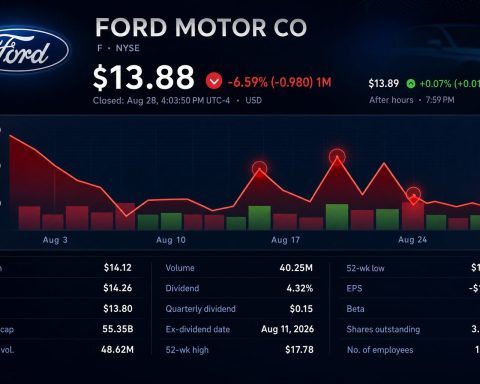
- Ford Motor Company NYSE:F was last quoted at $14.02, down 0.7%, while the SPDR S&P 500 ETF Trust NYSEARCA:SPY rose 1.7% and the Consumer Discretionary Select Sector SPDR Fund (NYSEARCA:XLY) gained 2.4%.
- Ford cut its J.D. Power initial-quality score to 152 problems per 100 vehicles from 193 a year earlier, a 21% drop, but still led the industry with 51 recalls this year.
- Analysts’ average Ford target of $14.78 sits about 5% above Monday’s $14.02 quote; the median target is $14.25.
- Regular U.S. trading had ended at the dateline time; Nasdaq lists regular hours at 9:30 a.m. to 4 p.m. ET and after-hours to 8 p.m. ET.
Ford left Monday’s stock rally with a problem for bulls: its best quality score in years still did not move the stock. The shares were last at $14.02, down 0.7%, while U.S. stocks ended sharply higher and the Nasdaq Composite rose 2.04%.
The split was not just against tech. General Motors Company NYSE:GM fell 1.0%, but Tesla Inc NASDAQ:TSLA rose 8.5%, the S&P 500 tracker gained 1.7% and the consumer-discretionary ETF rose 2.4%.
| Monday quote snapshot | Last price | Day move | Intraday range |
|---|---|---|---|
| Ford Motor Company NYSE:F | $14.02 | -0.7% | $13.97-$14.25 |
| General Motors Company NYSE:GM | $77.34 | -1.0% | $77.10-$79.09 |
| Tesla Inc NASDAQ:TSLA | $411.84 | +8.5% | $379.97-$413.17 |
| SPDR S&P 500 ETF Trust NYSEARCA:SPY | $741.00 | +1.7% | $732.30-$741.46 |
| Consumer Discretionary Select Sector SPDR Fund (NYSEARCA:XLY) | $117.12 | +2.4% | $115.07-$117.51 |
That creates the trade. Ford has a better operating story on quality, but the stock is already close to the sell-side middle. FactSet data on WSJ showed a $14.78 average price target, $14.25 median, $11 low and $20 high, with a Hold consensus.
J.D. Power said Ford ranked highest among mass-market brands in its 2026 U.S. Initial Quality Study with 152 problems per 100 vehicles. The industry score improved to 175 from 192, while Ford improved by 41 points from 193, a bigger cut than the industry’s 17-point gain.
Ford CEO Jim Farley called it “a proud day” and said the company was “just getting started.” Thomas King, president of OEM solutions at J.D. Power, said Ford ranked “highest among mass market brands,” and that the F-150, Mustang and Super Duty ranked highest in their segments. Business Wire
J.D. Power’s Frank Hanley put the investor issue in plain terms: “keeping the experience simple matters more than ever.” The study said infotainment was the only category where reported problems rose, with Android Auto and Apple CarPlay connectivity the largest single driver of that decline. JD Power
| Ford quality and stock gap | Latest data | Investor read |
|---|---|---|
| Ford initial-quality score | 152 PP100, down from 193 | About 21% fewer reported problems |
| Industry initial-quality score | 175 PP100, down from 192 | About 9% fewer reported problems |
| Ford average analyst target | $14.78 | About 5% above $14.02 |
| Ford median analyst target | $14.25 | About 2% above $14.02 |
| Ford target range | $11-$20 | Wide split on repair pace and earnings risk |
Ford’s own fix is more human than the AI talk around the stock. The company said it hired roughly 300 veteran engineers to run weekly design reviews and look for failure points before products reach the plant. Charles Poon, Ford’s vice president of vehicle hardware engineering, said: “Artificial intelligence is a fantastic tool, but it’s only as good as the information you use to train it.” Ford From the Road
Recall data is why Monday’s price action matters. Reuters reported Ford still led the industry with 51 recalls this year, versus 19 for Stellantis NYSE:STLA, and Ford has topped the industry in recall volume each year since 2020.
Two recent June recalls show the overhang. Ford recalled 419,967 Expedition and Lincoln Navigator vehicles over seat-belt issues, then 548,463 Expedition vehicles over defective center-console trim that could leave sharp edges.
The recall count matters because Ford’s 2026 earnings plan assumes repair costs come down. Ford raised its 2026 adjusted EBIT guide to $8.5 billion to $10.5 billion in April, and said in its quality release that warranty costs fell year over year in 2025 and that it expects the trend to continue in 2026.
Ford’s next hard test is July 29, when WSJ says the company is due to report second-quarter results. The same FactSet table showed a current Q2 EPS estimate of 35 cents, up from 34 cents one month earlier.
Related articles: NYSE:F