
Ford Motor Company NYSE:F is rewriting its electrification playbook heading into 2026—an announcement that quickly became one of the biggest auto and markets stories of December 15, 2025. In a sweeping strategic shift, Ford said it will take about $19.5 billion in EV-related special items, scale back select large EV programs, expand hybrids and extended-range EVs (EREVs), and launch a battery energy storage systems (BESS) business aimed at data centers and grid demand.
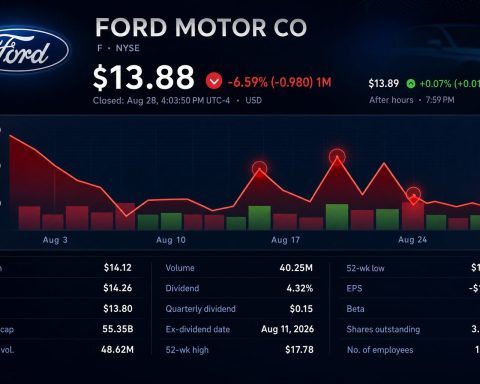
The pivot lands at a moment when Ford shares have already posted a powerful run in 2025, helped by truck profitability, improving operational discipline, and a dividend yield that has stood out in an index increasingly dominated by growth stocks.
What Ford announced on Dec. 16 headlines
While the company’s statement is dated December 15 in the U.S., it drove global “Dec. 16” coverage across markets and newsrooms due to timing across time zones and syndication. The key moves include:
- EV charges and restructuring: Ford expects ~$19.5B in special items (majority in Q4 2025), and ~$5.5B in cash effects largely in 2026–2027.
- A shift toward hybrids and EREVs: Ford says about 50% of global volume by 2030 is expected to be hybrids, EREVs, and EVs—up from 17% today.
- A new battery storage business: Ford plans to begin shipping BESS systems in 2027 with 20 GWh of annual capacity, targeting energy infrastructure and data center demand.
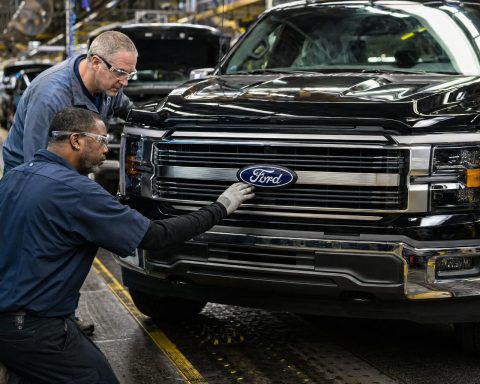
- Plant and product reallocation: BlueOval City in Tennessee is repositioned to build new trucks (instead of the previously planned EV truck), and Ohio Assembly is set for a new gas/hybrid commercial van—both with production start targets in 2029.
Why Ford is pulling back from “big EVs”
Ford’s move is not a retreat from electrification altogether—it’s a recalibration around profitability, customer demand, and policy-driven economics.
In a Form 8-K filing, Ford said it has observed lower-than-anticipated EV adoption and pointed to multiple pressures: changing consumer sentiment, competition, legal/policy changes, pricing dynamics, and the termination of U.S. EV purchase tax credits that Ford said negatively affected adoption rates.
The filing also flagged the possibility that looser regulatory requirements could further disrupt the EV market, extending industry underutilization of EV production capacity.
That context matters: Ford is essentially arguing that the economics of certain large EV programs no longer clear the hurdle rate—particularly in a world where incentives and regulatory frameworks can change quickly.
The biggest product signal: the next F-150 Lightning becomes an EREV
One of the most widely discussed elements of the announcement is what it means for America’s bestselling vehicle franchise.
Ford says production of the current-generation F-150 Lightning ends this year, and the next-generation version will use Extended Range Electric Vehicle (EREV) technology—an EV powertrain with a generator-backed estimated range of more than 700 miles.
Ford is positioning the EREV approach as a middle path between full battery-electric and traditional hybrids:
- The truck is still propelled 100% by electric motors (an “EV driving feel”), but
- adds the “freedom” of long-range towing and travel with a generator as backup. Ford From the Road
Auto media coverage framed this as a major reversal from earlier large-EV ambitions, noting the shift toward a range-extender design rather than a purely battery-electric pickup.
Battery storage: Ford’s new growth bet beyond vehicles
The other headline-grabbing move is Ford’s entry into battery energy storage—especially tied to AI data centers and grid stability.
Ford says it will leverage wholly owned plants and LFP battery technology to build battery storage solutions, with plans to ship in 2027 and reach 20 GWh annual capacity.
In the SEC exhibit, Ford goes further—saying it plans to repurpose battery manufacturing capacity in Glendale, Kentucky for large 5 MWh+ storage systems and invest roughly $2 billion over two years to scale the business.
This is strategically notable for two reasons:
- It monetizes battery capacity that may be underutilized if EV demand is slower than expected.
- It pushes Ford into a market where demand is being pulled not by consumers, but by enterprise infrastructure—utilities, industrial customers, and data center operators.
What this means for Ford stock after a strong 2025 run
The market backdrop for Ford investors heading into this pivot is unusual: Ford has been treated as both a “value/dividend” name and a “strategy turnaround” story at the same time.
Ford’s high-yield outperformance narrative (before the reset)
A widely circulated December 8 analysis called Ford a surprising high-yield S&P 500 winner, citing:
- 33.7% return in 2025
- 5.1% dividend yield
- $6.7B free cash flow through Q3
- A narrowed EV division loss (referenced as roughly $1.3B)
- And a low multiple (noted as 8x forward earnings) 24/7 Wall St.
That “income + momentum” combination is part of why Ford stayed in the spotlight even as AI-driven megacaps dominated index performance.
Has the rally already priced in the turnaround?
Just two days before the strategy shockwave, Simply Wall St highlighted how far the stock had already moved:
- Ford shares were up 42.6% year to date
- Trading around $13.76
- With a DCF-based intrinsic value estimate around $11.69 (implying ~17.7% overvalued on that model) Simply Wall St
At the same time, the same analysis noted Ford’s P/E around 11.7x, below the Auto industry average it cited (~18.7x), illustrating why valuation debates around Ford often produce mixed conclusions depending on methodology and assumptions.
Bottom line: Ford entered this week with bullish momentum behind it—so the new EV charges and program cancellations are likely to sharpen the market’s focus on execution and cash flow durability.
Why Ford keeps “trending” with investors
On December 15, Zacks (as republished by FINVIZ) noted Ford was one of the most searched stocks among its readers and pointed to the mechanics that often drive short-term attention: earnings estimate revisions, revenue expectations, and valuation multiples relative to peers.
The Zacks commentary also cited:
- Ford shares up about 4.3% over the past month (at the time of writing)
- A near-term earnings expectation of $0.06 per share for the current quarter (with a large year-over-year decline indicated)
- And a next-year consensus EPS outlook implying growth versus the prior year.
With today’s strategic pivot, those “estimate revision” dynamics become even more important: large non-cash impairments can hit reported results, while the market may look through them if Ford can demonstrate improving underlying profitability.
What to watch next: the real scorecard for this pivot
Ford’s announcement is big, but investors and industry watchers will likely judge it on a few measurable milestones:
- Details of the $19.5B charges
The SEC filing breaks out expected EV-related impairments and program costs (including an estimated $8.5B write-down tied to Model e assets and canceled EV programs). - How quickly hybrids and EREVs scale profitably
Ford is explicitly leaning into multi-powertrain demand—especially trucks and commercial vehicles—rather than betting exclusively on full battery-electric growth. - Battery storage execution and customer traction
The BESS business has a clear timeline (shipments targeted for 2027) and specific capacity targets (20 GWh). What’s missing—so far—is visibility into contracted customers, pricing, margins, and service economics. - F-150 Lightning transition risk
Ending current Lightning production and relaunching as an EREV creates a gap that competitors could exploit—unless Ford manages the product handoff smoothly. - Dividend resilience under higher restructuring costs
Ford’s yield has been central to the bull case in 2025. As cash effects land in 2026–2027, income-focused investors will track free cash flow closely.
The Dec. 16 takeaway
Ford’s new message to the market is blunt: the company still believes in electrification, but not at any cost—and not concentrated in the most capital-intensive, hardest-to-profit segments of the EV market.
For consumers, the headline is the next-generation F-150 Lightning EREV—a bet that the truck market wants EV torque and capability without the anxiety of charging during long-distance towing. Ford From the Road+1
For investors, the headline is the $19.5B reset paired with a push into hybrids, trucks, and energy storage, and a raised profitability outlook for 2025 adjusted EBIT.
Whether Ford’s powerful 2025 rally proves “fully priced in” now depends on execution—especially how quickly the company can turn a strategy reboot into sustained margins and cash generation across Ford Pro, Ford Blue, and Model e. Simply Wall St+1
Related articles: NYSE:F