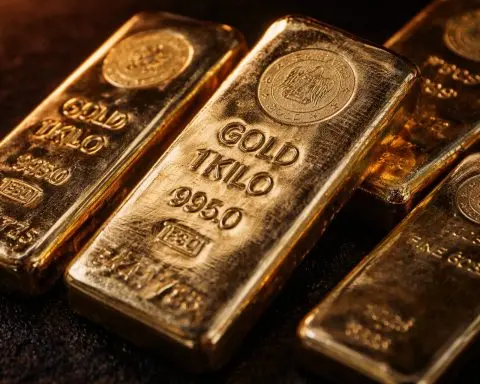
Gold is starting December firmly on the front foot. Across 5–7 December 2025, spot prices have hovered around $4,200 per ounce, just shy of recent record highs, as traders brace for a potential U.S. Federal Reserve rate cut at the 9–10 December FOMC meeting.Reuters+2JM Bullion+2
At the same time, a wave of fresh research from banks and asset managers is sketching out a bold roadmap for bullion in 2026, with base cases clustering around $4,000–$4,500 and upside scenarios reaching as high as $5,000 per ounce.Reuters+3State Street Global Advisors+3Exc…
Below is a deep dive into the latest news, forecasts and analyses on gold commodities for 5–7 December 2025, written with SEO in mind and suitable for Google News and Discover.
Gold Price Today: What Happened Between 5 and 7 December 2025?
Spot and futures levels
Across the end of the week and into Sunday, gold has largely traded in a tight band around $4,200 per ounce:
- On Friday 5 December, spot gold was about $4,212/oz in New York afternoon trade, up roughly 1% on the day but still headed for a small weekly loss of around 0.4%.Reuters
- U.S. gold futures for February delivery settled around $4,243/oz that same session.Reuters
- Data providers tracking daily closes show Friday’s levels clustered near $4,200–4,210/oz, confirming that the metal is consolidating just under its record zone.Gold Price+1
- By Sunday 7 December, live spot quotes from major bullion platforms still placed gold near $4,210–4,230/oz, underscoring how firmly prices are holding above the psychological $4,000 line.JM Bullion+1
Silver has been even more dramatic: it surged to a record intraday high near $59–60/oz on Friday, extending a year-to-date gain of almost 100% and outpacing gold’s already spectacular rally.Reuters+2The Economic Times+2
The immediate driver: Fed rate cut expectations
The dominant story behind these moves is monetary policy:
- Reuters reports that traders now see an ~87% probability of a 25 bps Fed rate cut at next week’s FOMC meeting, according to CME FedWatch pricing.Reuters
- The latest U.S. core PCE inflation reading showed annual price growth at roughly 2.8%, reinforcing the view that inflation is no longer a major barrier to easing.Kitco
- A softer U.S. dollar and lower Treasury yields, helped by weaker labour-market data (including a sharp drop in ADP employment), have provided a floor under gold.Forex Crunch+1
In short, the market is trading as if the “first proper cut” of this cycle is imminent — and gold is the asset class most visibly pricing that in.
Macro Backdrop: Liquidity Stress, QE‑Lite and the “Debasement Trade”
While daily moves hinge on the Fed, several deeper structural forces have become impossible to ignore.
Sprott: Fed ends QT as liquidity stress bites
A widely read 5 December precious metals report from Sprott argues that the Fed’s decision to end quantitative tightening on 1 December 2025 and pivot toward a form of “QE‑lite” is a crucial inflection point for gold:sprott.com
- Gold closed November at $4,239/oz, its highest monthly close on record, up almost 6% in the month and over 60% year-to-date.sprott.com+1
- Funding stress in U.S. repo markets and a surge in short‑term Treasury issuance have forced the Fed to shift from balance‑sheet reduction to renewed liquidity support.sprott.com
- Sprott characterises this mix of fiscal dominance, rising public debt, and liquidity injections as structurally bullish for gold, arguing that it undermines confidence in fiat currencies and encourages central banks to swap Treasuries for bullion.sprott.com+1
World Gold Council: A historic rally driven by multiple forces
The World Gold Council (WGC), in its Gold Outlook 2026 published on 4 December, notes that:World Gold Council
- Gold has logged more than 50 all‑time highs in 2025 and is up roughly 60% year to date, making this one of its strongest years since the end of Bretton Woods.
- The rally is unusually balanced, with returns explained by four roughly equal pillars:
- heightened geopolitical and geoeconomic risk
- weaker U.S. dollar and slightly lower real rates
- momentum and investor positioning
- underlying economic expansion
Rather than a single hype-driven catalyst, WGC sees a broad, multi‑factor repricing of gold in a world of higher macro uncertainty, elevated tail-risk events and more frequent “shocks”.World Gold Council
Bubble or Paradigm Shift? The Debate Around Gold’s 60% Year
One of the most provocative pieces published on 5 December comes from Reuters Breakingviews, which asks whether gold’s behaviour in 2025 is “bubble-like” or instead reflects a paradigm shift in the global monetary order.Reuters
Key points from that analysis:
- Gold has risen over 60% in dollar terms this year, its best performance since 1979; adjusted for inflation, it has never been more expensive.Reuters+1
- Yet classic bubble hallmarks are missing:
- Gold ETFs still hold over 10% less metal than at their 2020 peak, and shares in major gold‑miner ETFs remain well below previous highs.
- Retail speculation is more focused on AI‑linked equities and cryptocurrencies than on bullion.Reuters+1
- The column traces a regime shift back to the 2022 seizure of Russian FX reserves, which made many reserve managers rethink the safety of U.S. dollar assets and accelerate buying of “sanction‑proof” reserves like gold. Central banks have added more than 1,000 tonnes of gold per year for three consecutive years.Reuters+2State Street Global Advisors+2
- Compared with the late‑1970s bubble, today’s environment features:
- far higher U.S. public debt (around four times the share of GDP)
- a much lower policy rate and heavily extended asset valuations
- a Fed balance sheet packed with long-duration securities and large unrealised losses
Breakingviews ultimately argues that the surge may be rational in light of fiscal and geopolitical risk, especially given how poorly traditional “safe” government bonds have diversified equity drawdowns in recent years.Reuters
Short‑Term Gold Forecasts: The Week After the Fed Meeting
Forex markets: bullish bias, but with tactical risks
A 7 December weekly outlook from Forex Crunch/Forex Crunch’s gold desk describes gold as “moderately supported” heading into the 9–10 December Fed meeting.Forex Crunch
Their key takeaways:
- Gold stayed above the $4,200 support zone last week, even after briefly touching six‑week highs near $4,260, as mixed U.S. data and improved risk appetite limited further upside.Forex Crunch
- Markets are now pricing around a 90% chance of a 25 bps Fed cut, after notably weak private‑sector job figures and cooling PCE inflation.Forex Crunch
The report outlines three near‑term scenarios for XAU/USD:
- Dovish cut – If the Fed cuts and signals a gentle but sustained easing path for 2026, gold could retest $4,260 and potentially revisit the $4,300+ area.
- Cautious Fed – A cut paired with a hawkish tone and fewer projected 2026 cuts might trigger a pullback toward $4,150.
- Risk‑off shock – A cut plus risk‑off sentiment (weak equities, new geopolitical stress) could send gold decisively above $4,300, reviving talk of fresh all‑time highs.Forex Crunch
Technically, the daily chart is described as a bearish flag — often a continuation pattern following a strong advance. The downside “completion” level of that flag sits near $3,800, but with the RSI still above 60 and price trading over key moving averages, the strategist sees higher odds of another upside attempt unless $4,150 fails.Forex Crunch
Economic Times: Firm bias into Christmas and New Year
A same‑day piece from The Economic Times focusing on U.S. gold prices concludes that bullion is likely to stay “on the positive side” into Christmas 2025 and New Year, for three main reasons:The Economic Times
- Fed meeting focus – The FOMC outcome and Jerome Powell’s press conference are viewed as the central drivers for gold in the coming week.
- Central bank buying – Analysts flag continued official‑sector accumulation as an important tailwind.
- Data risk – China’s trade and inflation numbers, plus U.S. jobs data and currency moves (especially the rupee), could modulate the short‑term path.
In short, near‑term commentary across 5–7 December remains constructive but conditional: gold’s next leg depends heavily on whether the Fed validates the aggressive easing priced into the curve.
2026 Outlook: A Wall of Bullish Forecasts Around $4,500–$5,000
The last several days have also brought a cluster of medium‑term gold forecasts, many released just before or during the 5–7 December window.
State Street / SPDR Gold (SSGA): Structural bull cycle, $4,000–$5,000 range
State Street Global Advisors’ “Gold 2026 Outlook”, updated in early December, frames gold as being in the “middle innings of a structural bull cycle” and highlights five enduring forces:State Street Global Advisors
- The “alt‑fiat” and debasement trade – Global debt has climbed to roughly $340 trillion, about 3–4x global GDP, pushing investors toward assets that hedge currency debasement.
- Elevated stock–bond correlations – With bonds no longer reliably diversifying equities, gold’s role as a portfolio hedge becomes more important.
- ETF re‑stocking – After several years of outflows, gold ETFs have seen about $72 billion of inflows in 2025, adding more than 670 tonnes and helping tighten the physical market.
- Fed easing & weaker USD – A shift to an easing bias and a likely more dovish Fed chair in 2026 support a softer dollar and lower real rates.
- Robust physical demand – Particularly from emerging‑market central banks and Chinese retail buyers, even at record prices.
Their price scenarios for 2026:
- Base case (50% probability): consolidation in the $4,000–$4,500 range.
- Bull case (30%):$4,500–$5,000, driven by strong ETF inflows, continued central‑bank buying and renewed USD weakness.
- Bear case (20%):$3,500–$4,000, requiring a firmer dollar and a strong global growth rebound that shifts investors back toward risk assets.State Street Global Advisors
Even in its bear case, SSGA sees gold holding well above $3,500, suggesting that 2025’s move has likely reset the long‑term trading range upward.
World Gold Council: Scenario ranges rather than point targets
The WGC’s Gold Outlook 2026 does not publish explicit price targets but instead maps scenario bands:World Gold Council
- A “macro consensus” path implies roughly flat performance (–5% to +5%) from current levels.
- A “shallow slip” — slowing growth and additional rate cuts — could deliver 5–15% upside next year.
- A more severe “doom loop” recession with rising geopolitical risk could push gold 15–30% higher.
- A “reflation return” scenario, in which Trump‑era policies successfully re‑ignite growth and force the Fed to hike, could see gold fall 5–20% as the dollar and real yields rise.
The overarching message: despite 2025’s outsized rally, WGC still views the risk balance as skewed slightly to the upside, given persistent geopolitical risk and the probability of further easing.World Gold Council
UBS, Goldman Sachs, Morgan Stanley: Banks cluster around $4,500–$4,900
Recent bank research (much of it highlighted again in coverage over 5–7 December) broadly aligns with the institutional outlooks above:
- UBS raised its mid‑2026 target to around $4,500/oz, with an upside scenario near $4,900. The bank sees the plateau above $4,000 as a pause rather than the end of the cycle, citing softer U.S. real yields, geopolitical tension and fiscal risks. It expects central banks to buy roughly 900 tonnes in 2026 and continues to rate gold as an “attractive” long‑term holding.Exchange Rates UK
- Goldman Sachs recently lifted its December 2026 forecast to $4,900/oz, up from $4,300, pointing to strong ETF inflows and persistent central‑bank demand.Reuters+1
- Morgan Stanley argues that gold could climb to around $4,500/oz by mid‑2026, viewing recent pullbacks as buying opportunities against a backdrop of strong physical demand and ongoing macro uncertainty.Reuters+1
Notably, several of these targets have already been approached or exceeded in spot trading, highlighting how rapidly gold has outrun earlier forecasts — J.P. Morgan, for example, had projected an average of $3,675/oz for Q4 2025 back in June, well below today’s levels.JPMorgan Chase+1
BofA and the “run‑it‑hot” commodities thesis
A 7 December Business Insider piece, citing Bank of America strategists, describes commodities as the “best ‘run‑it‑hot’ trade for 2026” in a world of strong growth, ongoing fiscal and monetary stimulus and potentially hotter inflation.Business Insider
- The article notes that gold is up around 60% in 2025, outperforming most major asset classes and serving as a key beneficiary of the AI‑driven commodities boom.Business Insider+1
- BofA argues that excess fiscal spending, de‑globalisation and higher inflation expectations should continue to support metals and energy, with gold as the emblematic leader of the complex.Business Insider+1
Taken together, these institutional forecasts paint a picture in which $4,000 becomes the new structural floor, with a broad consensus that $4,500–$5,000 is achievable if current macro trends persist.
Structural Drivers to Watch in 2026
Across reports released or amplified between 5–7 December, several common themes emerge.
1. Central bank and EM demand
- Central banks have bought hundreds of tonnes of gold per year since 2009, and more than 1,000 tonnes annually in each of the last three years.Reuters+2World Gold Council+2
- Emerging‑market central banks in particular still hold much less gold as a share of reserves than advanced economies, leaving room for continued diversification away from the dollar.World Gold Council+1
This “price‑inelastic” official demand is repeatedly cited as a key reason why corrections have remained shallow despite record highs.
2. ETF flows and portfolio reallocation
- Gold ETFs have seen record or near‑record inflows in 2025, with global holdings still below their 2020 peak in tonnage terms — suggesting the market is not yet over‑owned.State Street Global Advisors+1
- State Street estimates that gold’s total investable market is roughly $14 trillion, versus more than $250 trillion for global bonds and equities. A 1% shift of those larger markets into gold would represent an 18% increase in gold holdings, potentially pushing prices higher even without new mine supply.State Street Global Advisors
3. Fiscal dominance and the “debasement trade”
- Sprott, WGC and SSGA all emphasise fiscal dominance — large, persistent budget deficits increasingly steering monetary policy.sprott.com+2World Gold Council+2
- As governments issue more short‑term debt and central banks are forced to manage liquidity, investors worry about currency debasement, pushing them toward real assets like gold.
4. Geopolitical and geoeconomic fragmentation
- WGC’s return‑attribution model credits geopolitical risk and dollar weakness with a large share of 2025’s gains, particularly under Trump’s second term and a more fragmented trading system.World Gold Council+1
- Breakingviews connects the dots from sanctions risk and reserve seizures to a long‑term realignment of central‑bank reserves in favour of gold.Reuters
5. The changing role of bonds
- Analysts across SSGA, WGC and Reuters highlight that equities and government bonds have become more positively correlated in stress events, eroding the traditional 60/40 portfolio’s defensive properties.State Street Global Advisors+2World Gold C…
- Gold, in contrast, has generally performed better in equity drawdowns this cycle, reinforcing its status as a potential core hedge rather than just a niche safe haven.
What Could Go Wrong for Gold?
Despite the bullish tone, several downside risks are flagged in the latest research.
Reflation and a stronger dollar
The WGC’s “reflation return” scenario outlines the main bear case:World Gold Council+1
- If fiscal and industrial policies — including those tied to AI and reshoring — successfully lift growth and productivity, inflation could re‑accelerate.
- The Fed might then be forced to hold or raise rates rather than continue cutting, driving real yields and the dollar higher.
- Under this scenario, gold could face a 5–20% drawdown from current levels as investors rotate back into risk assets and reduce hedges.
Technical risk and crowded positioning
Short‑term technical risks also exist:
- Forex‑market analysis points to a bearish flag on the daily chart, with downside completion pointing toward $3,800 if key supports break.Forex Crunch
- With gold having delivered 60%+ returns in 2025, some investors may be tempted to take profits, especially if the Fed disappoints ultra‑dovish expectations or if volatility spikes elsewhere.World Gold Council+1
Policy shifts and central‑bank behaviour
Finally, central‑bank demand — while supportive — is not guaranteed:
- WGC notes that official purchases are often policy‑driven rather than purely market‑driven, meaning that political decisions or reserve‑management changes could see buying slow back toward pre‑COVID norms, removing an important pillar of support.World Gold Council
Key Events to Watch in the Days Ahead
From a trader’s or analyst’s perspective, the next week or two are packed with catalysts:
- 9–10 December – FOMC meeting & Powell press conference (primary driver for real rates, dollar and risk sentiment).Reuters+2The Economic Times+2
- U.S. labour‑market data – including JOLTS, ADP updates and jobless claims.Forex Crunch
- China trade and inflation data, which can influence both global growth expectations and physical jewellery/investment demand in one of the world’s largest gold markets.The Economic Times+1
How these releases land relative to expectations will likely determine whether gold’s $4,200 “launchpad” area survives — or whether the market finally grants the metal a deeper correction after an extraordinary year.
Bottom Line: Gold Is Anchored Above $4,000, But the Story Isn’t Finished
Across the news and research published between 5 and 7 December 2025, a consistent narrative emerges:
- Now: Gold is consolidating around $4,200/oz, supported by Fed cut expectations, a weaker dollar and robust structural demand.Reuters+2JM Bullion+2
- Near term (weeks): Analysts expect elevated volatility around the Fed meeting, with plausible paths spanning roughly $4,150–$4,300, depending on how dovish policymakers sound and how risk assets react.Forex Crunch+1
- Medium term (2026): Major institutions cluster around $4,000–$4,500 base‑case ranges, with $5,000 increasingly treated as a realistic — though not guaranteed — upside scenario if central‑bank buying, ETF inflows and liquidity support continue.World Gold Council+4State Street Global Ad…
For now, gold looks less like a classic speculative bubble and more like an asset being repriced for a new monetary, fiscal and geopolitical regime. But with so much good news already in the price, the coming Fed decisions and macro data will be crucial in deciding whether 2025’s spectacular rally gets a quiet consolidation — or one more explosive chapter.