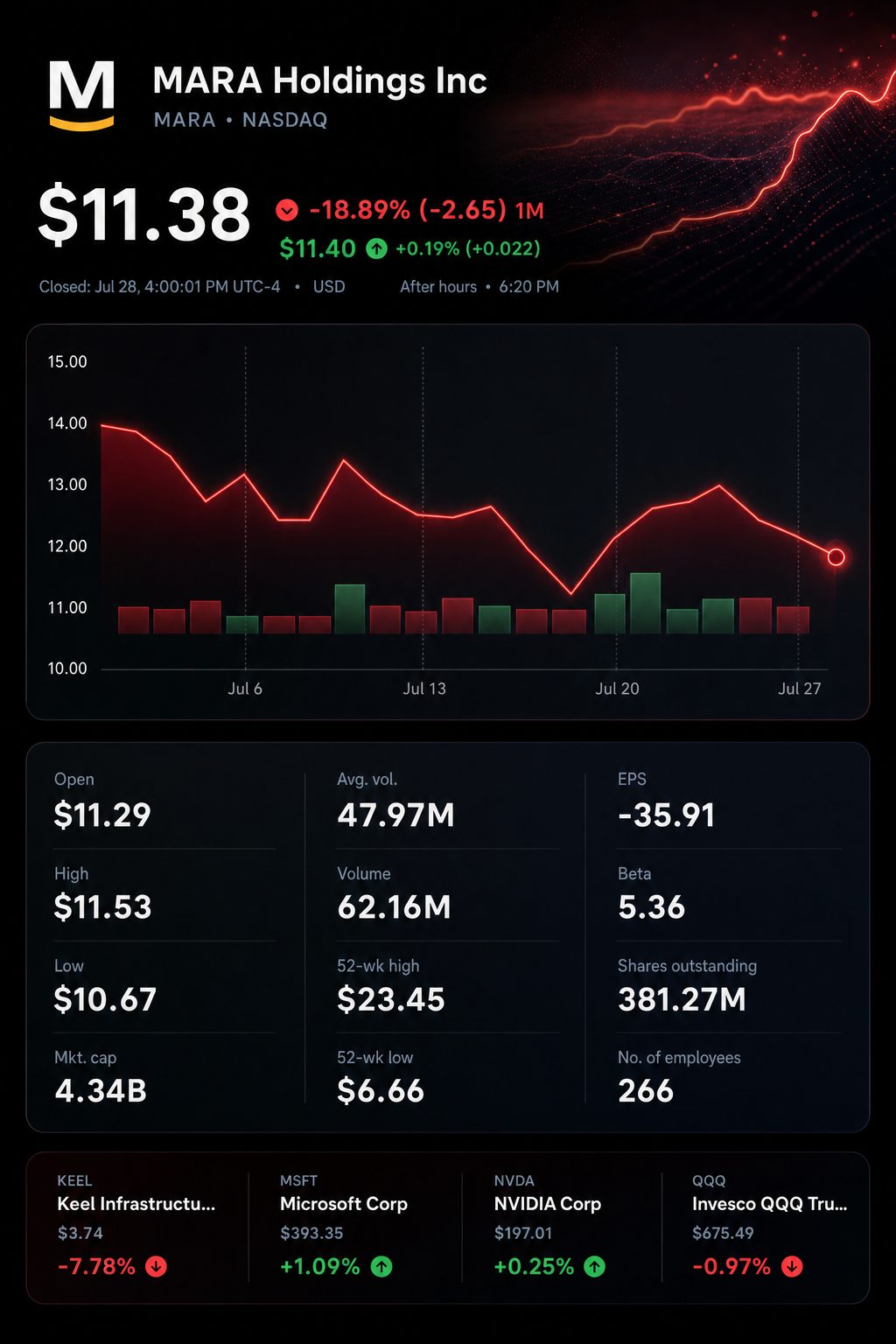
MARA finished the session at $11.38, as Bitcoin hovered around $63,940.
A sample valuation gives MARA’s operating and development platform an estimated worth of approximately $4 billion.
The upcoming Federal Reserve decision and MARA’s results on August 6 are the next key events.
MARA Holdings NASDAQ:MARA finished Tuesday down 3.3% at $11.38. Bitcoin dropped 1.3%, trading near $63,940. U.S. cash markets remained shut during the session.
The wider market provided few clues. The S&P 500 edged up 0.2%, as the Nasdaq Composite fell 0.2%. MARA’s drop once more highlighted its heightened sensitivity to shifts in cryptocurrency prices.
The stock declined by 6.1% across Monday and Tuesday, reversing part of last week’s advance of 13.4%. Nearly half of those gains have now been wiped out.
At Tuesday’s close, or late Bitcoin spot, the sector performed as follows:
MARA outperformed CleanSpark and IREN, but its drop was still more than double the percentage fall of Bitcoin. The stock remains closely tied to crypto volatility.
Valuation is the key indicator. Based on current equity value and the most recent balance-sheet figures for MARA, the implied value for its operating assets and development projects is around $4 billion.
Sample MARA valuation breakdown
Value
Market capitalization
$4.33 billion
Plus: total debt as of March 31
$2.45 billion
Minus: cash as of March 31
$0.51 billion
Minus: 35,303 BTC at Tuesday’s market rate
$2.26 billion
Indicative net value of operations and projects
$4.00 billion
The figures are based on holdings and debt as of March 31. These amounts could have shifted during the second quarter. Working-capital adjustments and any potential tax implications are not included.
To put it in perspective, $4 billion is nearly 28 times the $144 million in annualized adjusted EBITDA reported by Long Ridge Energy. This figure does not represent a direct acquisition multiple, as MARA’s broader mining and infrastructure operations are also factored in.
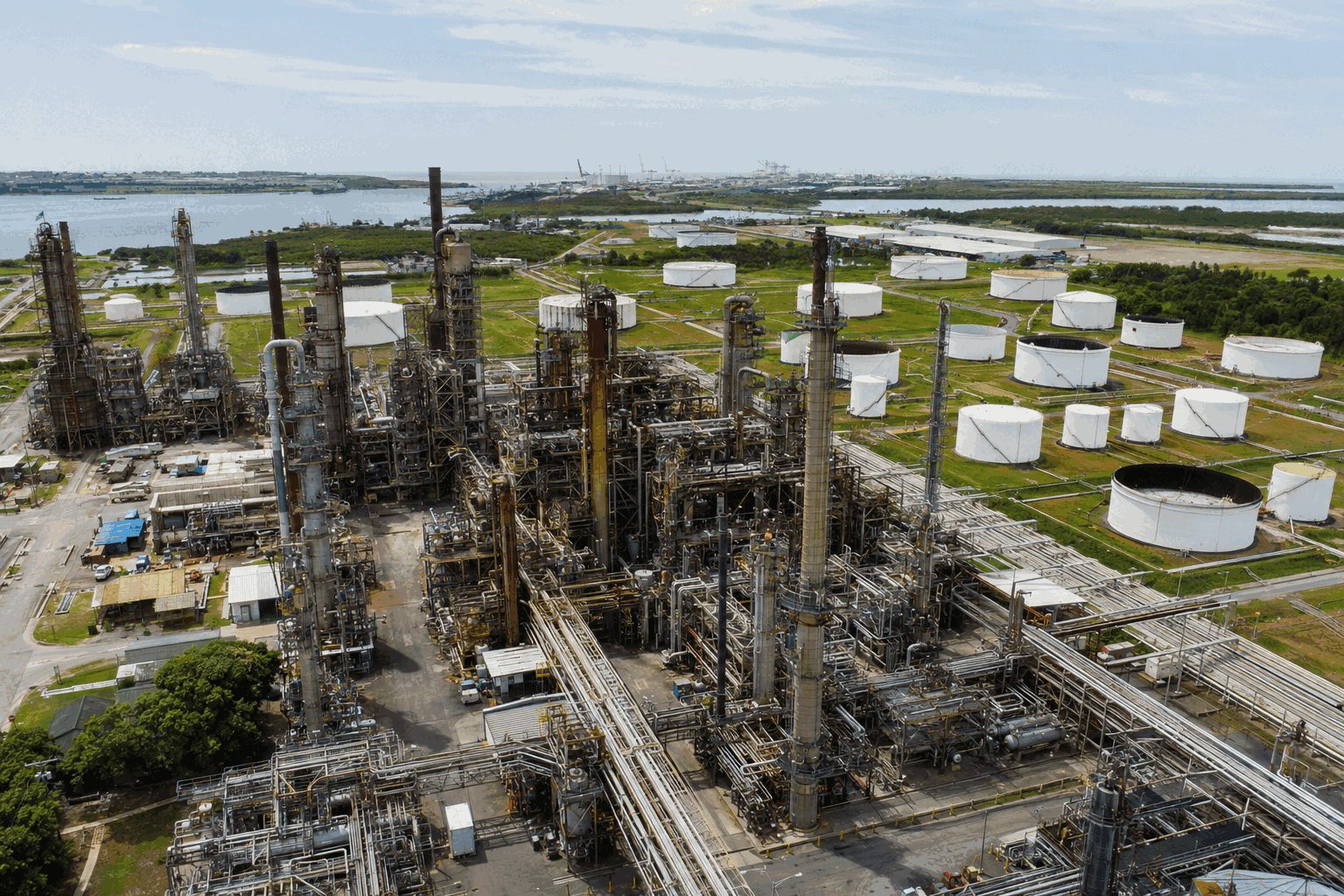
MARA has struck a deal to acquire Long Ridge for approximately $1.5 billion, with the purchase price factoring in no less than $785 million in debt to be taken on. The property in Ohio features a 505-megawatt gas facility and spans over 1,600 acres.
Chief Executive Fred Thiel stated, “Power is the scarce input in AI,” while presenting the deal. MARA anticipates over one gigawatt of possible capacity at the site. The $144 million figure is a non-GAAP measure, calculated from projected annualized results for the second half of 2025. MARA
The Texas project introduces an additional long-term choice. MARA anticipates achieving one gigawatt of grid capacity by October 2027, with the potential to expand to two gigawatts by April 2028. The company reported interest from prospective tenants, but not yet secured revenue.
First-quarter results were uneven. Revenue dropped 18% to $174.6 million. Energized hashrate climbed 33% to 72.2 exahashes per second. Bought power cost reached $40,047 for each Bitcoin.
MARA disposed of 20,880 Bitcoin in the quarter at an average price of $70,137 per coin. By the end of March, the company held 35,303 Bitcoin, $513.7 million in cash, and had $2.45 billion in outstanding debt.
The next key macro event comes on Wednesday, when the Federal Reserve is set to announce its rate decision at 2 p.m. EDT. MARA will disclose its second-quarter earnings on August 6 at 5 p.m. EDT.
Investors are set to focus on three key figures: Bitcoin reserves, mining power expenses, and confirmed AI rental agreements. Collectively, these will indicate if MARA is able to sustain its platform valuation of about $4 billion.
Risks are still focused. If Bitcoin prices fall, treasury value and mining margins could decline. Infrastructure premiums could be undermined by postponed approvals, expensive financing, or absence of tenant contracts.
MARA ended the session at $11.38, slipping 3.3%. The stock’s intraday range spanned from $10.67 to $11.53 with about 61.9 million shares traded. MarketWatch Bitcoin hovered close to $63,937 during the same period, down 1.3%. Shares of RIOT, CleanSpark and IREN also dropped by between 3.4% and 6.6%. The most recent update on MARA's investor site was dated July 22. MARA The pattern indicates a sector-driven move rather than a company-specific event.
What level of Bitcoin exposure does MARA currently maintain?
Marathon Digital (MARA) reported holding 35,303 bitcoin as of March 31, with a then-value of $2.4 billion. SEC At the current spot price of $63,937, that holding is worth close to $2.26 billion, or approximately 52% of MARA’s present $4.33 billion market value. This comparison is illustrative only. During the first quarter, MARA sold 20,880 bitcoin and may continue liquidating some reserves. SEC Investors are awaiting June 30 balances, expected August 6.
Is Bitcoin mining still profitable with prices around $64,000?
In Q1, energy costs at company-owned locations amounted to $40,047 for each bitcoin produced. Compared to the spot price, the straightforward spread before overhead stands at around $23,890. SEC This figure does not represent a profit margin, as it does not factor in maintenance, hosting, depreciation, labor, taxes, or corporate overhead. The energy cost per bitcoin climbed 12.1% from $35,728 the prior year. MARA explained this increase was due to higher network difficulty and unfavorable weather.
What are the key points to watch in the August 6 earnings report?
MARA plans to review second-quarter results on August 6 at 5:00 p.m. Eastern. The shareholder letter with financial results will be released prior to the call. MARA First-quarter revenue was down 18% at $174.6 million compared to last year. In the first quarter, MARA mined 2,247 bitcoin and closed March with 72.2 EH/s. SEC The net loss for the first quarter was $1.3 billion, which included $1.0 billion in fair-value losses. SEC Investors are focused on output, reserves, energy expenditures, cash usage, and funding.
Is balance-sheet risk lower now, or is there still potential for dilution?
Total debt decreased from $3.6 billion to around $2.4 billion in Q1. MARA bought back approximately $1.0 billion of zero-coupon convertible notes. SEC The company sold 15,133 bitcoin for close to $1.1 billion to support these buybacks. SEC Cash and equivalents totaled $513.7 million as of March 31. The ATM facility’s $1.5 billion capacity remains intact and untouched since Q3 2025. SEC With shares at $11.38, full ATM utilization would amount to about 132 million shares before fees, representing 35% of April’s outstanding share count. The final amount to be issued has not been determined.
What might Long Ridge contribute, and what is the level of risk associated with the agreement?
The $1.5 billion transaction covers a 505 MW facility and more than 1,600 acres. MARA estimates annualized adjusted EBITDA of $144 million from second-half 2025 operations. MARA This is a non-GAAP metric annualized from second-half results. Closing is anticipated for the second half of 2026, subject to regulatory clearances. Upon completion, MARA projects about $900 million in Long Ridge debt. SEC Barclays has agreed to provide a bridge facility of up to $785 million. The main risks for shareholders remain financing and closing conditions.
What proportion of revenue currently comes from AI and HPC?
Exaion’s first-quarter effect on overall results was immaterial. SEC In February, MARA acquired a 64% stake in Exaion for $174.5 million. The company operates four data centers in France and Canada. Mara Starwood locations were still moving through predevelopment and have not secured qualifying tenants. SEC Long Ridge’s first AI service is planned for launch in mid-2028. MARA MARA stated it is holding talks with potential tenants, though no hyperscale deals have been finalized. Valuation is mostly dependent on execution rather than current AI income.
What is the significance of the Texas project, and what potential risks does it face?
The Matagorda location spans over 1,200 acres. MARA anticipates reaching one gigawatt by October 2027 and two gigawatts by April 2028. MARA Maximum payments tied to milestones reach $600 million if all are completed. Payment progression is conditional on regulatory approvals, land deals, power agreements, and tenant signings. SEC After an HPC lease, HIF will hold a minority interest in the project. If fully energized, portfolio capacity would approach 4.8 GW. MARA Figures refer to development goals, not currently available data-center output.
Might the next shift be intensified by short interest?
Short interest reached 110.28 million shares as of July 15, representing 29.2%-29.6% of float, based on calculation method. MarketBeat This was a 3.13% increase from the prior reporting interval. Days-to-cover stood at about 2.5 trading days. MarketBeat Substantial short interest may intensify movements around Bitcoin or earnings events, but offers no assurance of a short squeeze. July 15 figures were released on July 24; updated data is expected August 11.
Michał Rogucki is a senior markets reporter at TS2.tech. His coverage ranges from stocks and technology to economic developments affecting global markets. He graduated from Humboldt University of Berlin and worked in investment research and market analysis before becoming a financial journalist.
A surprise around the 0.10 forecast could shift the morning growth narrative and influence Treasury yields and the dollar before the opening bell.
#2
PDD Holdings earnings
The day’s largest scheduled equity report can move PDD and the broader China-internet / e-commerce complex through revenue growth, margins and Temu commentary.
#3
XPeng earnings
Deliveries, margin progression and spending on AI-enabled mobility can affect U.S.-traded Chinese EV names and related technology suppliers.