
NEW YORK, June 22, 2026, 06:21 EDT
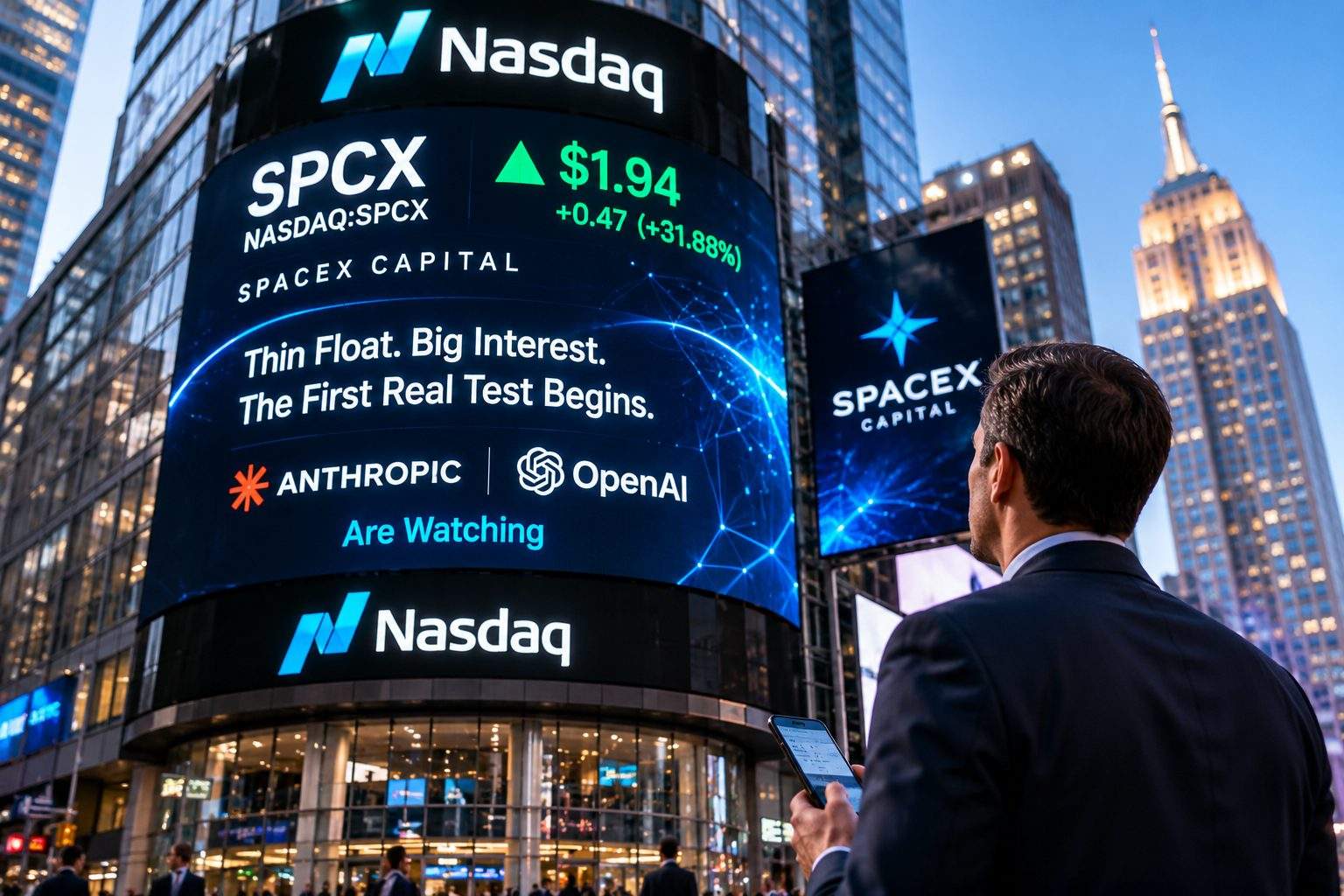
- SpaceX fell to $178.35 in premarket trading, leaving NASDAQ: SPCX 21.0% below last week’s peak but 32.1% above its IPO price.
- The offering distributed roughly 638.9 million shares, equivalent to only about 4.9% of SpaceX’s implied equity—a structure that amplifies both index demand and price swings.
- Applying the same float ratio to Anthropic and OpenAI would put approximately $95.8 billion of stock into public hands against nearly $2 trillion of combined headline valuation.
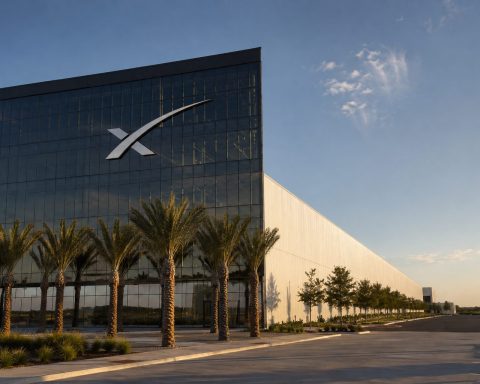
SpaceX NASDAQ:SPCX traded at $178.35 at 5:13 a.m. EDT Monday, down 3.59% from Thursday’s close and extending a two-session retreat. The market-structure explanation is more compelling than a fresh operating trigger: investors are repricing the scarcity premium embedded in its record IPO before a key index review. The stock is 21.0% below Tuesday’s $225.64 intraday high but still 32.1% above its $135 offer price. That reversal is Wall Street’s first live test of whether a mega-cap issuer can float less than 5% of its implied equity, create benchmark demand and preserve orderly price discovery—the setup Anthropic and OpenAI may try to replicate.
The supply math explains NASDAQ: SPCX better than another revenue multiple. SpaceX’s final prospectus offered 555.56 million shares, while underwriters subsequently bought another 83.3 million through the greenshoe, taking total distributed IPO shares to roughly 638.9 million and reported proceeds to $85.7 billion. The $135 price valued the company at approximately $1.77 trillion. Dividing that valuation by the offer price implies about 13.11 billion shares, making the IPO block equivalent to roughly 4.87% of implied equity—a useful proxy for initial tradable supply, though not an official free-float calculation.
That produces a rarely discussed 20.5-times float multiplier. Each $1 move in SPCX changes its implied headline market value by about $13.11 billion, while changing the value of the IPO-and-greenshoe block by approximately $638.9 million. The $47.29 retreat from $225.64 to $178.35 therefore maps to a roughly $620.0 billion contraction in headline equity value, versus about $30.2 billion across the distributed shares. This is valuation arithmetic, not $620 billion of cash leaving the stock. It shows how a small number of traded shares can set the price for billions of locked or closely held shares.
Scarcity worked at first. More than 510 million shares worth about $84 billion changed hands on debut day, when SPCX closed at $160.95, up 19%, and retail investors received roughly 20% of the allocation. “Demand significantly outstripped the initial supply,” Brian Jacobsen, chief economic strategist at Annex Wealth Management, told Reuters after the greenshoe was exercised. That is the attractive part of the blueprint: a giant valuation, controlled supply, wide retail participation and enough turnover to create institutional liquidity immediately. Reuters
The next layer is passive money—but the likely effect is smaller than the $2 trillion headline suggests. Nasdaq’s rules allow the largest new listings to be evaluated for fast entry on their seventh trading day, subject to liquidity requirements. For securities with low floats, the shares used for index weighting are capped at three times free float. Applying that rule to the 4.87% proxy would initially recognize roughly 14.6% of SpaceX’s full equity, producing an effective indexed market capitalization near $342 billion at $178.35 rather than approximately $2.34 trillion. The actual figure will depend on Nasdaq’s official float determination.
Anthropic’s bankers now have a real market experiment rather than a pitch-book assumption. The company submitted a confidential draft S-1 on June 1, but said the number of shares and price remain unset and that any offering depends on market conditions. Its latest funding round valued Anthropic at $965 billion. “Filing shortly after SpaceX allows Anthropic to capitalize on strong investor interest,” IPOX vice president Kat Liu told Reuters. The more useful lesson, however, is that keeping supply tight can support the opening valuation while making every subsequent trade carry far more informational weight. Anthropic
OpenAI announced its own confidential S-1 submission on June 8, while emphasizing that timing remains undecided and that a listing “may be a while.” Reuters has reported that the company could seek a valuation of up to $1 trillion, potentially as early as September, while CEO Sam Altman told staff he expected an IPO “within the next year,” according to The Information. Public investors will also have to price the capital intensity: The Information reported that OpenAI burned $3.7 billion during the first quarter on $5.7 billion of revenue, figures Reuters said it could not independently verify. OpenAI
Consider the supply scenario, not as a forecast but as a stress test. Applying SpaceX’s estimated 4.87% initial distribution ratio to Anthropic’s $965 billion private valuation and a hypothetical $1 trillion OpenAI IPO valuation would create approximately $95.8 billion of publicly tradable equity against $1.965 trillion of combined headline value. That is only about 12% more stock than SpaceX’s $85.7 billion offering. Wall Street would not need to absorb $2 trillion; it would need to clear less than $100 billion while using that small block to establish the valuation of everything else.
The bear case is concentrated and asymmetric: with so little implied equity initially tradable, even moderate selling can overwhelm the available bid. A sustained break below Thursday’s $172.11 intraday low would bring the $160.95debut close, followed by the $150 opening price and $135 offer price, back into view. Supply will eventually expand as well: SpaceX’s lockup permits up to 20% of specified locked shares to become transferable after second-quarter results, subject to the agreement’s conditions. For Anthropic and OpenAI, copying the thin-float structure could produce a powerful debut but magnify disappointments involving growth, margins, governance or capital spending.
Because the market was closed for Juneteenth on Friday, June 19, Tuesday, June 23 should be SpaceX’s seventh trading day by calendar count—the point at which Nasdaq can evaluate the company for fast entry. Eligibility and timing are not guaranteed. Still, this is the next decisive catalyst: if a float-adjusted index bid stabilizes SPCX without recreating the launch-day premium, Wall Street has a workable template for Anthropic and OpenAI; if it does not, both AI companies will have to sell investors more fundamentals—and less scarcity.
Related articles: NASDAQ:SPCX

![Australia Stock Market Today 26/08/2026 [UPDATE: 11:43 AEST] [Headline CPI Cools as Sticky Core Tests ASX Gains]](https://ts2.tech/wp-content/uploads/2026/08/AU-market-dashboard-2026-08-26-1143-480x384.jpg "Australia Stock Market Today 26/08/2026 [UPDATE: 11:43 AEST] [Headline CPI Cools as Sticky Core Tests ASX Gains]")