
Washington, July 15, 2026, 15:09 (EDT)
- The FCC license covers one test satellite at an operating altitude of 625 kilometres and a two-year term after activation, not Reflect Orbital’s proposed commercial constellation.
- Reflect’s roadmap implies about 9,000 additional satellites a year from 2031 through 2035, or 24.7 a day, nearly three times the best recent industry benchmark.
- A fleet of 50,000 would equal roughly 3.1 times the entire active satellite population counted on July 8.
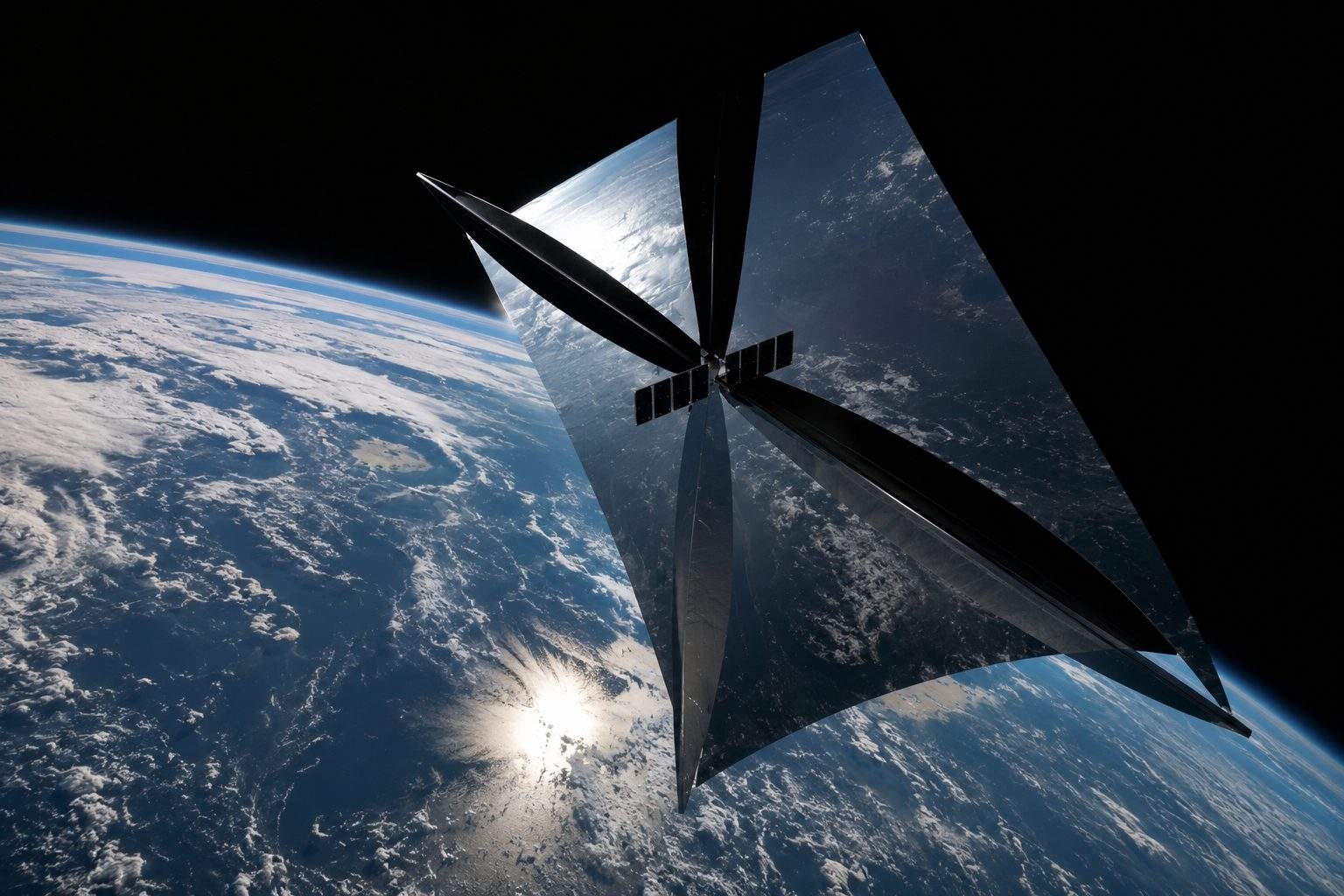
Reflect Orbital’s first FCC license clears a near-term hurdle for its Eärendil-1 mirror satellite, but the startup’s own timetable turns the approval into a harder manufacturing problem. Moving from more than 5,000 spacecraft in 2030 to more than 50,000 in 2035 would require an average of 9,000 additions a year, or 24.7 each day.
That implied deployment rate is 2.8 times SpaceX NASDAQ:SPCX’s record 3,180 Starlink satellites placed in orbit during 2025. Reflect does not have publicly traded shares, so the ruling creates no direct equity catalyst, but the comparison shows why launch capacity, factory output and financing now matter more than the initial regulatory win. SpaceX’s shares began trading in June.
The FCC’s July 9 order grants radio-frequency authority for one satellite operating around 625 kilometres above Earth. Reflect must post a surety bond by August 10, launch no later than July 9, 2032, and operate under a two-year license once Eärendil-1 is activated. The agency called it a “limited, short-duration technology test exercise.” Chief Executive Ben Nowack said the license was a “first step toward rigorously testing” the system and its safeguards.
The company’s published targets show the distance between that test and a revenue-scale energy service. Lux measures light reaching a surface; capacity factor is average power output as a share of maximum output.
| Year | Planned fleet | Lighting target | Energy target |
|---|---|---|---|
| 2026 | 2 satellites | 0.1 lux for 5 minutes, similar to moonlight | Testing |
| 2030 | 5,000+ | Up to 5,000 lux for several minutes | 50 W/m² for 20 minutes; 1% capacity-factor gain |
| 2035 | 50,000+ | Up to 36,000 lux for several hours | 300 W/m² for 3 hours; 20% capacity-factor gain |
Scale looks large even beside today’s busiest constellations. Astronomer Jonathan McDowell’s tracker counted 16,234 active satellites in orbit on July 8, including 10,736 active Starlinks. Reflect’s 2035 target would be 3.1 times the first number and 4.7 times the second. Retirements and replacement craft will change those ratios by 2035, but they give an order-of-magnitude check on the capital and launch task.
| Comparison | Observed or implied figure | Investor read-through |
|---|---|---|
| All active satellites, July 8 | 16,234 | Reflect target equals 3.1 times the total |
| Active Starlinks | 10,736 | Reflect target equals 4.7 times the network |
| SpaceX Starlink deployments in 2025 | 3,180 a year | Reflect’s planned ramp is 2.8 times faster |
| Reflect additions, 2031–2035 | 9,000 a year | Average of 24.7 satellites a day |
The optics provide a second scale check. Eärendil-1 is expected to unfold an 18-metre-by-18-metre reflector and cast light over an area roughly 5 to 6 kilometres wide. Using NASA’s solar irradiance figure of 1,361.6 watts per square metre, an ideal reflector of that size could intercept no more than about 0.44 megawatts before losses from its angle, surface, pointing and the atmosphere. Averaged across a five-kilometre-wide circle, that is an upper limit of about 0.022 watts per square metre.
Under that deliberately generous ceiling, supplying 50 watts per square metre across the same area would take about 2,200 Eärendil-sized reflectors pointing there at once. The 2035 target of 300 watts would require roughly 13,400. Those are mathematical equivalents, not fleet forecasts: they hold the demo’s mirror and spot dimensions fixed and assume no losses. Still, the calculation separates a moonlight demonstration from an energy product.
Eärendil-1 can answer narrower questions that matter first, including whether the membrane unfolds, retains its shape, points accurately and can halt a reflection promptly. It cannot validate the economics of the 2030 energy service by itself; Reflect’s roadmap lists energy applications as testing through 2028. The first mission is engineering evidence, not proof of the full business model.
But the risk is not confined to hardware. Any multi-satellite deployment would require new approvals, while the FCC said concerns about optical astronomy were outside its review and could not justify added conditions. More than 1,800 people submitted letters during the proceeding. Betty Kioko of the European Southern Observatory called the concept “an existential threat” to optical astronomy. A jurisdictional gap that allowed one experiment to proceed could produce a slower and more political process for thousands of mirrors.
Reflect says its motorised reflector can be steered away from observatories and switched off by changing the satellite’s angle. It has also promised advance position data, independent reviews and limits on where and when light is directed. The company said it was “willing to change course if the evidence does not support deployment.” Those safeguards will carry more weight once measured in orbit. Reflect Orbital
For investors, the next useful checkpoints are a launch later this year, successful reflector deployment, measured brightness and spot size, pointing accuracy and evidence that production costs can support thousands of units. The FCC ruling opens a test window. The economics still have to fit through it.
Related articles: NASDAQ:SPCX


![US Stock Market Today 08/25/2026 [UPDATE: 00:06 EDT] [Micron and Sandisk Turn Green as QQQ Gains Overnight]](https://ts2.tech/wp-content/uploads/2026/08/US-market-dashboard-2026-08-25-0002-480x384.jpg "US Stock Market Today 08/25/2026 [UPDATE: 00:06 EDT] [Micron and Sandisk Turn Green as QQQ Gains Overnight]")