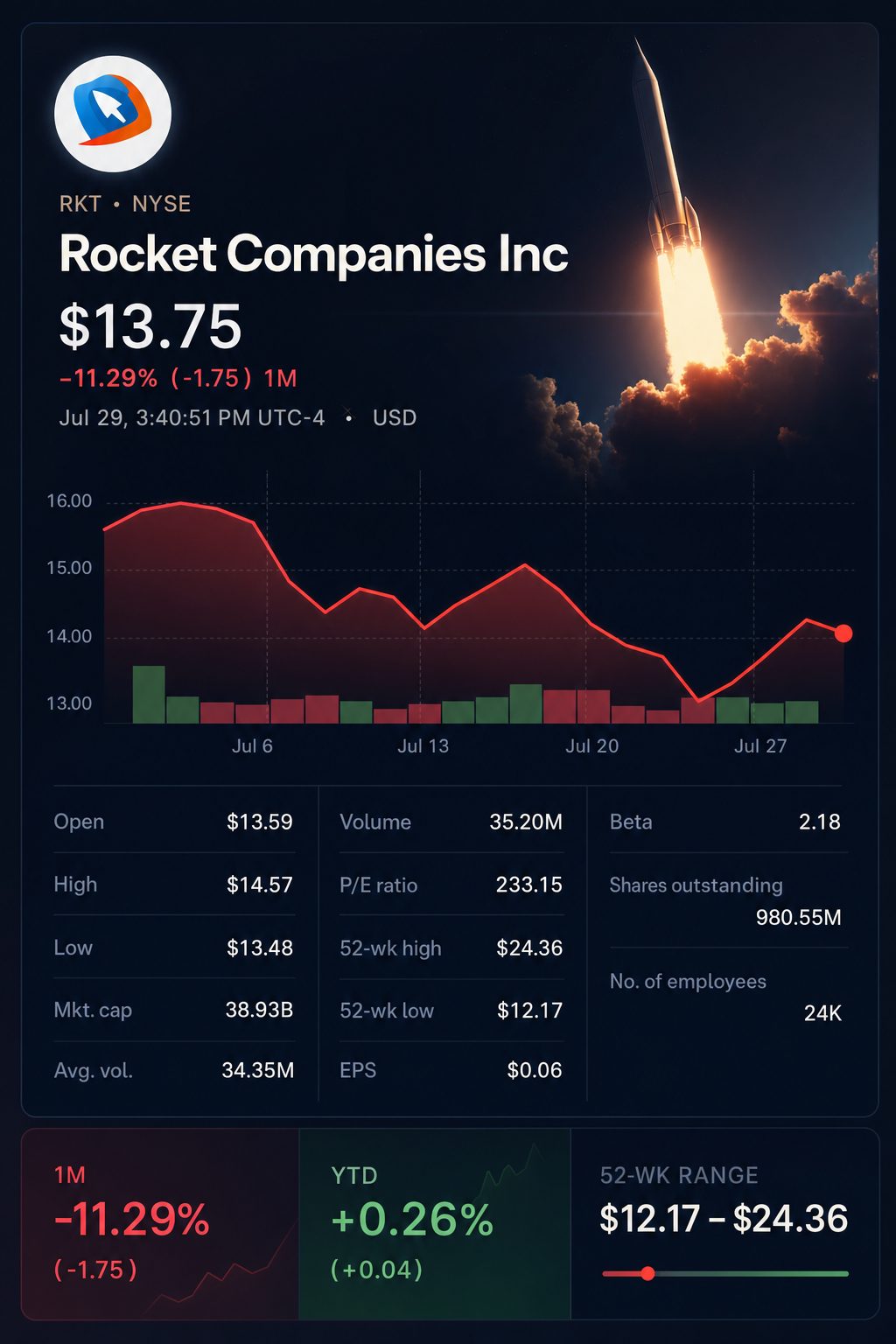
Rocket Companies Inc. NYSE:RKT rose 2.8% to $14.37 in open trading.
Mortgage applications fell 6.4%, while the 30-year rate reached 6.76%.
Rocket’s gross servicing-rights asset equals about 47% of its market value.
Rocket shares advanced Wednesday even as mortgage demand hit a one-year low. The divergence sharpened attention on Rocket’s enlarged servicing franchise.
Rocket held $19.38 billion of mortgage servicing rights at March 31. That gross asset equals about 47% of its current market capitalization.
Its servicing portfolio carried $2.11 trillion of unpaid principal. That was 47 times first-quarter closed origination volume of $44.7 billion.
The comparison needs caution. Rocket also reported $26.31 billion of secured and unsecured financing.
Latest quoted trades were recorded around 2:46 p.m. EDT.
The peer rally was broad but uneven. UWM outpaced Rocket, while loanDepot posted a modest advance.
Mortgage demand moved in the opposite direction. The industry application index fell 6.4% last week.
Refinancing applications dropped 9.9%, while purchase demand also weakened. The average 30-year fixed rate rose seven basis points to 6.76%.
Mortgage Bankers Association economist Joel Kan said rates “continue to significantly impact refinance borrowers.” Reuters
Rocket’s serviced loans carried a weighted-average rate of 4.55% during the first quarter. The latest market average is 221 basis points higher.
That gap likely extends servicing lives because refinancing remains unattractive. It also delays Rocket’s opportunity to refinance existing customers into new loans.
Rocket booked a $279 million servicing-rights valuation gain from assumption changes in the first quarter. Hedge losses and servicing-rights realization partly offset that benefit.
The Federal Reserve held its target range at 3.50%-3.75% Wednesday. Three policymakers favored a quarter-point increase.
Rocket will report second-quarter results on August 6. Company guidance calls for $2.7 billion to $2.9 billion of adjusted revenue.
Management expects $400 million of expense synergies by year-end, one year early. Investors will seek evidence in servicing margins and operating costs.
Shares remain about 41% below their $24.36 52-week high. The discount shows that servicing scale has not removed rate-cycle concerns.
Risks: Rocket’s servicing asset is rate-sensitive in both directions. A hypothetical 10% adverse prepayment-speed change would reduce its fair value by $504 million. Persistently high rates could also suppress new loan production.
The August report will test whether servicing scale can sustain earnings through weak demand. That is now Rocket’s central investor question.
What is RKT's current trading level, and how do analysts view its 12-month price prospects?
At 2:47 p.m. ET, RKT shares were up 3.3% at $14.44. The stock moved between $13.50 and $14.56 on volume of about 29.8 million. Rocket’s implied market capitalization was about $41.1 billion. My twelve-month base estimate remains $17, reflecting an 18% rise. The bull scenario points to $22, while the bear case is $11, indicating potential moves of up to 52% higher and 24% lower. Analyst targets vary; the WSJ average is $19.23, with a range from $15.50 to $22.50.
What does Rocket need to announce on August 6 to fuel a further rally?
Rocket is set to announce its second-quarter results on August 6. Yahoo Finance The company has forecast adjusted revenue in the range of $2.7 billion to $2.9 billion. For the first quarter, Rocket reported adjusted revenue of $2.82 billion and EBITDA of $738 million. Adjusted diluted earnings amounted to $0.15 per share. SEC My outlook anticipates adjusted revenue near $2.8 billion and EBITDA of $700 million, suggesting a 25% margin, down from roughly 26.2% in the previous quarter. Adjusted revenue topping $2.9 billion would be positive, while coming in below guidance could be negative.
What impact do the Fed’s decision today and current mortgage rates pose for Rocket?
The Federal Reserve maintained its target policy range at 3.50% to 3.75% on Wednesday, though three voting officials favored a quarter-point hike. Federal Reserve Freddie Mac reported the average 30-year mortgage rate at 6.58%, close to its highest level over the past year. Freddie Mac In contrast, the MBA’s lender survey showed a comparable contract rate of 6.76%. Mortgage applications dropped 6.4%, and refinance requests slid 9.9% during the week. Reuters The trends continue to weigh on Rocket’s purchase and refinancing activity, with servicing mitigating but not fully offsetting these effects.
Have the integrations with Redfin and Mr. Cooper resulted in quantifiable benefits?
Rocket completed the acquisition of Redfin in July 2025 and finalized the purchase of Mr. Cooper in October. Over half of the integrated servicing volume now operates on Rocket’s consolidated platform. The company forecasts it will realize the entire $400 million in cost synergies by the end of 2026, accelerating its schedule by a full year compared to initial projections. Redfin’s monthly active users in March rose by 3.3% compared to the previous year. Since the Redfin purchase, digital mortgage purchase leads have surged to more than three times prior levels. SEC Despite these encouraging trends, it is still challenging to measure financial conversion.
Is Rocket’s servicing portfolio able to counterbalance slower mortgage originations?
Rocket handled $2.1 trillion in servicing for 9.4 million loans as of the end of March. In the first quarter, the company generated $1.08 billion in servicing fee income before accounting for valuation changes. Adjustments to the fair value of MSRs reduced reported servicing income by $485 million. Even so, net loan-servicing income for the quarter totaled $598 million. SEC Ongoing fees help support earnings during steep declines in mortgage originations, but fluctuations in rates can result in sizable MSR valuation changes and volatile GAAP results.
Was the sharp rise in Q1 profit sustainable, or was it largely attributed to acquisitions?
Adjusted revenue increased by 108% from the previous year, totaling $2.82 billion. Adjusted EBITDA surged 337% to reach $738 million for the quarter. GAAP net income was $297 million, compared to a net loss of $212 million in the prior period. These results are robust. Both acquisitions completed after Q1 2025, so the figures are not entirely organic. Closed origination volume amounted to $44.7 billion, and the gain-on-sale margin was 2.74%. SEC Maintaining this margin would significantly underpin the base-case price outlook.
Has Rocket maintained a robust balance sheet following its string of acquisitions?
Rocket reported total liquidity of $9.4 billion, which includes $2.69 billion in cash. Secured financing stood at $15.88 billion, and unsecured financing was $10.43 billion. SEC A large share of secured borrowing supports mortgage loans, servicing rights and required advances, so gross financing figures exaggerate Rocket’s typical corporate leverage. SEC In June, Rocket sold $1.5 billion in new senior notes, carrying coupons of 6.125% and 6.500% and maturing in 2031 and 2034. This transaction stretches out maturities, but swapping lower-cost notes is expected to lift interest expenses.
What factors might send RKT to $22, or lower it to $11?
The $22 bull scenario depends on adjusted-revenue surpassing expectations and clear integration cost savings. Mortgage rates approaching 6% would make homes more affordable and improve refinancing prospects. Redfin visitor traffic must also more reliably turn into Rocket-financed loans. The $11 bear scenario expects mortgage rates to stay in the 6.5% to 7% range. Ongoing sluggish applications and postponed synergies would weigh on profits. SEC Both scenarios are possible. These are scenario estimates, not exact forecasts or assured results.
Khadija Saeed is a financial markets reporter at TS2.tech. Her coverage ranges from stocks and technology to emerging industries and developments across global markets. She studied economics and finance at the London School of Economics and worked in market research before becoming a financial journalist. Follow Khadija Saeed on Google News.
Surprising starts and permits data can impact homebuilders, mortgage-sensitive stocks, Treasury yields, and the dollar if results deviate significantly from consensus estimates.
#02
Home Depot Q2
The results and outlook provide key insights into housing turnover, renovation demand, professional customer activity, and U.S. discretionary spending.
#03
09:15 ET industrial production
A robust or disappointing factory or utilities report can shift expectations for economic growth, cyclical stocks, bond yields, and the Federal Reserve’s policy direction.