
NEW YORK, June 30, 2026, 12:06 (EDT)
- SoFi shares fell about 1.8% while QQQ rose about 1.3% near midday.
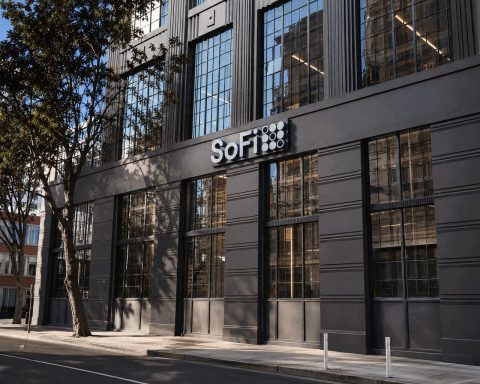
- SoFi launched small-business loans of $2,500 to $250,000, funded by SoFi Bank.
- At the maximum loan size, SoFi would need about 49,000 small-business loans to match Q1 total loan originations.
- The new product tests whether SoFi can turn its 14.7 million-member base into a business-credit channel.
SoFi Technologies, Inc. NASDAQ:SOFI fell in midday trade on Tuesday after the digital lender launched small-business loans, a product push that adds a new credit line but does not yet answer the stock’s harder question: how much more loan volume can SoFi add without leaning too much on its balance sheet.
The shares were down 1.8% at $17.87 at 11:50 a.m. EDT, versus a 1.3% gain for Invesco QQQ Trust Series 1 NASDAQ:QQQ and a 0.6% rise for SPDR S&P 500 ETF Trust NYSEARCA:SPY. SoFi traded between $17.72 and $18.33, with volume near 23.9 million shares.
| Midday market check | Price | Day change | Intraday range | Volume |
|---|---|---|---|---|
| SoFi Technologies NASDAQ:SOFI | $17.87 | -1.8% | $17.72-$18.33 | 23.9 mln |
| Invesco QQQ Trust NASDAQ:QQQ | $733.79 | +1.3% | $723.00-$733.89 | 15.1 mln |
| SPDR S&P 500 ETF Trust NYSEARCA:SPY | $745.57 | +0.6% | $740.50-$745.66 | 15.8 mln |
SoFi said the new loans range from $2,500 to $250,000, carry no application fee, no origination fee and no prepayment penalty, and may fund within 24 hours after approval if conditions are met. The loans are originated by SoFi Bank, N.A.
CEO Anthony Noto said the product addresses members whose “financial lives do not stop at personal goals.” He said SoFi was giving them business financing through the same digital platform they use for personal finance. SoFi Investors
The scale problem is plain. At the $250,000 maximum loan size, about 49,000 fully drawn small-business loans would equal SoFi’s $12.2 billion of first-quarter loan originations. About 15,200 would equal the $3.8 billion of personal and home loans SoFi sold or moved through its Loan Platform Business in the quarter.
| Scale marker | Latest figure | Small-business loans needed at $250,000 cap |
|---|---|---|
| Q1 total loan originations | $12.2 bln | 48,800 |
| Q1 personal loan originations | $8.3 bln | 33,200 |
| Q1 student loan originations | $2.6 bln | 10,400 |
| Q1 home loan originations | $1.2 bln | 4,800 |
| Q1 loans sold or transferred through Loan Platform Business | more than $3.8 bln | about 15,200 |
That math matters because SoFi’s premium still rests on the idea that it can cross-sell more products to a fast-growing member base and shift more revenue toward fee streams. In the first quarter, SoFi added 1.1 million members to reach 14.7 million, reported $1.1 billion in GAAP revenue and posted its 10th straight quarter of GAAP profit. Fee-based revenue rose 23% to $386.8 million.
Lending still carried the company. First-quarter total originations rose 68% to $12.2 billion, including $8.3 billion of personal loans, $2.6 billion of student loans and $1.2 billion of home loans. The Loan Platform Business added $140.8 million to adjusted net revenue, including $138.3 million tied to $3.0 billion of personal loans originated on behalf of third parties and referrals.
The weaker piece sits in the technology platform. SoFi said first-quarter technology platform revenue fell 27% to $75.1 million, and contribution profit fell 61% to $12.0 million after a large client left the platform in 2025. Technology platform accounts were down 16% from a year earlier at 133 million.
That makes the small-business launch more than a product notice. It is a test of whether SoFi can use deposits, data and its app base to build a new credit line while its enterprise technology arm is still rebuilding growth.
Small-business credit demand gives SoFi a real market to chase. A Federal Reserve small-business survey released in March said the share of applicants seeking financing from online lenders rose to 29% in the 2025 survey from 17% in the 2020 survey. Another Fed summary said 60% of firms that borrowed from online lenders reported higher-than-expected borrowing costs.
The stock’s muted reaction also follows an older investor worry. After SoFi’s first-quarter report in April, William Blair analyst Andrew Jeffrey said SoFi had not passed Q1 revenue and EBITDA upside into its full-year forecast. “The Street will hate these results,” the brokerage said, while adding it saw limited downside. Noto told Reuters then that “the health of our consumer base remains strong.” reuters.com
Related articles: NASDAQ:SOFI