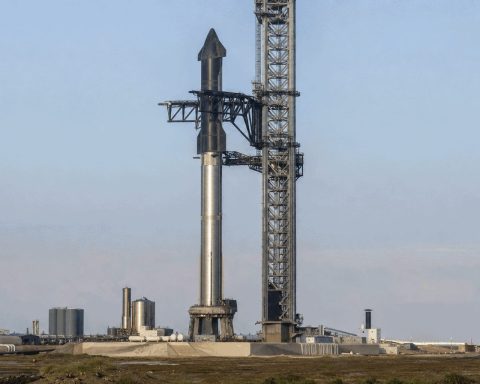

- SpaceX launch: On Sept. 28, SpaceX’s Falcon 9 rocket lifted off from California, deploying 28 Starlink internet satellites, boosting the constellation above 8,500 units space.com. This was SpaceX’s 124th Falcon 9 launch of 2025. The first stage successfully landed on its droneship, marking the 28th flight for that booster space.com space.com.
- NASA/NOAA missions: On Sept. 24 (reported Sept. 29), SpaceX launched three science spacecraft for NASA and NOAA satellitetoday.com. The payload included the IMAP heliophysics probe to study the Sun’s protective heliosphere, NOAA’s SWFO-L1 satellite for space-weather monitoring, and NASA’s Carruthers Geocorona Observatory to image Earth’s exosphere. NASA’s Joe Westlake said these missions will help protect our “interconnected world” from solar storms satellitetoday.com.
- Crew & cargo spacecraft: Sierra Space announced its Dream Chaser cargo shuttle’s first flight to the ISS is now delayed until late 2026 spaceflightnow.com. NASA and Sierra agreed Dream Chaser will fly free in orbit (not docking) as a demonstration. NASA ISS manager Dana Weigel noted, “development of new space transportation systems is difficult and can take longer than what’s originally planned” spaceflightnow.com. Sierra Space’s Faith Ozmen said the new schedule still “provides unique capabilities” and underscores Dream Chaser’s importance as a national asset spaceflightnow.com.
- ESA & industry milestones: The European Space Agency (ESA) and rocket maker Avio signed a €40 million contract to build a reusable upper stage demonstrator esa.int. ESA’s head of transportation, Toni Tolker-Nielsen, hailed the deal as paving Europe’s “long-term future in space” esa.int. The work will leverage advances in liquid-oxygen/methane engines and aim to lower launch costs for future European rockets.
- China’s space activities: China reports it launched the Fengyun-3 08 meteorological satellite on Sept. 27en.people.cn. Fengyun-3 08 carries nine sensors to improve weather forecasting, climate monitoring and disaster tracking. State media say the mission “strengthens China’s capabilities in global numerical weather prediction, climate change response and disaster prevention”en.people.cn. This continues China’s recent surge in satellite launches (e.g. IoT and broadband satellites earlier this month) to build out its communications and observation networks.
- Satellite communications: SpaceX filed with the U.S. FCC to launch 15,000 new satellites for a direct-to-cell-phone service satellitetoday.com. Using mobile spectrum bought from EchoStar, this “Starlink Direct-to-Cell” network is intended to provide connectivity “virtually anywhere on Earth,” including underserved regions satellitetoday.com. SpaceX COO Gwynne Shotwell said the spectrum deal will change how SpaceX partners with carriers and device makers to expand coverage. Meanwhile, Europe’s satellite operators saw big gains: Eutelsat reported its new low-orbit broadband business grew 84% in 2024–25 (now 15% of group revenue) fieldfisher.com. OneWeb completed a €1.5 billion fundraising (backed by the UK and France) and plans to activate five more ground stations (44 in total) by 2026 fieldfisher.com. Luxembourg announced a $350 million investment in its secure comms program (GovSat-2) fieldfisher.com, and AST SpaceMobile acquired global S‑band spectrum rights to bolster space-based phone broadband fieldfisher.com.
- Earth observation: Planet Labs released its hyperspectral data from the Tanager-1 satellite, which launched in late 2024 investing.com. Tanager-1 collects imagery in 400+ spectral bands and has already detected over 5,500 methane and CO₂ plumes worldwide. Planet co-founder Robbie Schingler says Tanager’s data are “science-grade and nearly ideal radiometric quality” investing.com, enabling new services (e.g. methane-monitoring subscriptions in key oil regions). Planet also noted strong financial performance: after reporting 20% YoY revenue growth, analysts raised price targets on the stock investing.com.
- Space debris / sustainability: A new ESA environment report finds about 40,000 tracked objects in orbit (∼11,000 active satellites) and warns of rapidly rising debris esa.int. It notes that without better end-of-life disposal, fragmentations will add thousands of pieces (even with no new launches). To avoid a runaway collision cascade (“Kessler syndrome”), ESA stresses that “active debris removal is required” esa.int. In response, private and public groups are advancing cleanup tech. For example, NorthStar Earth & Space joined the EU-funded ALBATOR project to test a plasma “Ion Beam Shepherd” system for contactless debris removal northstar-data.com. NorthStar CEO Stewart Bain called debris a “growing threat to the safety and sustainability of global space operations” northstar-data.com. In-orbit servicing is also getting regulatory support: the UK published a report with 60+ recommendations to streamline licenses for satellite rendezvous, repairs, and debris removal, targeting a £2.7 billion service market by 2031 fieldfisher.com.
- Regulatory & policy changes: Several nations moved forward on space law and infrastructure. Italy’s Parliament enacted a new Space Economy Law (effective June 25, 2025) and the EU Commission proposed a comprehensive “Space Act” to tighten safety, security and sustainability rules outerspacelawsapienza.it. The UK government announced that the UK Space Agency will merge into the Department for Science, Innovation & Technology by April 2026, keeping the UKSA brand but streamlining oversight fieldfisher.com. Portugal granted its first spaceport license to the Atlantic Spaceport Consortium in the Azores, aiming for suborbital launches by 2026 and orbital missions by 2027 fieldfisher.com. In the U.S., SpaceX’s FCC filing for a 15,000‑satellite network (above) is a notable regulatory move. At the United Nations, COPUOS (space committee) reaffirmed international focus on space traffic coordination, paving the way for a new expert group on space situational awareness and data sharing (building on proposals from the UAE and others).
- Market and industry outlook: Research firms forecast a booming space industry. One analysis projects the global space launch market to grow from about $15 billion in 2023 to $41 billion by 2030 (roughly 15% annual growth) grandviewresearch.com, driven by megaconstellations and more commercial launches. The study notes a shift from government to private-dominated launches and the impact of reusable rockets lowering costs grandviewresearch.com. However, it warns that unchecked satellite deployments will worsen debris and that new cleanup technologies and strict end-of-life rules are needed grandviewresearch.com. In the commercial satellite sector, analysts highlight SpaceX’s Starlink as the new cash-cow: it reportedly has ~8.5 million subscribers (as of Sept 2025) and could account for ~70% of SpaceX’s 2025 revenue. Overall, space is seen as a fast-growing economic frontier, but one that requires coordinated policy and innovation to remain safe and sustainable.
Sources: Authoritative space news outlets, agency releases and expert commentary from Sept. 28–29, 2025, including Space.com space.com, Spaceflight Now spaceflightnow.com, ESA and company press releases esa.int northstar-data.com, and industry reports grandviewresearch.com. All statistics and quotes above are cited to linked original reports.
Related articles: Space