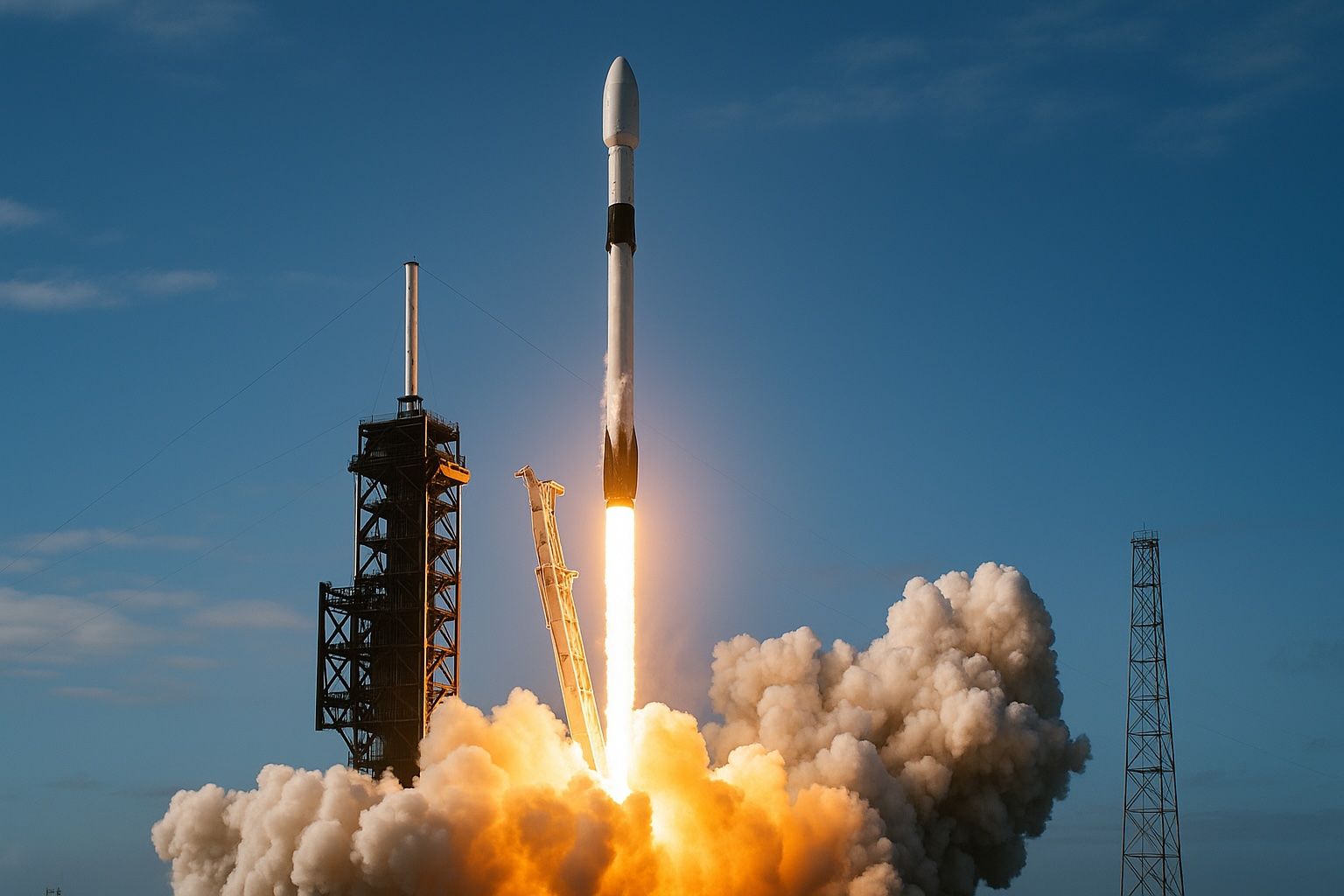

- On 23 June 2025 at 07:18 UTC, the Falcon 9 lifted the QUICK³ nano-satellite into a 550 km sun-synchronous orbit from Vandenberg Space Force Base during SpaceX’s Transporter-14 rideshare, with payload separation confirmed nine minutes after launch.
- The QUICK³ spacecraft weighs 4 kg and is a 3-U CubeSat (10 × 10 × 30 cm) with a primary experiment window of 6 minutes per 97-minute orbit.
- QUICK³ aims to bypass fiber-based quantum key distribution limits by sending true single photons through near-vacuum upper atmosphere to enable intercontinental quantum-secure links.
- A hexagonal-boron-nitride colour centre single-photon source emits at 650–700 nm, paired with a 698 nm seed laser in a 45 × 80 × 20 mm, 200 g module.
- On-board photonics are integrated interferometers to test Born-rule in micro-gravity, supplied by CNR-IFN (Italy), with payload avionics including a radiation-hardened FPGA and single-photon detectors from the National University of Singapore.
- The mission features a two-for-one science objective with downlinks of quantum-encrypted test keys to optical ground stations in Munich and Jena.
- The Born-rule experiment tests whether the Born-probability rule holds when the gravitational potential changes from 9.8 m/s^2 to 0.0 m/s^2, a potential hint of physics beyond the Standard Model.
- Timeline milestones include 2021 design paper publication, 2023 optics pass tests, March 2024 ScienceDaily preview, 23 June 2025 orbital insertion and first telemetry lock-on, and Q4 2025 planned first on-orbit quantum key exchange and Born-rule dataset release.
- WISeSat 3, Geneva-based, rode Transporter-14 alongside QUICK³ and features the first “Quantum RootKey” secure element embedded in a satellite’s on-board computer.
- Global context includes China’s Jinan-1 (2022) with a 12,900 km quantum-encrypted image relay, ESA/Airbus Eutelsat Quantum GEO (operational 2021), Europe’s Eagle-1 planned launch NET late 2025, and WISeSat (2025) embedding post-quantum cryptographic silicon.
1. Launch Day in Numbers
At 07:18 UTC on 23 June 2025, a Falcon 9 lifted the QUICK³ (Quantum Upgraded Innovative Cubesat Kit) nano‑satellite into a 550 km sun‑synchronous orbit from Vandenberg Space Force Base during SpaceX’s Transporter‑14 rideshare mission. Although low coastal clouds obscured the pad, onboard cameras confirmed successful separation of the shoebox‑sized payload barely nine minutes after booster launch.
- Mass: 4 kg
- Form factor: 3‑U CubeSat (10 × 10 × 30 cm)
- Primary experiment window: 6 minutes per 97‑minute orbit
2. Why QUICK³ Matters
Traditional fiber‑based quantum key distribution tops out at ≈400 km because faint laser pulses are attenuated and cannot be amplified without destroying the information encoded in single photons. QUICK³ bypasses that limit by sending true single photons through near‑vacuum upper atmosphere, slashing loss and enabling intercontinental links.
Breakthrough Hardware
| Component | Innovation | Partner |
|---|---|---|
| Single‑photon source | Hexagonal‑boron‑nitride colour centre emitting at 650‑700 nm | TUM / FSU Jena |
| Seed laser (698 nm) | 45 × 80 × 20 mm module, 200 g | Ferdinand‑Braun‑Institut (FBH) |
| On‑chip photonics | Integrated interferometers to test Born‑rule in micro‑gravity | CNR‑IFN (Italy) |
| Payload avionics | Radiation‑hardened FPGA & single‑photon detectors | National University of Singapore |
Two‑for‑One Science
- Secure Communications Demo – down‑links streams of quantum‑encrypted test keys to optical ground stations in Munich and Jena.
- Fundamental Physics – measures whether the Born‑probability rule truly holds in a gravitational potential change of 9.8 m s⁻² → 0.0 m s⁻². If deviations appear, they could hint at physics beyond the Standard Model.
“In this mission we are testing single‑photon technology for nano‑satellites for the first time … Either you go heavy and expensive or you use laser pulses that cripple data‑rates. We chose neither.” — Prof. Tobias Vogl, Technical University of Munich tum.de
3. How We Got Here – A Timeline
| Year | Milestone |
|---|---|
| 2021 | QUICK³ design paper published outlining single‑photon CubeSat concept arxiv.org |
| 2023 | Optics pass 40 g vibration & −20 → +60 °C thermal cycling |
| Mar 2024 | ScienceDaily previews imminent launch window sciencedaily.com |
| 23 Jun 2025 | Orbital insertion & first telemetry lock‑on |
| Q4 2025 | Planned first on‑orbit quantum key exchange & Born‑rule dataset release |
4. More Than One Quantum Payload on This Rocket
QUICK³ wasn’t alone. Geneva‑based WISeSat 3 also rode Transporter‑14, debuting the first “Quantum RootKey” secure element baked into a satellite’s on‑board computer.
“We are making space communications quantum‑resilient while enabling the world’s first DePIN from orbit.” — Carlos Moreira, CEO SEALSQ tmcnet.com
Together, both payloads signal a shift from proof‑of‑concept optics to commercial‑grade post‑quantum security services.
5. Global Context: The Quantum‑Sat Arms Race
| Country / Consortium | Recent or Planned Mission | Distinctive Angle |
|---|---|---|
| China | Jinan‑1 (2022), record 12 900 km quantum‑encrypted image relay | Demonstrated real‑time QKD across half Earth circumference scientificamerican.com |
| ESA / Airbus | Eutelsat Quantum GEO satellite (operational 2021) | Software‑defined beam steering paves way for future quantum payload hosting esa.int |
| EU‑Backed Eagle‑1 | Launch NET late 2025 | Dedicated in‑orbit QKD validator for European Quantum Secure Network esa.int |
| Private (WISeSat) | WISeSat 3 (2025) | First satellite embedding post‑quantum cryptographic silicon tmcnet.com |
6. Expert Reactions
- Dr. Viviana Villafañe (TUM Quantum Photonics) notes that single‑photon emitters “could push secret‑key rates 2‑3 × higher than laser‑pulse CubeSats once atmospheric turbulence is mastered.” tum.de
- Prof. Christopher Lee (MITRE Quantum Communications, unaffiliated) told Advanced Science News the mission “brings us a step closer to a layered, space‑ground quantum internet, where CubeSats act as trusted nodes.” advancedsciencenews.com
7. Engineering Hurdles Still Ahead
- Pointing & Tracking – maintaining sub‑μrad alignment between a 3‑U CubeSat and a 40 cm ground telescope while both move ≈7.6 km s⁻¹.
- Radiation Damage – Single‑photon detectors degrade after ~10 kRad; QUICK³ carries redundant detectors and annealing heaters.
- Constellation Scaling – Modelling by the team suggests ≥300 LEO nodes for global night‑time coverage, with cross‑links planned for QUICK^4 onward.
8. Economic & Policy Implications
- Sovereign security: EU’s upcoming European Quantum Communication Infrastructure (EuroQCI) earmarks €1 billion for trans‑border QKD; QUICK³ data will feed its standards.
- Post‑quantum mandates: The U.S. NSA’s Commercial National Security Algorithm Suite 2.0 deadlines start 2026; space‑based key distribution offers a compliance fast‑track for telecom operators.
- New revenue lines: Analysts at Markets‑and‑Markets peg the quantum‑safe satellite market at $6 bn by 2030, CAGR > 35 %.
9. What’s Next?
- July 2025 – First down‑link attempt to TUM’s Oberpfaffenhofen optical station.
- Late 2025 – Comparative Born‑rule dataset publicly released; raw visibilities >90 % needed to set new limits on quantum foundational deviations.
- 2026‑27 – QUICK⁴‑⁵ missions with dual‑band entangled‑photon sources and inter‑satellite cross‑links.
Bottom Line
A project that started as a graduate‑student design study is now orbiting above your head every 97 minutes, beaming the building blocks of an unhackable internet. Whether it proves quantum mechanics universal or merely ushers in a new cybersecurity era, QUICK³ has already secured a place in space‑tech history—one single photon at a time.
Related articles: EPA:AIR