
NEW YORK, July 15, 2026, 09:06 EDT
U.S. stock futures climbed Wednesday after a drop in producer prices, but traders were focused on who was leading gains. Nasdaq 100 futures were up about 0.5% before the open, outpacing S&P 500 and Dow futures, as cooling inflation and more signs of AI-related spending pushed investors back into tech.
Nasdaq outpaced the Dow by 0.38 percentage point and led the S&P 500 by 0.34 point as of 08:36 EDT. The gap points to traders rotating into rate-sensitive growth names as bond yields dip, instead of chasing a wider economic rally. Most of June’s inflation relief came via energy, with service costs still rising.
| U.S. futures contract | Level | Point move | Percentage move |
|---|---|---|---|
| Dow Jones | 52,868.00 | up 77.00 | up 0.15% |
| S&P 500 | 7,606.00 | up 14.75 | up 0.19% |
| Nasdaq 100 | 29,948.75 | up 158.50 | up 0.53% |
Futures indications at 08:36 EDT; market-makers’ levels can vary from what’s on the exchange.
Tuesday’s session showed a similar tilt, with the Nasdaq Composite up 0.90%. The S&P 500 added 0.38%, while the Dow barely moved, finishing 0.02% higher. The S&P is still up more than 10% for the year and sits less than 1% under its June record close. That keeps the market exposed if earnings disappoint and gains stay focused on just a handful of stocks.
The producer-price report for June put up some mixed numbers. Final demand prices dropped 0.3%, missing forecasts of no move, as goods prices sank to their lowest point since July 2022. Services edged up 0.2%. The gauge that strips out food, energy and trade services stayed 5.1% above where it was a year ago. Fuel prices got cheaper last month, but basic business costs stuck around.
| June producer-price measure | Monthly change | Annual change or detail |
|---|---|---|
| Final demand | -0.3% | Up 5.5% from a year earlier |
| Final-demand goods | -1.4% | Biggest drop since July 2022 |
| Energy goods | -6.4% | Gasoline slid 12.0% |
| Final-demand services | +0.2% | Trade margins up 0.4% |
| Excluding food, energy and trade | +0.1% | Up 5.1% from a year ago |
Gasoline accounted for almost two-thirds of the drop in final-demand goods.
Treasurys moved to back up the divide in equities. The two-year yield, which responds to Fed policy, dropped roughly 0.03 point to 4.16% after the report. Before the PPI print, CME Group’s NASDAQ:CME FedWatch tool gave a July quarter-point rate hike about a 17% shot. That’s down from 41% before consumer-inflation numbers came in Tuesday. Lower yields give a lift to companies priced on profits far out.
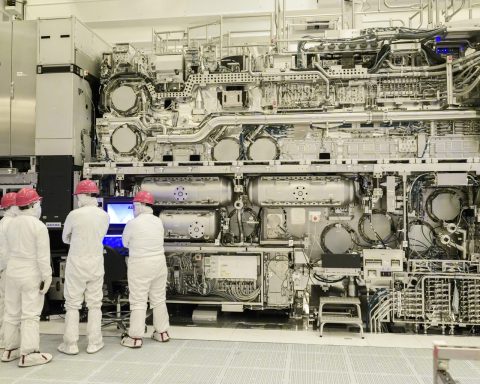
ASML Holding NV NASDAQ:ASML gave the strongest earnings backing for that bet. The chip-equipment firm’s U.S. shares were up 3.6% premarket after ASML raised its 2026 sales outlook to 43 billion to 45 billion euros. “Ongoing AI-related investments and continued progress in AI technologies are driving demand for advanced Logic and Memory chips,” CEO Christophe Fouquet said. Reuters
Results from outside tech helped a bit. Morgan Stanley NYSE:MS was up 1% after the bank posted $5.58 billion in quarterly net income and record revenue of $21.35 billion, with trading and dealmaking up. BlackRock NYSE:BLK added 6% as assets under management reached an all-time high at $15.34 trillion, with net inflows of $192 billion for the quarter. Even with those strong numbers, the gap between Nasdaq and Dow futures remained.
PayPal Holdings NASDAQ:PYPL surged almost 22% after Reuters reported that Stripe and Advent International made a $60.50 per share bid, putting a $53 billion value on the company. That price is about 28% above Tuesday’s close. The deal hasn’t been announced by PayPal—Reuters cited sources.
Energy-driven relief on inflation could be short-lived. West Texas Intermediate crude climbed 0.37% to $79.63 a barrel and Brent was up 0.57% at $85.21, with U.S.-Iran tensions again weighing on exports from the region. “With shipping around the Gulf becoming increasingly fraught with danger, traffic flows are declining once more,” said KCM Trade analyst Tim Waterer. Federal Reserve Chair Kevin Warsh, who has said the Fed won’t accept persistently high inflation, testifies at 10:00 EDT. The Fed’s Beige Book comes at 14:00. markets.businessinsider.com
The real test after the bell is market breadth. If banks, industrials, and other cyclical stocks don’t follow tech higher, even after softer inflation numbers and solid bank earnings, the move could be more about protecting tech valuations than betting on the bigger economy. The S&P 500 is right near its high, so that gap—between valuation support and economic confidence—matters more than the small uptick in futures.
Related articles: US Economy