NEW YORK, July 28, 2026, 09:07 EDT
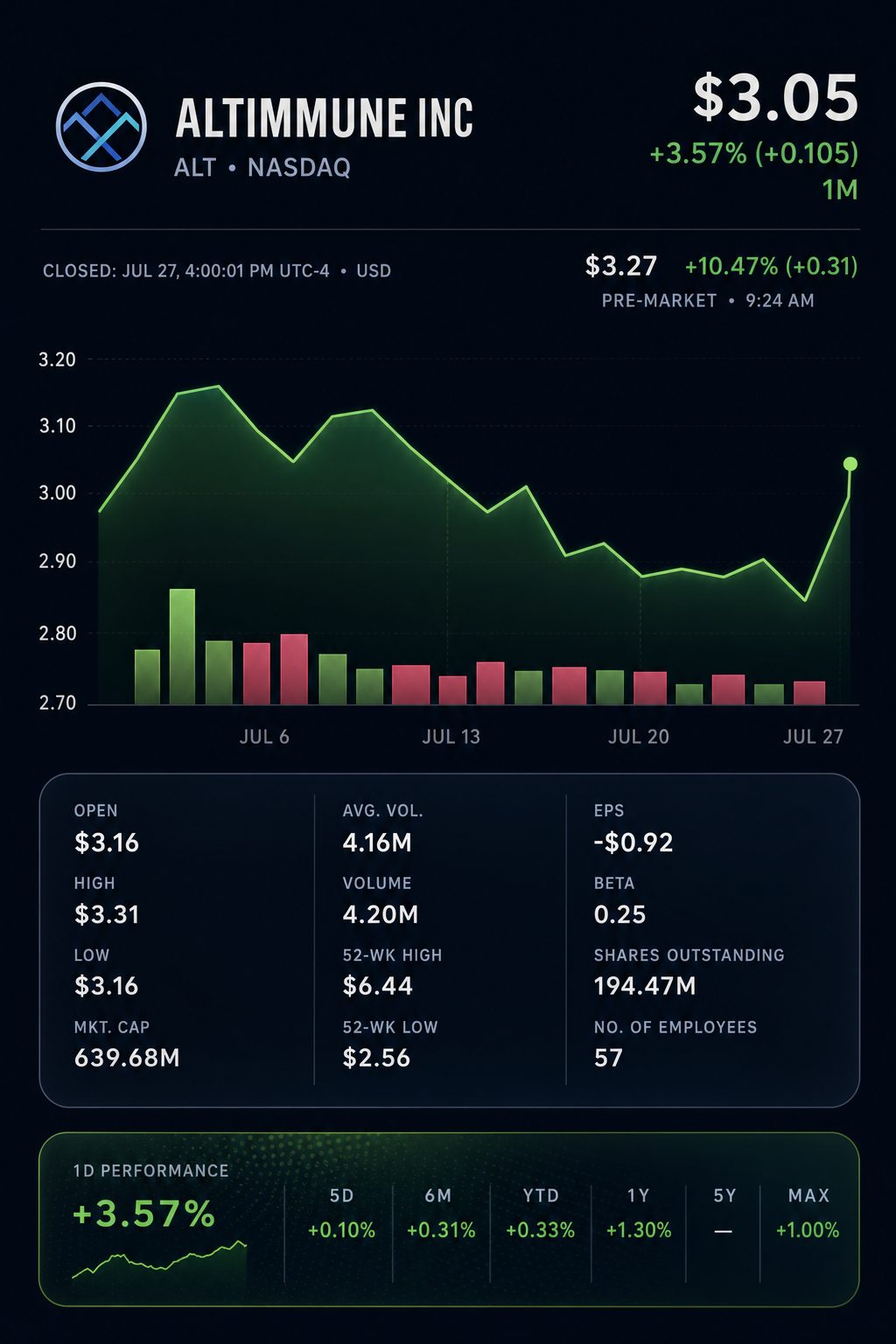
- The stock climbed roughly 10% in premarket trading after closing at $2.96 on Monday.
- Pemvidutide led to a decrease of 1.45 heavy-drinking days per week compared to placebo.
- The increase lifted 75 million warrants past their $3 exercise threshold.
Altimmune stock gained roughly 10% in premarket trading on Tuesday. The company’s Phase 2 RECLAIM study showed pemvidutide achieved its primary endpoint. U.S. markets had not opened at the time of reporting.
The price action surpassed a key financing level. In April, Altimmune released 75 million warrants that can be exercised immediately. Each warrant is priced at $3 per share.
A complete cash exercise has the potential to generate $225 million in gross proceeds, amounting to 42% of Altimmune’s cash and short-term investments as of April 30. The funds may help cover expenses tied to the anticipated Phase 3 trial in metabolic dysfunction-associated steatohepatitis, or MASH.
The financing will be dilutive. Calculations show the warrant shares represent 38.6% of Altimmune’s basic share count as of May 8. This figure does not account for pre-funded warrants or employee equity awards. The exercise of the warrants is not mandatory.
RECLAIM assigned approximately 100 patients to either pemvidutide or placebo groups. Participants received treatment over 24 weeks. Altimmune shared this efficacy analysis:
| Week-24 measure | Placebo | Pemvidutide | Treatment effect | P-value |
|---|---|---|---|---|
| Weekly reduction in heavy-drinking days | -2.75 | -4.20 | -1.45 days | 0.0014 |
| Reduction by two WHO risk levels | 34.8% | 64.4% | +29.6 points | 0.0049 |
| No heavy-drinking days | 17.4% | 42.2% | +24.8 points | 0.0066 |
| Rise in days without alcohol | 20.5% | 38.9% | +18.4 points | 0.0075 |
| Change in PEth alcohol biomarker | +22.0 | -153.4 | -175.3 | Below 0.0001 |
Participants in the active group cut heavy drinking by 4.20 days per week, while those receiving placebo reduced their heavy drinking by 2.75 days. The additional reduction of 1.45 days in the active group surpassed the projections of Jefferies Financial Group NYSE:JEF analysts, who anticipated an effect between 0.9 and 1.1 days.
The observed effect surpassed that range by approximately 32% to 61%. Early estimates suggest an annual reduction of about 75 heavy-drinking days, based on the persistence of the 24-week effect. This projection was not an endpoint of the trial.
Additional endpoints reinforced the outcome. Approximately two-thirds of patients receiving treatment saw a two-level reduction in World Health Organization risk scores. Pemvidutide further delivered a 9.1% weight loss compared to placebo.
Thomas Smith, analyst at Leerink Partners, described the initial efficacy results as “encouraging.” He also noted it is still challenging to compare them to Novo Nordisk’s NYSE:NVO semaglutide. Reuters
Pemvidutide was linked to a higher incidence of gastrointestinal side effects. Nausea occurred in 44% of patients given the drug, compared to 24% for those on placebo. Rates of constipation stood at 26% for pemvidutide recipients and 6% for the placebo group.
Five individuals discontinued pemvidutide due to side effects linked to the drug. A single serious incident involving low blood sodium was regarded as potentially connected to treatment. Overall, discontinuations reached 20% for pemvidutide and 22% for placebo.
Altimmune intends to hold an End-of-Phase 2 meeting with the U.S. Food and Drug Administration. The agency is expected to assist in outlining the registrational pathway. The findings are currently available as topline data and have not yet appeared in a peer-reviewed publication.
Risks are still elevated. RECLAIM was limited in size and included only participants with body mass indexes greater than 25. Placebo group improvements were significant. A more extensive study could reveal reduced effectiveness or new safety concerns. Exercising warrants would further dilute current shareholders.
Investors are set to monitor if Altimmune remains above the $3 mark in regular trading. Continued momentum may increase the appeal of warrant exercises, offering additional funds ahead of upcoming Phase 3 expenditures and resulting in a higher share count.
Related articles: NYSE:JEF