NEW YORK, July 28, 2026, 7:04 p.m. EDT
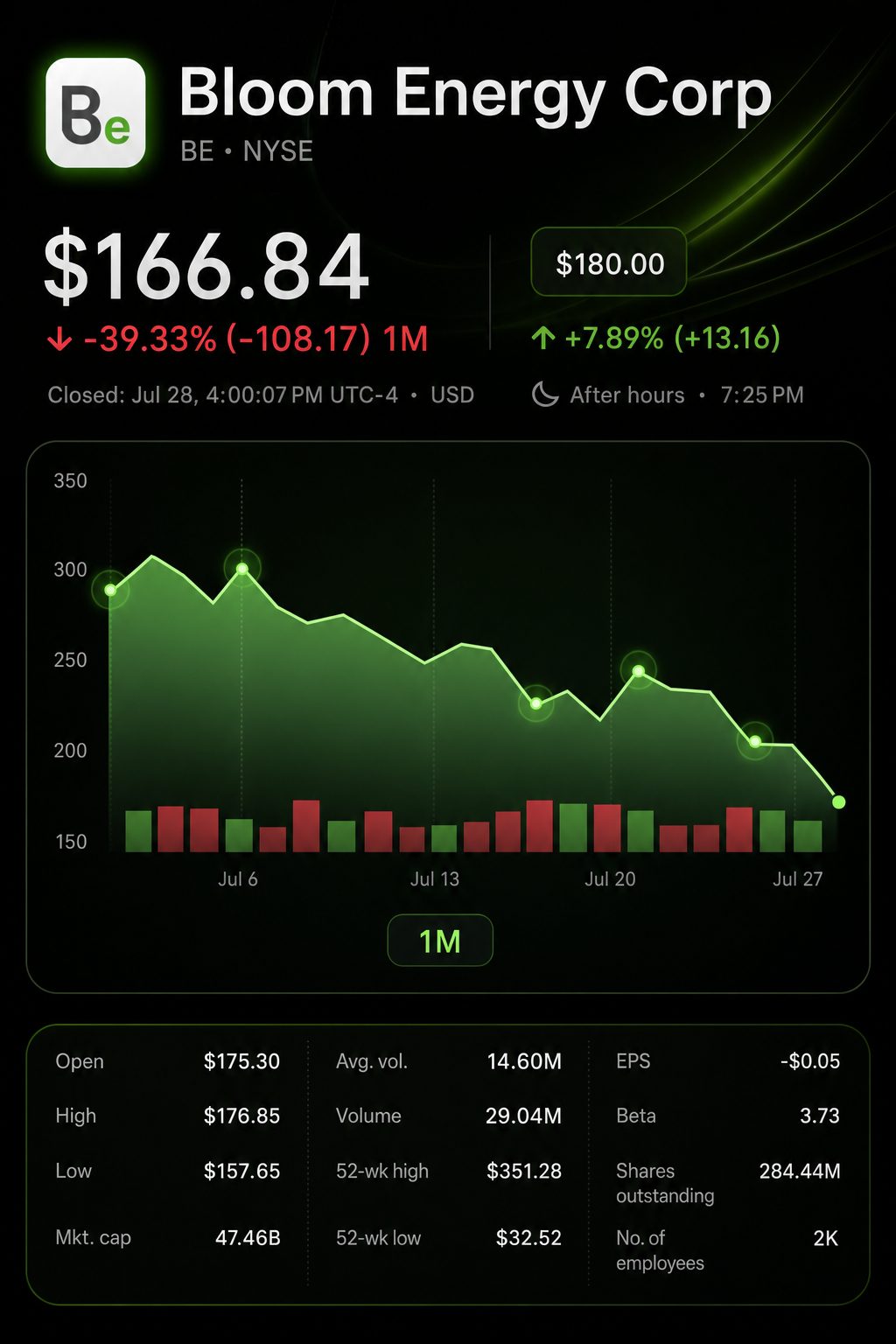
- Shares of Bloom Energy rose roughly 10.6% in after-hours trading to $184.44, following an 11.3% drop to $166.84 at the close.
- Bloom Energy reported second-quarter revenue of $1.065 billion. Adjusted earnings came in at 78 cents per share, surpassing Wall Street expectations.
- The midpoint of the outlook implies that average quarterly revenue in the second half would need to be just 4.8% higher than in the second quarter.
Shares of Bloom Energy Corporation NYSE:BE surged in after-hours trade on Tuesday following record revenue and a further raise to its 2026 forecast. The gain almost fully offset losses earlier in the regular session. After-hours pricing is still provisional.
The guidance calculations hold the key signal for investors.
Bloom’s revenue midpoint forecast of $4.05 billion suggests $2.234 billion for the last six months, or $1.117 billion each quarter. This marks an increase of 4.8% compared to the second quarter.
The adjusted operating income target is even less demanding. Meeting the midpoint means roughly $240.3 million is needed each quarter in the second half. In the second quarter, Bloom achieved $239.6 million.
| Measure | Q2 2026 actual | Implied H2 quarterly average | Required change |
|---|---|---|---|
| Revenue | $1.065 billion | $1.117 billion | +4.8% |
| Non-GAAP operating income | $239.6 million | $240.3 million | +0.3% |
First-half results and midpoint values from company guidance form the basis for calculations. Figures based on guidance are estimates.
This reduces the necessity for a significant new surge in demand. The main challenge will be whether Bloom can replicate results as it scales up production capacity.
Revenue for the second quarter jumped 165.5% compared to the same period last year. Product revenue surged 215.4% to reach $935.4 million. FactSet analysts had forecast total revenue around $826 million.
Bloom reported adjusted earnings of 78 cents per share, compared with the FactSet consensus of 41 cents. GAAP net income totaled $196.3 million, reversing a loss of $42.6 million in the same period a year earlier.
Operating cash flow climbed to $226.4 million, marking an improvement in cash generation. In the same period a year earlier, Bloom used $213.1 million.
Margins improved alongside higher volume. GAAP gross margin stood at 33.4%, up from 30.0% in the prior quarter and 26.7% in the same period last year.
Non-GAAP gross margin reached 34.3%. If the annual margin is precisely 34%, the midpoint suggests about 34.7% in the second half. Bloom must sustain the recent efficiency improvements to maintain this level.
KR Sridhar, Chief Executive, stated that Bloom’s systems had received approval from all major U.S. hyperscalers. He also referenced over a dozen neoclouds, AI labs and colocation providers. “Bloom is now a standard for AI onsite power,” Sridhar said. Bloom Energy
Chief Financial Officer Simon Edwards said the performance was the result of disciplined execution. He also highlighted investment in increased capacity and improved operating capability.
Oracle Corporation NYSE:ORCL is featured in the demand scenario. The company has entered into a contract for an initial 1.2 gigawatts as part of a deal that could reach 2.8 gigawatts. Projects are currently being rolled out in the United States.
Brookfield Asset Management Ltd. NYSE:BAM increased its Bloom financing structure to $25 billion in June. This initiative is aimed at supporting power projects that supply AI infrastructure.
Expectations continue to fluctuate. Bloom closed Tuesday’s regular session down 23.6% over five days. Shares were off 42.4% for the past month, but still up 92% for 2026.
Despite the late session rebound, shares remained roughly 15% lower than they were five sessions ago. The difference highlights how much growth expectation was priced into the stock.
Risks: Bloom is required to turn significant deals into reported revenue as it seeks to grow production. Any setbacks involving delayed data centres, dependence on a small number of customers, issues with interconnection, or limited supply may negatively affect the run-rate. The forecast depends on non-GAAP figures and the company’s management assumptions.
Upcoming sessions provide new insights into demand. Microsoft Corporation NASDAQ:MSFT and Meta Platforms, Inc. NASDAQ:META are set to report on Wednesday, followed by Amazon.com, Inc. NASDAQ:AMZN on Thursday. Their plans for capital expenditures may influence sentiment for suppliers powering AI.
The Federal Reserve is set to announce its policy verdict on Wednesday. An increase in rates would boost the discount rate imposed on growth stocks with long durations.
Bloom met the latest earnings expectations. The 2026 midpoint now requires the company to maintain its Q2 performance rather than exceed it.
Related articles: NYSE:BE