Transocean Shares Decline Even as Oil Prices Climb; Valaris Deal Gap Tightens
29 July 2026
2 mins read

Transocean Shares Decline Even as Oil Prices Climb; Valaris Deal Gap Tightens

NEW YORK, July 29, 2026, 12:59 p.m. EDT

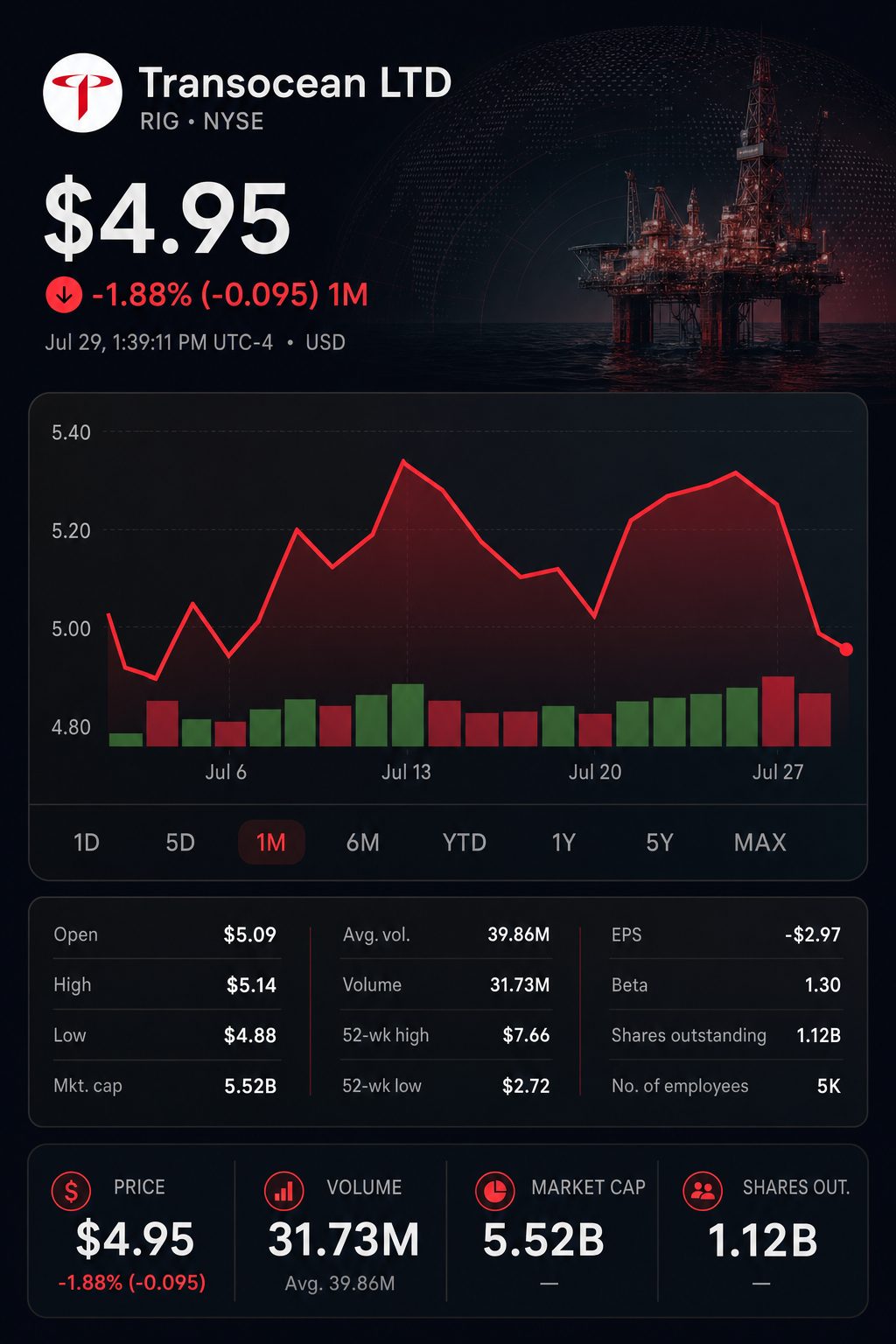
  • Transocean Ltd. slipped 1.3% to $4.93 as Brent crude rose 7.3%.
  • The established merger ratio places Valaris Ltd. at approximately $75.03. The company’s shares were 2.0% beneath that price.
  • Second-quarter earnings and an updated fleet report are expected after the close on August 5.

Shares of Transocean dropped 1.3% to $4.93 during midday trading in New York. Brent crude gained 7.3%, reaching $90.25 per barrel.

The difference stood out. Shares of offshore rival Noble Corp. rose 2.1% to $40.01.

Stock chart for NYSE:RIG

RIG is likewise being offered as currency in Transocean’s bid to acquire Valaris. Valaris shareholders would be entitled to receive 15.235 Transocean shares for each Valaris share held.

With the ratio at $4.925, the implied value is roughly $75.03. When the transaction was first disclosed, that value was $82.12.

Valaris was last at $73.56, creating a gap of $1.47. The gross spread stands at 2.0% before expenses.

Merger measureMidday value
Transocean stock price$4.925
Set exchange ratio15.235 RIG shares
Calculated Valaris offer$75.03
Valaris stock price$73.56
Total spread$1.47, or 2.0%
Initial implied value$82.12

Prices reflect midday data. The spread calculation is based on a hedge position of 15.235 RIG shares per Valaris share.

Initial assessment: Should both firms confirm compliance by July 31 and the deal finalizes near September 29, the hedged spread annualizes at roughly 12%. If closing shifts to year-end, the rate decreases to about 5%. These numbers do not include financing, borrowing expenses or the possibility of the deal failing.

The tight spread indicates investors continue to see a high likelihood of completion. This is an interpretation, not a certainty.

The Committee on Foreign Investment granted approval for the deal on June 29. The Justice Department made a Second Request on May 4.

The companies consented to refrain from certifying substantial compliance before July 31. Unless terminated early, they are required to wait 60 days following mutual certification.

Approvals from shareholders and additional closing conditions are still required. The deal will make use of a Bermuda court-approved scheme, and both firms continue to expect the transaction to close in the second half.

Transocean will announce its second-quarter results following the close on August 5 and plans to release a refreshed fleet status report. Changes in RIG shares will impact the implied value of the Valaris deal.

The company projects drilling revenue between $930 million and $970 million, based on revenue efficiency of 96.5%. Operating costs are expected to range from $630 million to $660 million.

Revenue for the first quarter came to $1.081 billion. Adjusted EBITDA amounted to $440 million, and free cash flow was reported at $136 million. As of May 4, backlog was $7.1 billion.

An agreement reached in June with Equinor ASA increased the backlog by over $1 billion, covering seven rig-years. The initial dayrate is above $400,000. The projects are set to start in 2027 and 2028.

“We know that our debt level negatively impacts our equity value. This transaction addresses that,” CEO Keelan Adamson stated in February. The management aims to achieve leverage close to 1.5 times within 24 months of the deal closing. Reuters

Risks: The DOJ review could postpone or alter the deal. Material concerns include shareholder votes, court consent, integration expenses, rig outages, leverage, and fluctuations in oil prices.

There are now two key dates: July 31 for the DOJ review and August 5 for the earnings report. Until those events, RIG is trading both as a drilling company and as deal currency.

TS2 TECH • EXTENDED COVERAGE

Further analysis

What is RIG’s current trading level, and what does its positioning indicate?

RIG was last seen trading at approximately $4.92 at 12:45 p.m. EDT on July 29, down 1.4% on the day. The session range spanned from $4.88 to $5.16. The company’s market cap stood near $5.53 billion. Over the past 52 weeks, the stock has fluctuated between $2.72 and $7.66. Short interest in the public float was about 24% as of July 15, potentially increasing volatility. MarketWatch

What can investors look for in the earnings report due August 5?

Transocean will announce its second-quarter results following Wednesday’s market close on August 5. The company projects contract drilling revenue to fall within $930 million to $970 million. Analysts forecast approximately $956.8 million in revenue and an adjusted EPS of $0.01. This revenue projection is marginally higher than Transocean’s midpoint estimate of $950 million. Operating and maintenance expenses are forecasted between $630 million and $660 million. The firm aims for 96.5% fleetwide revenue efficiency in the quarter. Full-year revenue expectations are unchanged at $3.8 billion to $3.9 billion. Deepwater

Does Transocean’s profitability stem from core operations, or is it a result of accounting measures?

GAAP net income for the first quarter stood at $71 million, equating to $0.06 per diluted share. Adjusted net income showed a loss of $28 million, or $0.03 per share. The reported GAAP result was aided by a $110 million discrete tax benefit. Adjusted EBITDA was $440 million, corresponding to a margin of 40.7%. Free cash flow totaled $136 million following $28 million in capital expenditures. Cash generation increased. The trailing loss continues to include $3.04 billion in 2025 asset impairments. Deepwater

What is the current strength of the backlog following the most recent contract awards?

The most recent official figure stood at $7.1 billion as of May 4. Transocean has since disclosed an extra $185 million in secured contract awards. Additionally, a separate deal with Equinor may contribute over $1 billion, though it is still subject to necessary Norwegian license clearances. All amounts are presented as gross additions and do not account for regular reductions from the revenue backlog. Most of the recently confirmed work is scheduled to start in 2027 or 2028. An exact revised total is expected with the fleet report on August 5. Deepwater

Is the Valaris merger expected to be finalized in 2026?

The transaction received approval from CFIUS on June 29, meeting a key condition. The U.S. antitrust process is ongoing, as the Justice Department has issued a second request. In line with their DOJ commitment, compliance cannot be certified until after July 31. Once both certifications are obtained, closing typically takes place after 60 days, unless DOJ permits an earlier date. Shareholder votes and other regulatory approvals are still pending. Management currently aims to complete the deal in the second half of 2026, though the timeline remains uncertain. SEC

Is the Valaris transaction sufficient to warrant its dilution?

Valaris shareholders are set to receive 15.235 RIG shares per VAL share held. Following the merger, current Transocean shareholders would control around 53% of the enlarged group. The new entity’s fleet will include 73 rigs spanning both deepwater and jackup segments. The management estimates annual cost synergies in excess of $200 million. A leverage ratio of 1.5 times is targeted within 24 months post-merger. Exchangeable bonds may issue an additional 75.3 million shares under the March agreement. While the deal has the potential to generate value, those gains have yet to be demonstrated. Reuters

Does the balance sheet continue to pose the primary risk?

As of March 31, principal debt stood at $5.137 billion, down $549 million from the end of the year. The company reported total liquidity of $1.125 billion, factoring in its credit facility. Unrestricted cash amounted to $330 million and revolver availability was $462 million. Scheduled debt repayments total $338 million through March 2027. The maturity bucket for 2030 is significantly larger, at $1.629 billion. With guided interest of $610 million in 2026, debt remains a key risk. Deepwater

To what extent do oil prices and dayrates impact RIG?

RIG is more than just a play on spot oil. In the first quarter, the company’s average daily revenue fleetwide was $475,600. For May, the backlog implied an average dayrate over $450,000. New work for Equinor launches from a starting base dayrate of $399,000, with contract adjustments expected to push that rate beyond $400,000 once operations begin. Most Equinor contracts kick off in 2027 and 2028. Ongoing offshore project greenlights are likely to have greater significance than any single swing in oil prices. Deepwater

What is a realistic outlook for RIG stock over the next 12 months?

RIG is currently priced near $4.92, trading below the consensus target published by MarketScreener. Fourteen analysts offer an average target of $6.40 and assign a Hold rating. Target estimates range from $4.00 to $10.00, reflecting a broad lack of consensus. My base-case projection places RIG between $5.75 and $7.00 over the upcoming twelve months, implying potential upside of about 17% to 42% from the current level. Risks such as a delayed merger or disappointing earnings could send the stock down to $3.75–$4.50. If the merger closes smoothly and deleveraging accelerates, the shares could reach $8.00–$10.00, although these outcomes are not guaranteed. MarketScreener

Marcin Frąckiewicz is the founder and CEO of TS2 Space, a satellite communications company serving customers around the world. A graduate of the Warsaw School of Economics (SGH), he has more than two decades of experience in telecommunications, satellite services and technology ventures. He writes about satellite communications, space technology, artificial intelligence and the stock market, with a particular focus on technology companies, semiconductors, emerging industries and the trends shaping global innovation. Follow Marcin Frąckiewicz on Google News, Facebook. or Linkedin.

AI PORTFOLIO

Top Stock Picks

Today’s highest-ranked model selections.

#1 BUY IN STAGES

AerCap

NYSE: AER 95 / 100
#2 BUY ON WEAKNESS

Xylem

NYSE: XYL 93 / 100
#3 ACCUMULATE

General Dynamics

NYSE: GD 91 / 100
#4 BUY WITH LIMITS

Visa

NYSE: V 88 / 100
#5 TACTICAL BUY

IDEX

NYSE: IEX 85 / 100
View full portfolio
Editorial model selection. Not personalised advice.
UiPath Shares Gain 22% as Market Considers Company’s Cash Position Amidst Lagging ARR Increases
Previous Story

UiPath Shares Gain 22% as Market Considers Company’s Cash Position Amidst Lagging ARR Increases

Parsons shares drop 38% following $118 million in charges and lower 2026 outlook
Next Story

Parsons shares drop 38% following $118 million in charges and lower 2026 outlook