SoundHound AI (NASDAQ:SOUN) reaches 52-week low; shares unaffected by healthcare push

SoundHound AI (NASDAQ:SOUN) reaches 52-week low; shares unaffected by healthcare push

NEW YORK, July 29, 2026, 14:04 (EDT)

  • SoundHound dropped 6.4% to $5.84, reaching a session low of $5.795 in regular trading.
  • MUSC Health broadened the deployment of its AI agent following over 2.2 million patient calls.
  • Initial calculations indicate LivePerson may be able to more than double its first-quarter revenue, while its share count would be diluted by around 10%.

Shares of SoundHound AI Inc. declined 6.4% to $5.84 on Wednesday, reaching a new 52-week low of $5.795. The Nasdaq market session was still underway.

The drop came after an upbeat customer announcement. MUSC Health rolled out SoundHound’s “Emily” agent at retail and specialty pharmacy locations. Since 2024, the platform has managed over 2.2 million patient calls. GlobeNewswire
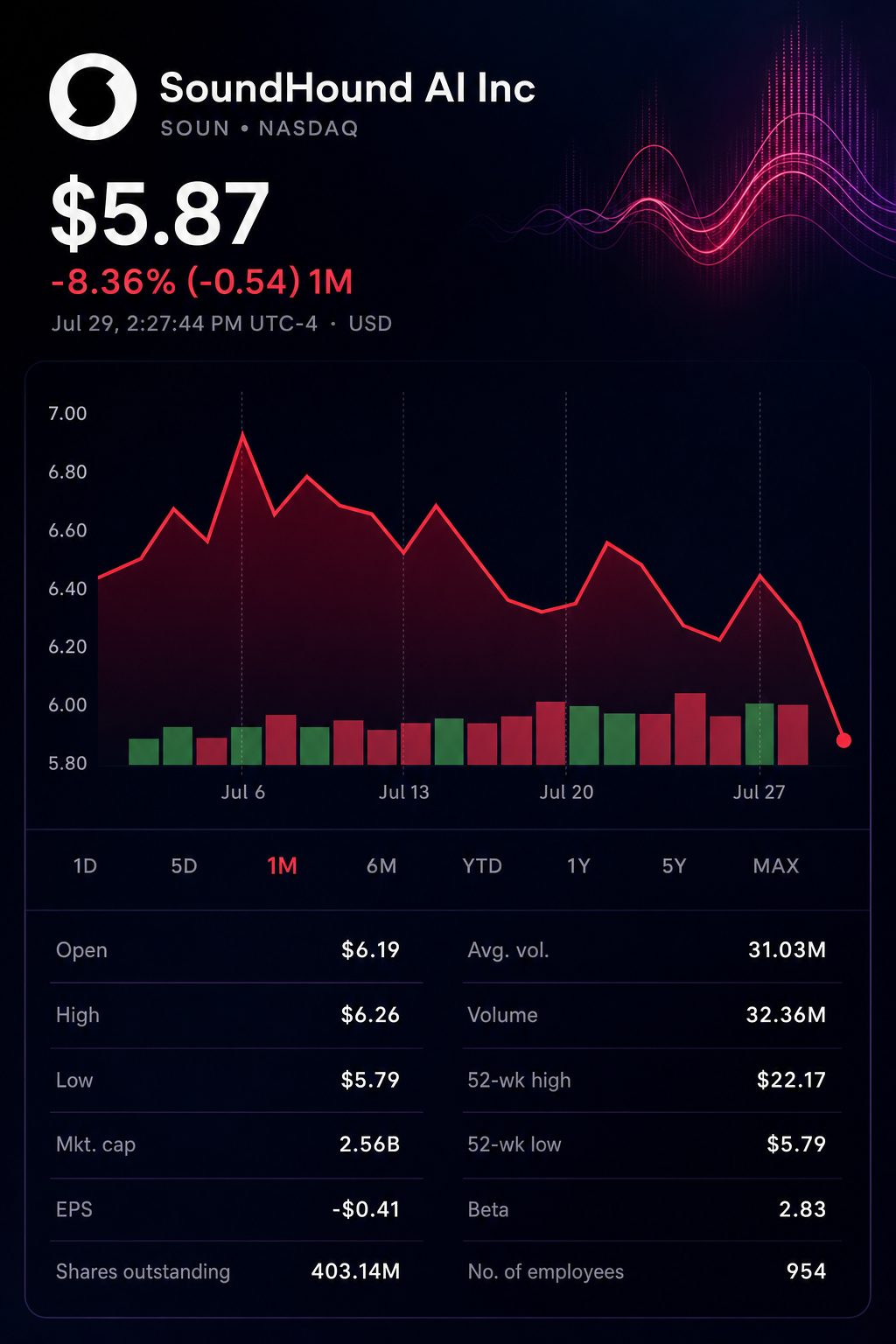
Stock chart for NASDAQ:SOUN

The announcement did not disclose the contract amount, revenue impact or margin information. Investors were provided with data on usage, but there were no details about unit economics.

SoundHound’s equity stands at $2.51 billion, amounting to 10.4 times its projected 2026 revenue at the median guidance figure. This initial estimate is based on the company’s forecasted range of $225 million to $260 million.

Wider declines accounted for just a portion of the drop. Invesco QQQ Trust slid 0.8%, while voice software firm Cerence Inc. fell 3.3%.

MUSC introduced features for prescription refills, status updates and pharmacy call transfers. Crystal Broj, the digital transformation lead at MUSC, said the platform “delivers measurable efficiencies while maintaining the high level of service our patients expect.” GlobeNewswire

The rollout demonstrates that the software is capable of managing actual healthcare workloads. However, it does not indicate the revenue generated by each workload.

Preliminary comparisonSoundHound standalonePro forma with LivePerson
Revenue for first quarter$44.2 million$101.2 million
First-quarter revenue, annualized$176.8 million$404.6 million
Basic weighted-average share count421.5 million464.1 million
Example equity value at $5.84$2.51 billion$2.76 billion
Equity value as multiple of annualized revenue14.2 times6.8 times

This table is not intended as a projection. It annualizes revenue from the March quarter and incorporates 42.6 million additional shares at a price of $5.84. The SEC data remain unaudited and may change due to closing adjustments.

The planned takeover provides a quicker path to scaling. LivePerson reported pro forma first-quarter revenue of $57.0 million, surpassing SoundHound’s $44.2 million.

The scale is driven by a seller under pressure. LivePerson disclosed that its debt is greater than the combined value of the deal. CEO John Sabino cautioned that the stock may have “little or nothing” in value if the agreement is not ratified. PR Newswire

The voting deadline is August 19, with a special meeting set for August 20. LivePerson plans an investor town hall at 8 a.m. EDT on August 5.

SoundHound is scheduled to release its second-quarter earnings at 5 p.m. EDT on the same day. The announcement will gauge if increasing usage is enhancing the quality of its revenue.

Revenue for the first quarter increased by 52% to $44.2 million. However, GAAP gross margin declined by 5.4 percentage points, reaching 31.1%. Operating cash outflow expanded to $26.3 million, compared with $19.2 million previously.

SoundHound reported cash holdings of $216 million at the close of March and said it had no outstanding debt. The available liquidity provides an extended runway, but does not guarantee improved returns.

Risks: LivePerson’s approval is still not guaranteed, with integration potentially extending beyond initial expectations. The planned share offering results in dilution for shareholders. Additionally, SoundHound disclosed that its controls over financial reporting were ineffective due to material weaknesses as of March 31.

Adoption is increasing. Investors continue to require evidence of revenue.

TS2 TECH • EXTENDED COVERAGE

Further analysis

What is causing SoundHound AI shares to decline today?

SOUN hovered close to $5.85 as of 1:50 p.m. Eastern, slipping about 39 cents. More than 30 million shares had already traded hands ahead of the close. Confirmed company updates were positive: MUSC Health grew its pharmacy automation after handling 2.2 million calls. Broader market weakness was also a factor, with the Nasdaq off 1.13% before the Federal Reserve announcement. There was no clearly verified, company-specific negative news fully accounting for the drop. SoundHound AI

What does SoundHound need to report on August 5?

SoundHound is set to announce its second-quarter results after markets close on August 5. Analysts are projecting revenue of approximately $52.47 million, representing an increase of about 23% from the same period last year. The published EPS estimates range from a loss of about $0.06 to $0.13 per share. That gap is not clarified by research services, leaving EPS consensus unclear. In Q1, the company posted gross margins of 31.1% on a GAAP basis and 49.7% on a non-GAAP basis. Investors may focus on whether margins expand and if EBITDA loss narrows below $26.7 million. The earnings call is scheduled for 5:00 p.m. Eastern. SoundHound Investors

Is it still possible to achieve the 2026 revenue target?

Management has maintained its full-year revenue guidance at $225 million to $260 million. With $44.2 million reported in Q1, the next three quarters require $180.8 million to $215.8 million combined. This breaks down to a quarterly average of $60.3 million to $71.9 million. Should Q2 results align with consensus, the average for the second half would need to reach $64.2 million to $81.7 million. While the lower end remains attainable, meeting the upper range calls for significant acceleration later in the year and allows minimal margin for error. SEC

To what extent is SoundHound’s growth organic?

First-quarter revenue rose 52% to $44.2 million, reported basis. Service subscription revenue climbed 46% to $35.8 million, mainly due to acquisitions. Product royalties jumped 88% to $8.35 million, led by licensing activity in Asia and EMEA. Management noted 88% growth when excluding acquisitions in core automotive and IoT, a metric that represents a more limited part of the business and does not reflect consolidated organic growth. Investors continue to await a comprehensive organic-growth reconciliation. SEC

What benefits does the LivePerson acquisition provide, and what is its level of dilution?

SoundHound assessed the value of LivePerson equity at nearly $43 million, while the initial aggregate consideration is $271.8 million. This higher sum factors in note restructuring and other elements of the merger consideration. SEC Pro forma documents indicate an addition of 42.6 million basic shares, an increase of around 10% over the weighted average in March. Joint first-quarter revenue would have reached approximately $101.2 million. SEC LivePerson’s $57.0 million revenue contribution dropped about 12% year on year. Shareholders of LivePerson are scheduled to vote August 20, leaving the timing of the deal’s closure unresolved. TradingView

At what point might SoundHound achieve profitability and generate positive cash flow?

The company has not provided a confirmed break-even quarter. Adjusted EBITDA for Q1 stood at a negative $26.7 million, approximately 60% of the company’s revenue. Operating cash burned totaled $26.3 million, compared to $19.2 million for the same period last year. Cash holdings were $215.6 million as of March 31, prior to an April gross share sale of $48.5 million. Based on these numbers and a steady burn rate, this indicates around ten quarters of runway. This basic projection does not account for LivePerson financing or shifts in operating requirements. Achieving profitability will require improvements in margins and expense efficiency, not just an increase in reported revenue. SEC

What level of threat does dilution risk pose?

In April, SoundHound issued 6.23 million shares at an average price of $7.78 each, generating $48.5 million gross and completing its previous ATM program. On May 11, SoundHound launched a new at-the-market offering of up to $300 million. Stock-based compensation for the first quarter reached $18.5 million, around 42% of revenue. Total unrecognized RSU expense stood at $157.2 million, expected to be incurred over 2.39 years. The LivePerson transaction would increase the basic share count by another 42.6 million. Dilution remains a significant per-share valuation concern. SEC

What is the extent of the accounting-control weaknesses?

Management described disclosure controls as ineffective as of March 31 due to ongoing material weaknesses. The issues involved complex transactions, inadequate segregation of duties, and extensive account-level controls. Some deficiencies factored into past restatements and smaller errors through 2025. Steps to bolster treasury and payroll controls were taken, but the remediation process is still underway. This does not suggest that current results are misstated, but increases reporting risk during a major integration. SEC

What is an appropriate 12-month price target for SOUN?

SoundHound trades at $5.85, giving it a market capitalisation of about $2.51 billion—approximately 10.4 times the midpoint of management’s projected 2026 revenue. Based on valuation metrics, a base case for the next twelve months is $7.50, with a range from $6 to $9. The bullish scenario targets $12 to $15 if the company posts stronger growth, sees margin improvement, and successfully completes the LivePerson acquisition. A bearish outcome would see shares between $3.50 and $5 if financial guidance weakens, dilution increases, or cash burn continues. Analysts’ published price targets range from $12.50 to $14.93, based on varying coverage and methodology. These represent possible scenarios rather than forecasts. SEC

Roman Perkowski is a senior markets reporter at TS2.tech, specializing in stocks, technology and macroeconomic trends. A graduate of the Cracow University of Economics, he previously worked in investment research and corporate finance. His coverage helps readers understand the key forces driving global financial markets and emerging industries. Follow Roman Perkowski on Google News.

AI PORTFOLIO

Top Stock Picks

Today’s highest-ranked model selections.

#1 BUY IN STAGES

AerCap

NYSE: AER 95 / 100
#2 BUY ON WEAKNESS

Xylem

NYSE: XYL 93 / 100
#3 ACCUMULATE

General Dynamics

NYSE: GD 91 / 100
#4 BUY WITH LIMITS

Visa

NYSE: V 88 / 100
#5 TACTICAL BUY

IDEX

NYSE: IEX 85 / 100
View full portfolio
Editorial model selection. Not personalised advice.
Avantor (NYSE:AVTR) stock jumps 15% as sales outlook improves, margins lag
Previous Story

Avantor (NYSE:AVTR) stock jumps 15% as sales outlook improves, margins lag

Garmin surges 17% after Q2 margin surge prompts valuation shift
Next Story

Garmin surges 17% after Q2 margin surge prompts valuation shift