NEW YORK, July 29, 2026, 15:00 EDT
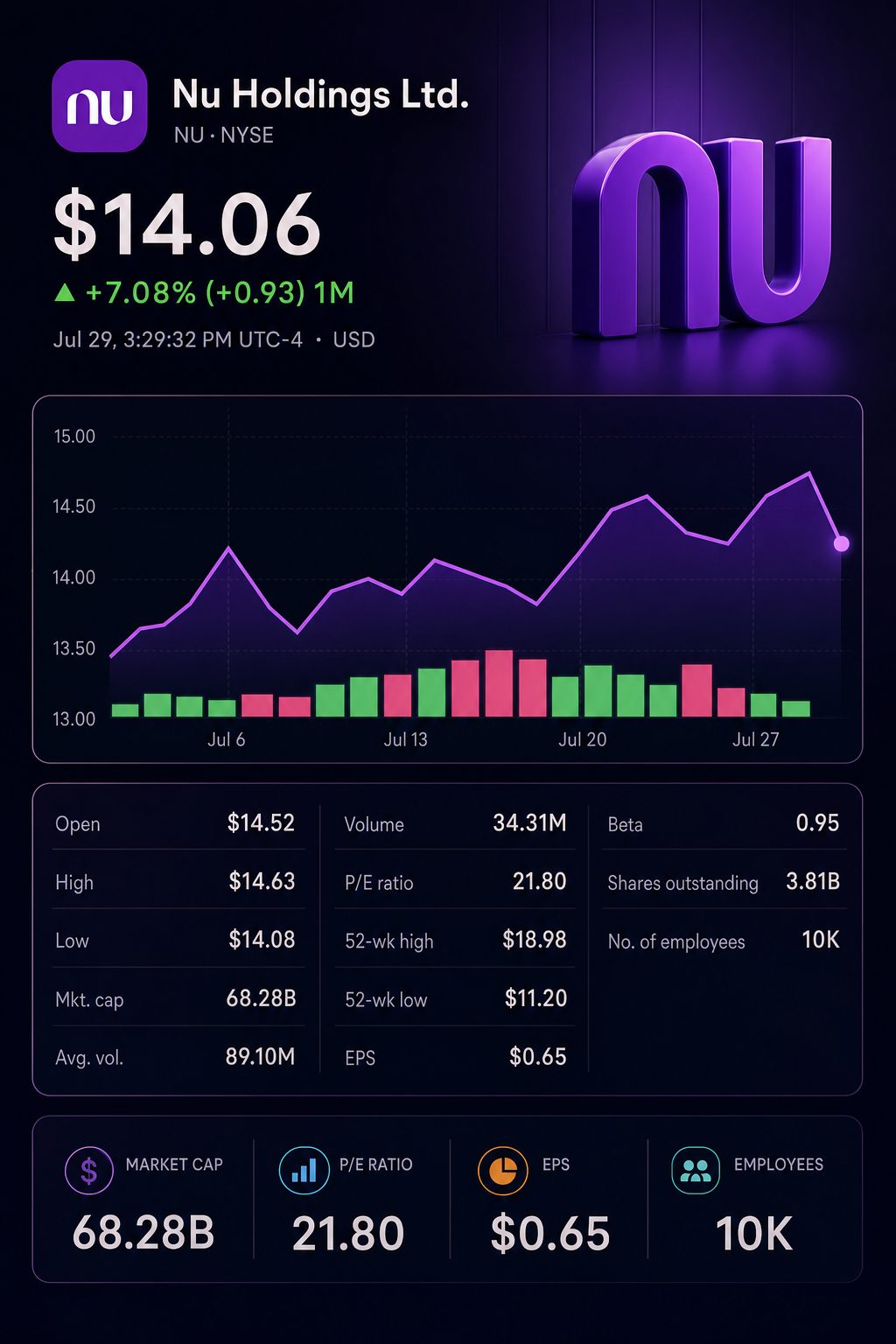
- Nu shares declined 3.1% to $14.23 in afternoon trading on Wednesday. Intraday data is still subject to change.
- Croma’s new card package eliminates its R$39 monthly charge for customers who spend at least R$4,000 each month.
- Nu’s rewards expense for the first quarter jumped 95%, outpacing the 31% increase in card income.
Nu Holdings Ltd. NYSE:NU was down 3.1% at $14.23 on Wednesday afternoon. Price and volume data are provisional as U.S. markets continued trading.
Nubank’s July 28 introduction of Croma in Brazil triggered the decline. The product shifts investor focus from expanding the customer base to increasing wallet share and improving revenue quality. Nu’s Brazilian customer count already tops 115 million.
General purchases with Croma earn 0.8% cashback, while qualifying subscription transactions return 5% cashback. The offering further includes mobile connectivity, toll payment features, and investment bonuses.
The service charges a monthly fee of 39 Brazilian reais (R$39). Nu does not apply this fee to customers who spend R$4,000 per month or maintain R$30,000 in savings and investments.
“This is how we acknowledge and strengthen our bond with those who select and rely on Nubank,” said Tulio Oliveira, vice president for Croma and Ultravioleta. Nu International
A sample calculation highlights the possible magnitude. With one million users each paying full fees, yearly gross fees would reach R$468 million. This figure does not account for waivers, rewards, partner expenses or taxes. The calculation does not represent company guidance.
This group would account for under 1% of Nu’s customer base in Brazil. At the required spending level, annual card billings would reach R$48 billion. The estimate is based on each individual spending R$4,000 per month.
The waiver carries greater significance than the headline fee. It indicates Nu is encouraging Croma to focus its spending, deposits, and additional services within its platform.
The expense challenge has already emerged. In the first quarter, Nu’s filing reveals rewards costs increased at a much higher rate than card-related revenues.
| Q1 card economics | 2026 | 2025 | Year-on-year change |
|---|---|---|---|
| Revenue from credit and prepaid cards | $486.2 million | $372.4 million | +30.6% |
| Reward costs | $38.4 million | $19.7 million | +95.0% |
| Rewards as portion of card revenue | 7.9% | 5.3% | +2.6 percentage points |
Rewards expense increased at about three times the pace of card income. While this ratio serves merely as a proxy and not as an actual product margin, it highlights the economic hurdle Croma faces.
Nu posted average monthly revenue per active customer at approximately $16 during the first quarter. Its efficiency ratio dropped to 17.6%, compared with 19.9% a quarter earlier. The lower ratio provides Nu with investment capacity, though careful management is still required.
Credit indicators showed less positive movement. Early-stage delinquencies increased by 89 basis points to reach 5.0%. The risk-adjusted net interest margin declined to 9.5%, compared with 10.5% previously. The ratio of loans overdue by more than 90 days slipped to 6.5%.
Chief Executive David Vélez stated that Nu would “grow limits with resilience, not just speed.” Croma is now expected to meet the same measure. Nu International
The main business continued to generate solid profits. Net income for the first quarter increased by 41% to $871 million. Return on equity, annualized, hit 29%.
Nu underperformed other Brazilian fintech stocks on Wednesday. PagSeguro Digital Ltd. NYSE:PAGS rose 0.3%, while shares of StoneCo Ltd. NASDAQ:STNE slipped 1.1%. The iShares MSCI Brazil ETF (NYSEARCA:EWZ) dropped 0.7%.
U.S. markets showed a mixed performance during the broader session as the Federal Reserve kept its benchmark interest rate unchanged at 3.50%-3.75%. Three Fed officials dissented, backing a 25 basis-point hike.
Nu will announce its second-quarter earnings following market close on August 13. Investors are set to monitor active-customer revenue, reward expenses, card transaction volumes, and initial signs of delinquencies.
Risks persist. Higher rewards might drive increased spending but not deliver sufficient incremental revenue. If early delinquencies worsen, risk-adjusted margins may come under additional pressure.
The stock’s future direction may rely less on the growth of new accounts. Net economics per active customer has become more significant.
Related articles: NYSE:NU