NEW YORK, July 31, 2026, 05:15 (EDT) — U.S. premarket; main session trading yet to start.
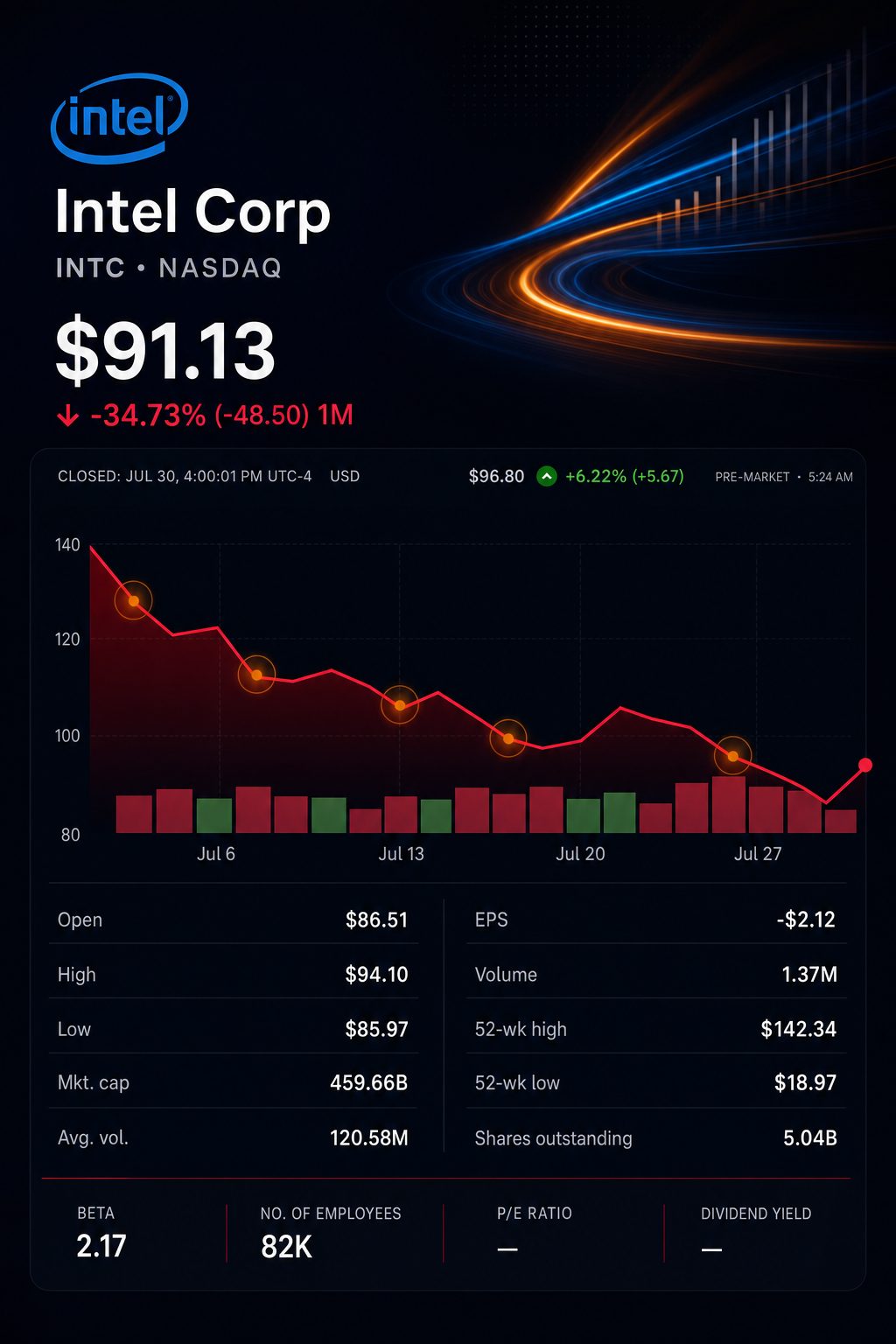
- Intel finished Thursday’s session up 11.3% at $91.13. Shares were indicated up another 5.0% at $95.71 as of 04:27 EDT on Friday.
- Intel’s filings suggest roughly 82% of its implied server growth is due to price and mix factors.
- External foundry revenue accounted for just 5.1% of total foundry sales, while the segment posted a $2.1 billion loss.
Intel stock finished Thursday up 11.3% at $91.13. Shares were indicated 5.0% higher at $95.71 as of 04:27 EDT Friday.
The recovery coincided with widespread renewed interest in hardware tied to AI. Microsoft NASDAQ:MSFT addressed worries about expenditures by reporting cloud expansion and providing cash flow outlook. Amazon.com NASDAQ:AMZN reported its quickest cloud growth in over four years. Nasdaq 100 futures advanced 1.2% in early Friday trading.
“These are true battleground stocks,” said Jed Ellerbroek, portfolio manager at Argent Capital Management. On Thursday, Intel outperformed the chip index but lagged behind AMD. Reuters
| Thursday close | Share or index move | Versus SOX |
|---|---|---|
| Advanced Micro Devices NASDAQ:AMD | up 13.00% | outperformed by 4.8 points |
| Intel | rose 11.30% | exceeded by 3.1 points |
| PHLX Semiconductor Index (INDEXNASDAQ:SOX) | gained 8.20% | Reference |
| Nvidia NASDAQ:NVDA | increased by 2.65% | lagged by 5.6 points |
| Qualcomm NASDAQ:QCOM | fell 2.62% | underperformed by 10.8 points |
Intel’s report indicated slimmer profit margins. Growth was mainly driven by server prices and stronger sales of high-end products.
Server average selling prices climbed 48%, as unit volume expanded 9%. Together, these drivers point to a 61.3% rise in revenue. A logarithmic analysis attributes roughly 82% of the increase to price and mix.
| Server-growth component | Year-on-year change | Share of implied lift |
|---|---|---|
| Average selling price and mix | +48% | Approximately 82% |
| Unit volume | +9% | Roughly 18% |
| Combined price-volume effect | +61.3% | 100% |
| Reported DCAI revenue | +59% | Close to the derived effect |
Based on Intel’s stated adjustments calculated through logarithmic attribution.
The outcome is similar to DCAI’s reported 59% jump in revenue. DCAI’s operating income climbed by $1.8 billion. Intel Products posted a gain of $2.1 billion, with DCAI accounting for roughly 86% of that figure.
Intel’s comparison by segment indicates the results of operating leverage. Segment revenues account for internal transactions.
| Intel business | Q2 revenue | Year-on-year | Operating signal |
|---|---|---|---|
| Client Computing and Physical AI | $8.9 billion | +13% | Operating income increased by $290 million |
| Data Center and AI | $6.3 billion | +59% | Operating income climbed $1.8 billion |
| Intel Foundry | $5.8 billion | +31% | Operating loss came to $2.1 billion |
| External foundry customers | $293 million | Not comparable | Accounts for 5.1% of foundry revenue |
Foundry continues to be the more challenging segment. External revenue totaled $293 million, accounting for 5.1% of foundry sales. Intel stated that much of this growth came from Altera, which is now counted as an external customer. The division nevertheless posted a $2.1 billion loss.
Chief Executive Lip-Bu Tan stated, “AI is driving unprecedented demand for compute.” Finance chief Dave Zinsner said spending on equipment, clean-room and substrate would increase. SEC
Analysts at Melius Research stated that the rise in spending indicates “confidence that Foundry customers are coming.” However, external sales continue to be the key challenge. Reuters
Upon release, Intel’s outlook surpassed the initial expectations from pre-results consensus. The forecasts were measured against estimates gathered by London Stock Exchange Group LON:LSEG.
| Financial measure | Intel forecast | Preliminary comparator | Difference |
|---|---|---|---|
| Q3 revenue midpoint | $16.3 billion | $15.1 billion LSEG consensus | up 7.9% |
| Q3 adjusted EPS | $0.38 | $0.27 LSEG consensus | up 40.7% |
| 2026 capital spending | $20.0 billion | $18.0 billion prior plan | up 11.1% |
The consensus figures, which were preliminary, were published ahead of Intel’s report. The guidance reflects ongoing product momentum; however, concerns about foundry economics remain unaddressed.
Thursday’s rally did not reverse the week’s drop. Intel ended trading 1.3% lower than its July 24 close, staying 36% beneath its June 30 peak. If the premarket trend holds, the week could post a gain.
Reuters said Intel is set to supply Atom technology to RosaicLabs. The agreement covers register-transfer-level code, which represents chip design in detail. Rosaic chief Amarjit Gill and Tan have been investing together for years. Intel would not comment.
AMD is set to release earnings Tuesday following the market’s close. Investors will watch the company’s server-related remarks to assess if Intel’s pricing edge is a broader sector trend. U.S. July employment figures are scheduled for Friday at 08:30 EDT.
Risks are still concentrated. Increased client supply might ease prices in the latter half. Server shortages could limit unit expansion. Foundry losses and increased expenditures may reduce available cash. The Rosaic deal introduces an oversight concern.
The upcoming hurdle for investors is limited. Intel needs to transform pricing based on scarcity into sustainable chip volumes and consistent external foundry contracts.
Related articles: NASDAQ:MSFT