Apple Shares Slide 7% With Q3 EPS Boost Largely Attributed to Tariff Refund

Apple Shares Slide 7% With Q3 EPS Boost Largely Attributed to Tariff Refund

NEW YORK, July 31, 2026, 05:13 EDT — U.S. stocks are trading in premarket hours, ahead of the main session’s 09:30 EDT opening.

  • Apple stock dropped 7.3% before the market opened, threatening $361.6 billion in market capitalization.
  • Revenue increased by 16.4%, while guidance for the September quarter fell short of Wall Street expectations.
  • Preliminary earnings per share, adjusted for refunds, came in at approximately $1.91, exceeding the consensus estimate by two cents.

Apple Inc. shares lost 7.3% in pre-market trading on Friday. Despite posting record quarterly revenue, investors concentrated on the company’s increasing supply constraints. The slide could wipe out roughly $361.6 billion in market capitalization.
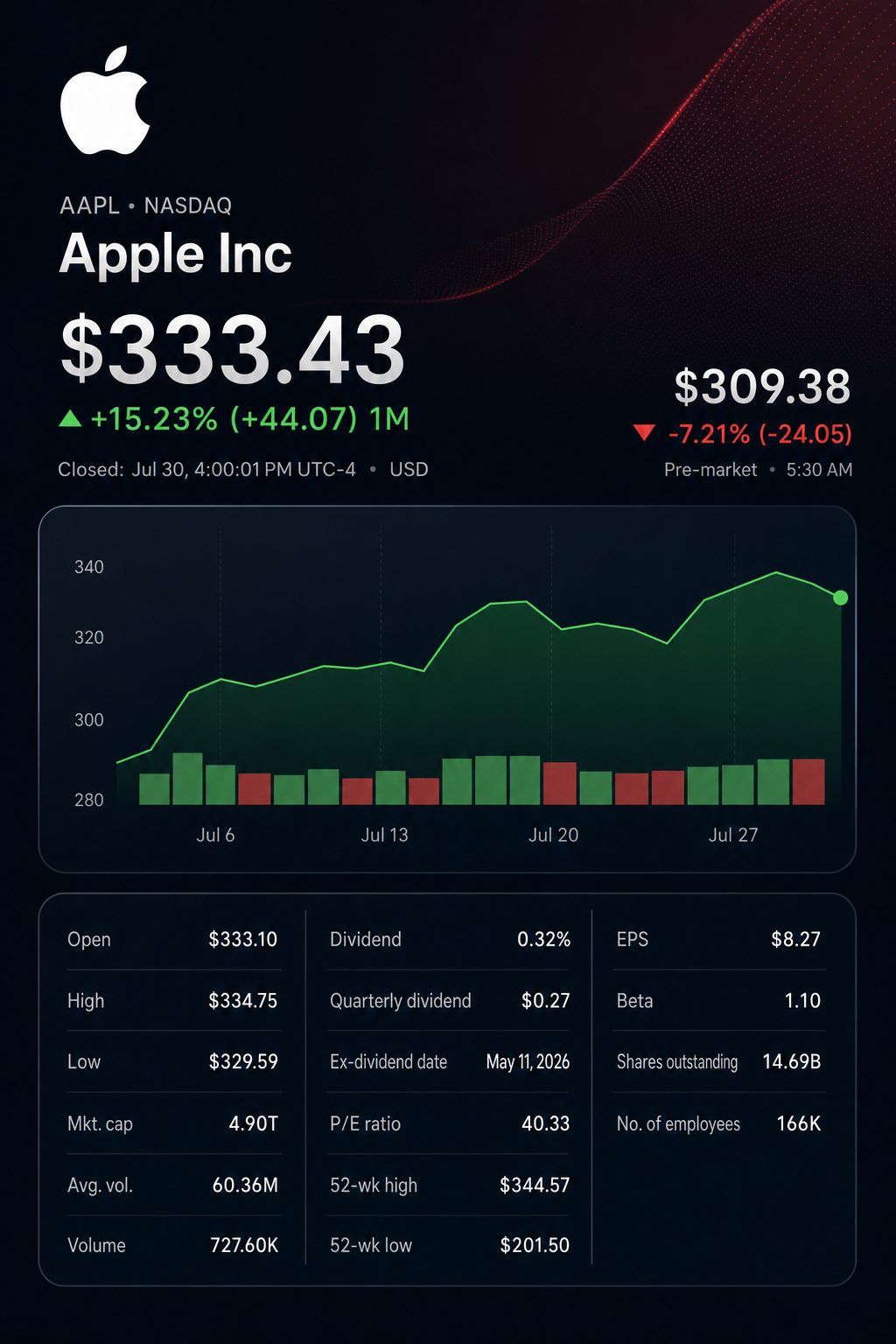
Stock chart for NASDAQ:AAPL

The underlying earnings outperformed by a narrower margin. Apple reported that tariff refunds contributed $0.11 per share to earnings. Gross margin was also increased by roughly two percentage points as a result.

A provisional calculation indicates that refund-adjusted EPS stands at approximately $1.91, compared to the $1.89 anticipated by Wall Street. Thus, the refund accounted for about 85% of the EPS surprise reported by Apple.

MeasureReportedEx-refund or underlyingWall Street
Diluted EPS$2.02$1.91$1.89
EPS surprise$0.13$0.02
Gross margin50.1%48.1%47.92%

Initial estimates account for Apple’s reported refund effects. The revised gross margin was marginally higher than anticipated.

Apple reported robust results for the quarter. Revenue climbed 16.4% to reach $109.42 billion, while net income jumped 27% to $29.79 billion. Tim Cook described the performance as Apple’s “strongest June quarter ever.” SEC

The iPhone accounted for almost 63% of Apple’s extra yearly revenue, while services made up an additional 22%.

Business lineQ3 revenueYear-on-year changeShare of total dollar growth
iPhone$54.25 billionup 21.7%62.9%
Services$30.74 billionrising 12.1%21.6%
Mac$10.35 billionup 28.7%15.0%
Wearables, Home and Accessories$7.88 billionincreased 6.5%3.1%
iPad$6.19 billiondown 5.9%-2.5%

Initial contribution figures are based on stated category revenue. Percentages sum to about 100% once rounded.

That combination raises a caution. Services revenue came in below the $31.22 billion forecast from analysts. Growth decelerated as well compared to the 16.3% in the prior quarter. Evercore ISI analyst Amit Daryanani said, “Slower App Store data continues to be an investor concern.” Reuters

The iPhone drove gains, with sales climbing 21.7% and topping the $53.86 billion forecast. Mac revenue also surpassed estimates by around $1.6 billion. In contrast, sales of iPad and in Greater China fell short of expectations.

The momentum was disrupted by the September forecast. Apple anticipated overall revenue to increase between 9% and 11%, while analysts on Wall Street had forecast roughly 12%.

September-quarter measureApple outlookComparisonPreliminary midpoint gap
Total revenue growth9%-11%Wall Street: about 12%-2.0 points
iPhone revenue growthMid-teensWall Street: 17.6%Roughly -2.6 points
Gross margin47%-48%Q3 ex-refund: 48.1%-0.6 points

Midpoint differences represent calculated estimates.

Cook stated that Apple is experiencing “very significant” constraints alongside restricted supply-chain flexibility. He pointed to advanced chipmaking capacity as the primary obstacle. The shortages are impacting iPhones, Macs, and certain iPads. Reuters

Analysts at JPMorgan Chase & Co. , headed by Samik Chatterjee, said, “Demand robustness is running into a wall of supply and cost challenges.” They anticipate that constraints will delay certain sales instead of causing them to be lost. Reuters

Cash generation provides balance. Operating cash flow for the nine-month period increased by 43%, reaching close to $117 billion. Capital expenditures, calculated by property and equipment acquisitions, declined by 28%.

Nine-month cash measureFY2026FY2025Change
Operating cash flow$117.0 billion$81.8 billion+43.1%
Purchases of property and equipment$6.8 billion$9.5 billion-28.2%
Free cash flow$110.2 billion$72.3 billion+52.5%
Free-cash-flow margin30.2%23.0%+7.2 points

Initial assessments measure free cash flow as operating cash flow less property and equipment acquisitions.

Anticipation was running high. As of Thursday, Apple had climbed roughly 3.6% across five trading days. It was still up 22.5% for 2026 after hitting an all-time high of $344.57 on Wednesday. The projected drop on Friday would offset the week’s earlier gains.

Focus in the coming week will be on updates to estimates and checks with suppliers. The upcoming set corporate event is Apple’s dividend record date, set for August 10. The company’s $0.27 quarterly dividend is payable on August 13.

Leadership changes introduce a new factor. On September 1, Cook will take on the role of executive chairman. John Ternus, currently head of hardware, will step in as chief executive on the same date.

Risks: Supply constraints may persist beyond Apple’s forecasts. Rising memory expenses or increased iPhone prices might dampen demand and squeeze margins. Services revenue is also under strain from changes in mobile gaming and App Store regulations.

Apple reported record demand and strong cash flow. However, investors are focused on sustainable earnings. The tariff refund was a one-off event.

TS2 TECH • EXTENDED COVERAGE

Further analysis

What is causing Apple’s shares to decline after reporting a solid quarter?

Apple finished Thursday at $333.43, then fell to about $309.50 in premarket trading ahead of Friday’s open. That reflected a 7.18% premarket drop as of 5:06 a.m. EDT. Shares had previously climbed over 22% in 2026 prior to the earnings release. However, investor attention shifted to Apple’s September outlook rather than the positive June-quarter performance. The company projected growth of 9% to 11%, coming in below the roughly 12% Wall Street consensus. The sharp move was attributed to production constraints and weaker expansion in the Services division. The Wall Street Journal

How solid were Apple’s results once tariff refunds were excluded?

Apple posted quarterly revenue of $109.42 billion, up 16.4% from a year earlier. Net income rose by 27.1% to $29.79 billion for the period. Diluted earnings per share climbed 29% to $2.02, ahead of analyst expectations of $1.89. The company reported a gross margin of 50.1%, though tariff refunds accounted for two percentage points of that figure. These refunds also boosted quarterly earnings per share by $0.11. Without this impact, EPS still slightly surpassed Wall Street estimates. Apple

What are the implications of Apple’s guidance for the September quarter?

Apple forecasts its revenue for the September quarter will rise by 9% to 11% compared with last year. Based on previous year figures, the company projects revenue of $111.7 billion to $113.8 billion. The midpoint stands about $2.2 billion under analyst consensus of $114.9 billion. Gross margin guidance comes in at 47%–48%, compared with 48.1% excluding last quarter’s refunds. Management mainly cites supply issues and currency effects for the gap. Investors remain watchful for signs that postponed sales will materialise in subsequent quarters. Reuters

Can the iPhone maintain its current pace of growth?

iPhone sales climbed 21.7% to $54.25 billion, surpassing the $53.86 billion forecast. The device accounted for 49.6% of Apple’s overall quarterly sales. Apple anticipates iPhone growth in the mid-teens range, trailing the 17.6% projected by analysts. Current demand looks high, but buyers may have accelerated purchases ahead of potential price hikes, bringing some future revenue forward. Ongoing supply constraints could further postpone sales, making it harder to assess fundamental demand trends.

Could Services represent a valuation concern?

Services revenue increased by 12.1% to $30.74 billion, falling short of the $31.22 billion analysts expected. The year-over-year growth rate was down from 16.3% seen in the previous March quarter. Services accounted for 28.1% of overall revenue and about 42.4% of reported gross profit, based on category sales and cost figures disclosed by Apple. Ongoing softness in App Store gaming and changes to payment rules continue to be significant obstacles. A further deceleration could put pressure on the premium multiple that investors currently award Apple.

Is Apple’s business in China genuinely back on track?

Revenue from Greater China rose by 22.4% to reach $18.82 billion in the quarter. However, that figure fell short of the $19.67 billion forecast from Visible Alpha. The region accounted for roughly 17.2% of Apple’s total revenue in the quarter. While the recovery was significant, investors were anticipating stronger results. Upcoming September pricing will show if growth can continue in the face of potential iPhone price changes.

What is the latest 12-month price target?

FactSet’s consensus shows an Overweight rating, with 33 analysts rating the stock positively, compared to four with negative views. Fourteen analysts advise holding Apple shares for now. The consensus 12-month price target averages $326.27, and the median target is $335. Forecasts as published span from $240 to $400 per share. With shares trading at $309.50 in premarket, both the average and median targets suggest potential gains of 5.4% and 8.2%. A number of these targets preceded Thursday’s guidance and could be updated in coming days. At this share price, consensus estimates for FY2027 earnings per share of $9.66 value the stock at about 32 times earnings. The Wall Street Journal

Do Apple’s cash reserves and share repurchase program underpin the stock?

Operating cash flow for the nine months ended June was $117.0 billion. After deducting $6.8 billion in capital expenditures, free cash flow came to roughly $110.2 billion. Apple spent $62.1 billion on share repurchases and paid $11.8 billion in dividends. The company reported cash and securities of $146.5 billion, with $84.3 billion in debt. This left net cash at about $62.2 billion at the end of the quarter. Share repurchases continue as the primary tool for returning capital to shareholders.

How much influence might Apple have on key indexes today?

Apple made up 7.90% of the S&P 500 and 8.55% of the Nasdaq-100 tracker QQQ as of July 29, prior to Thursday’s earnings report. A 7.18% fall in Apple shares mechanically reduces the S&P 500 by about 0.57 percentage points. For QQQ, the equivalent drag is roughly 0.61 percentage points. These effects may be either offset or heightened by movements in other stocks at Friday’s open. Opening prices are crucial. State Street Global Advisors

Is the investment case impacted by the CEO transition or changes to the AI roadmap?

John Ternus will take over as CEO on September 1, while Tim Cook moves to the role of executive chairman. Apple announced its board voted unanimously to approve the succession plan, calling it long-planned. Research and development expenditure jumped 32.3% to $11.73 billion for the quarter. The upcoming focus includes further Siri AI integration, iPhone pricing, and supply of components. Citi kept its $365 price target, pointing to both the iPhone release in September and upgrades to Siri. Analysts highlight elevated execution risk. Ongoing supply constraints could continue to mask the market’s real demand signal next quarter. Apple

Roman Perkowski is a senior markets reporter at TS2.tech, specializing in stocks, technology and macroeconomic trends. A graduate of the Cracow University of Economics, he previously worked in investment research and corporate finance. His coverage helps readers understand the key forces driving global financial markets and emerging industries. Follow Roman Perkowski on Google News.

Intel Shares Steady in U.S. Premarket as AI-driven CPU Sales Lift Profits Expectations
Previous Story

Intel (NASDAQ:INTC) Shares Recover; Price Increases, Product Mix Account for 82% of Server Expansion

Ulta Beauty aims for Gen Z with Pacsun partnership, while Target customer returns seen as key growth driver
Next Story

Ulta Beauty aims for Gen Z with Pacsun partnership, while Target customer returns seen as key growth driver