NEW YORK, July 31, 2026, 07:03 EDT
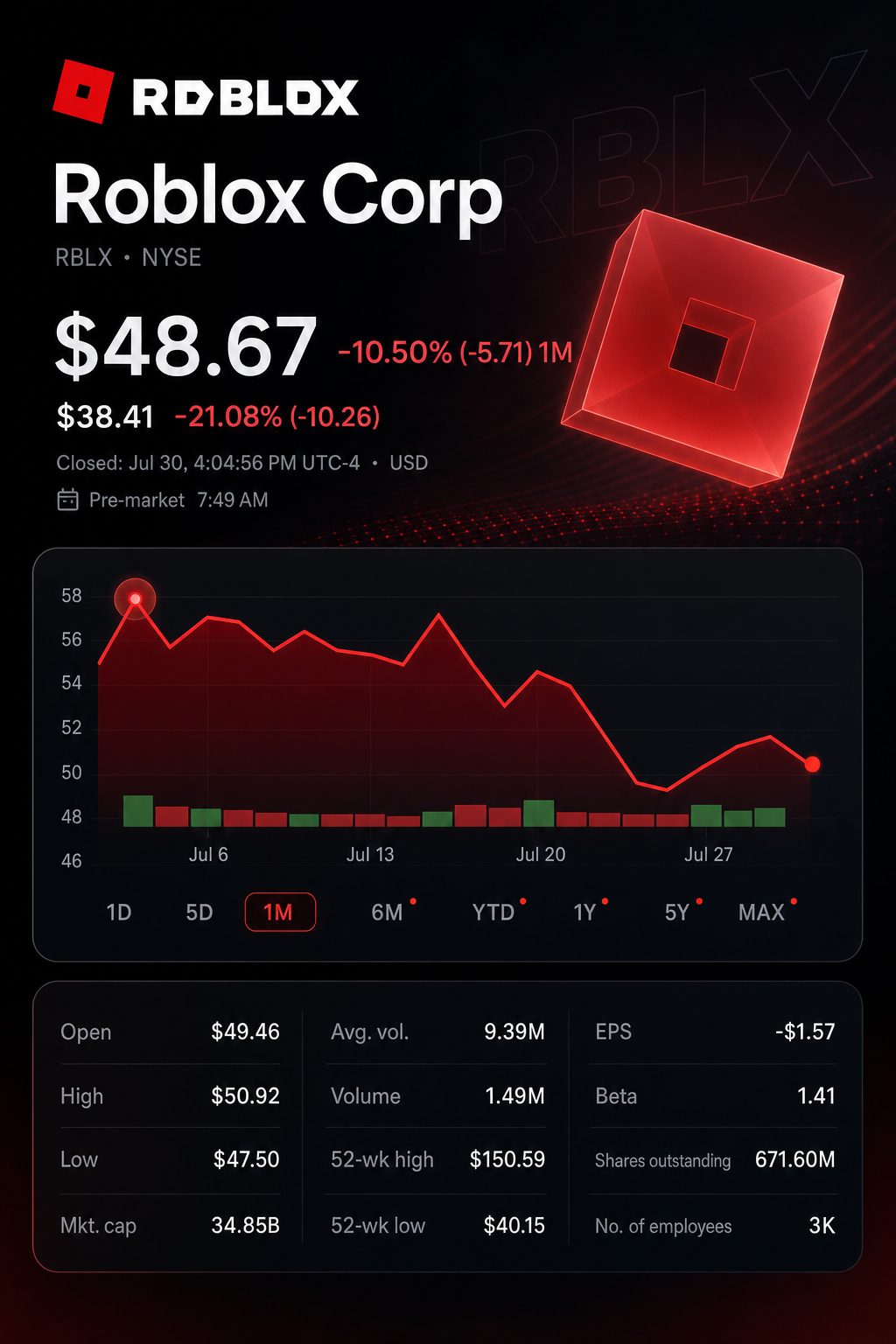
- Shares of Roblox were last seen at $38.35, falling 21.2% in premarket U.S. trading.
- The number of monthly payers in Q2 increased by 15%, while the average bookings per payer dropped 6%.
- The midpoint for Q3 bookings falls 8.8% short of LSEG’s projection. Free cash flow could become negative.
Shares of Roblox Corporation NYSE:RBLX dropped 21.2% to $38.35 ahead of Friday’s opening bell, after the company issued a weak bookings outlook that highlighted decreased spending from individual users. U.S. markets open for regular trading at 9:30 a.m. EDT.
The main concern for investors lies below the surface of the user numbers. The number of monthly paying users increased by 15% in the second quarter. However, bookings per paying user declined by 6%, and average spending per daily user decreased by 2%.
The action seemed limited to the company. Shares of Unity Software Inc. NYSE:U and Take-Two Interactive Software Inc. NASDAQ:TTWO showed little change in premarket trading.
Premarket overview
| Company | Price | Premarket move | Quote time |
|---|---|---|---|
| Roblox Corporation NYSE:RBLX | $38.35 | down 21.20% | 06:58 EDT |
| Unity Software Inc. NYSE:U | $33.19 | down 0.45% | 07:00 EDT |
| Take-Two Interactive Software Inc. NASDAQ:TTWO | $248.32 | up 0.36% | 07:00 EDT |
The data shown are premarket quotes with a delay.
Roblox reported overall growth in Q2, although unit-level expansion slowed considerably.
Q2 monetization compared to scale
| Metric | Q2 2025 | Q2 2026 | Year-on-year |
|---|---|---|---|
| Revenue | $1.081 billion | $1.469 billion | up 36% |
| Bookings | $1.438 billion | $1.557 billion | up 8% |
| Daily active users | 112 million | 123 million | up 10% |
| Hours engaged | 27 billion | 29 billion | up 5% |
| Monthly unique payers | 23.4 million | 27.0 million | up 15% |
| Bookings per daily user | $12.86 | $12.66 | down 2% |
| Bookings per monthly payer | $20.48 | $19.25 | down 6% |
Bookings, which log virtual-currency sales ahead of when revenue is officially recorded, increased by 8%, compared to a 36% gain in revenue. Typically, bookings are recognized as revenue over a projected 27-month period for each payer.
Chief Financial Officer Naveen Chopra said, “Monetization weakness is likely to continue.” Roblox’s recommendation engine has directed younger players to games that generate lower revenue per hour. Reuters
Geography is partly behind the dilution, as the fastest growth occurred beyond Roblox’s top spending market.
Bookings and expenditure by region
| Region | Bookings growth | Spending per daily user | Spending growth |
|---|---|---|---|
| United States and Canada | +1% | $38.63 | -5% |
| Europe | +18% | $13.35 | +16% |
| Asia-Pacific | +14% | $4.90 | -1% |
| Rest of world | +31% | $4.88 | +14% |
U.S. and Canadian bookings saw minimal growth, while regions with much lower overall spending experienced quicker expansion. This shift broadens Roblox’s global presence, but dampens overall monetization for the company.
The third-quarter outlook continues that trend. User figures could rebound, but cash flow may slow.
Q3 forecast compared to Q2
| Metric | Q2 2026 reported | Q3 2026 outlook | Q3 comparison |
|---|---|---|---|
| Revenue | $1.469 billion | $1.413 billion-$1.490 billion | +4% to +10% versus prior year |
| Bookings | $1.557 billion | $1.576 billion-$1.653 billion | -18% to -14% versus prior year |
| Bookings midpoint | — | $1.615 billion | 8.8% below LSEG projection |
| Operating cash flow | $318 million | $110 million-$175 million | — |
| Free cash flow | $294 million | -$60 million to +$5 million | — |
LSEG’s bookings forecast stood at $1.77 billion.
Management anticipates daily user numbers will increase again in Q3, while the monetization softness seen in Q2 is set to continue. During the second quarter, daily user figures declined by 7% on a sequential basis.
Roblox shifted to providing only quarterly guidance ahead of schedule by one quarter. The midpoint for its free-cash-flow range now stands at negative $27.5 million. This suggests a sequential decrease of around $322 million from Q2, according to company data.
Older users present the most obvious area for growth. In the second quarter, adults accounted for 27% of verified daily users. According to company figures, adults in the U.S. generate over 50% more revenue than users under 18.
Management is shifting from concentrated content towards a wider range. The leading 10 games accounted for around 20% of hours played, a decline from 30% three years ago. Titles beyond this group saw a 25% increase in hours and Robux spending rose by over 20%.
Risks: The updated algorithm has the potential to enhance retention earlier than anticipated, boosting expenditure. Despite this, ongoing safety measures, less engaging viral games, and significant artificial-intelligence spending may prolong the period of reduced cash flow.