
Date: November 7, 2025
Key points
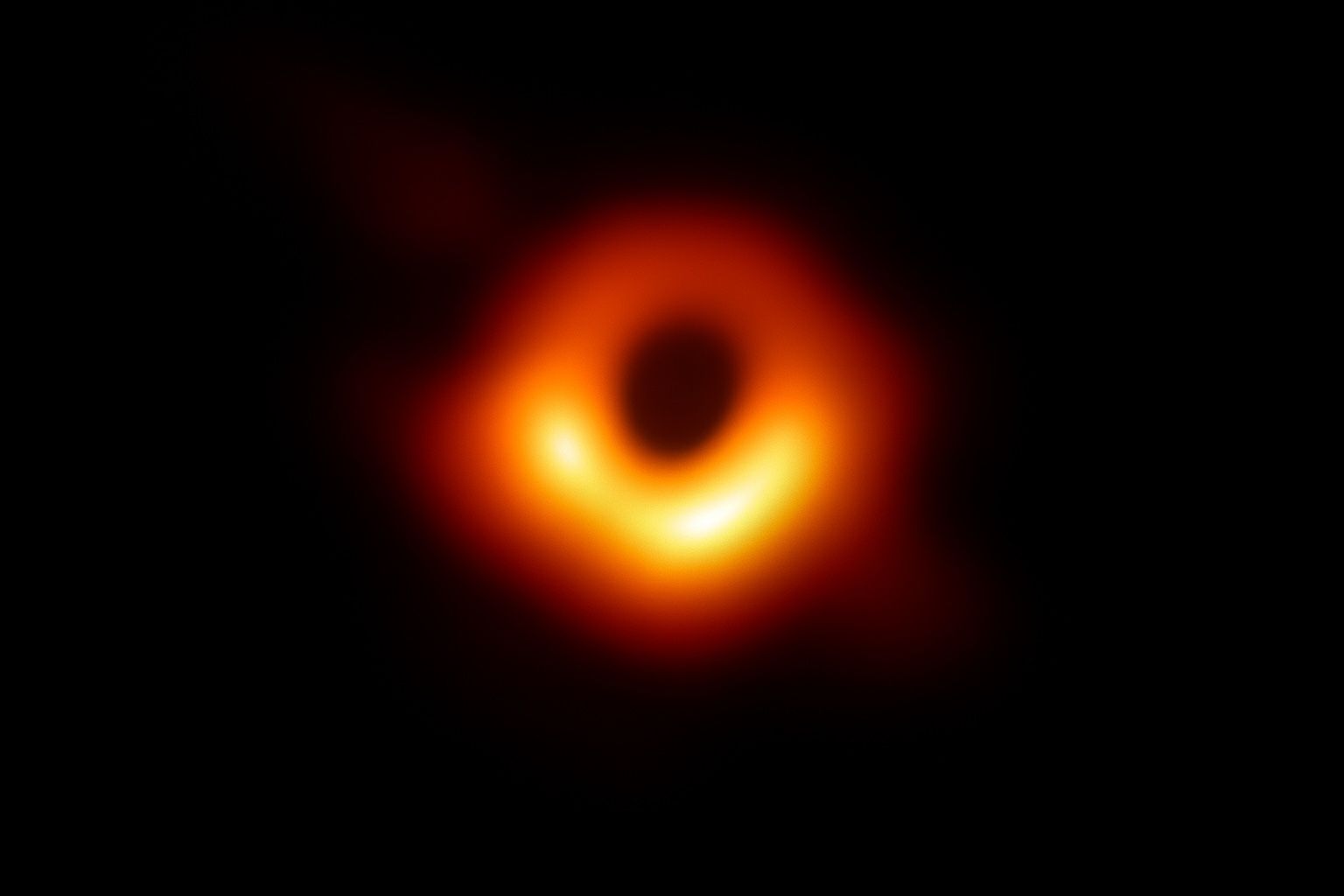
- Astronomers have reported the most luminous and most distant black hole flare ever recorded, peaking at the brightness of ~10 trillion suns. The outburst came from the active galactic nucleus (AGN) J2245+3743, about 10 billion light‑years away.
- The flare likely occurred when a supermassive black hole (~500 million solar masses) shredded a very massive star (>30 solar masses) in a rare, extreme tidal disruption event (TDE).
- Compared with previous champions (including the “Scary Barbie” event), the new flare is about 30× more powerful, with the source brightening by >40× in 2018 before slowly fading. Nature
- The team estimates the total energy radiated so far is ~10⁵⁴ ergs—roughly the amount you’d get by converting about one solar mass entirely into light.
- The discovery leans on long‑running sky surveys and follow‑up at Palomar and Keck; researchers emphasize the flare is still being monitored and remains scientifically “in play” as models are tested. California Institute of Technology
What happened—and why this one is different
A Caltech‑led team reports an extraordinary flare from the supermassive black hole in AGN J2245+3743, first seen rising dramatically in 2018 and now recognized as a record‑setter for both luminosity and distance. At peak, it shone with the light of ~10 trillion suns, unmistakably towering above the AGN’s usual variability.
The peer‑reviewed study, published November 4, 2025 in Nature Astronomy, quantifies just how extreme the event is: the source brightened by more than a factor of 40, radiating a cumulative ~10⁵⁴ ergs—on par with the complete conversion of ~1 solar mass into electromagnetic energy. That makes it ~30× more powerful than the previous most luminous AGN transient on record.
A star shredded by a monster black hole
What could power such a display? The authors favor a tidal disruption event—a catastrophe in which a star strays too close to a black hole and is torn apart by gravity—but they rigorously considered alternatives, including gravitational lensing of an AGN flare or an extreme supernova within the AGN’s disk. The data point most strongly to a TDE involving a star at least 30 times the mass of the Sun, interacting with a black hole weighing ~500 million Suns.
Scientists say the flare is still fading, suggesting the black hole has not yet finished its meal—“like a fish only halfway down the whale’s gullet,” as lead author Matthew Graham put it. The metaphor underscores that we are watching the event unfold, not just a single snapshot. California Institute of Technology
How astronomers caught the cosmic outburst
The initial rise was flagged by the Zwicky Transient Facility (ZTF) at Palomar Observatory, with complementary detections and follow‑up from other surveys and telescopes—including spectroscopic observations at Keck—building the case over several years. Because the source sits so far away, the team also accounts for cosmological time dilation: to us, the flare evolves more slowly than it did in its home galaxy, helping long‑baseline surveys capture the phenomenon in full.
How big is “10 trillion suns,” really?
For context, typical AGN variability can be hard to disentangle from day‑to‑day feeding. Here, however, the flare towered far above the baseline, making it “unlike any AGN we’ve ever seen,” according to the research team. The new event also dwarfs earlier record candidates such as “Scary Barbie” (ZTF20abrbeie), which likely involved a much smaller star (~3–10 solar masses) and was tens of times less luminous. Live Science+1
Why it matters
Extreme flares like this are natural laboratories for understanding how supermassive black holes grow and interact with their environments, especially in the early universe. They let researchers probe the structure of AGN accretion disks, test models of stellar dynamics near black holes, and refine how we distinguish TDEs from other violent transients. The sheer energy budget—~10⁵⁴ ergs—pushes those models into new territory.
What’s next
The team will continue monitoring J2245+3743 as it fades and evolves, while upcoming facilities such as the Vera C. Rubin Observatory (with its nightly, all‑sky cadence) are expected to surface more of these rare, high‑energy events. The authors have also made their photometry and spectroscopy publicly available, enabling independent checks and fresh modeling by the broader community.
Fast facts: J2245+3743
- Object: AGN J2245+3743 (full designation J224554.84+374326.5) Nature
- Distance: ~10 billion light‑years (observing the universe when it was much younger) California Institute of Technology
- Black hole mass: ~500 million solar masses California Institute of Technology
- Likely trigger: Tidal disruption of a >30‑solar‑mass star in an AGN disk Nature+1
- Peak brightness: ~10 trillion suns; >40× brightening relative to baseline; ~30× more powerful than prior AGN transients Live Science+1
The reporting landscape (Nov. 7, 2025)
Coverage today emphasizes the discovery’s record‑shattering luminosity and the likelihood of a massive‑star TDE. Live Science provides a reader‑friendly overview keyed to today’s date, while the peer‑reviewed paper offers the technical backbone. Regional outlets have also highlighted the Caltech connection and quotes from the study’s lead author, reflecting broad public interest.
Glossary
- AGN (Active Galactic Nucleus): A supermassive black hole actively accreting gas, dust, and stars, producing variable, high‑energy emission.
- TDE (Tidal Disruption Event): When a star ventures too close to a black hole and is torn apart; some of the debris is accreted, powering a luminous flare.
Sources: Nature Astronomy research article; Caltech news release; Live Science coverage (Nov. 7); regional reporting via SFGATE.
Editor’s note: This article reflects the state of knowledge as of November 7, 2025; researchers continue to observe J2245+3743 and test alternative explanations alongside the leading TDE scenario.
Related articles: Space Exploration