
Today: 18 July 2026
Browse Category

NYSE:AMX 29 May 2025 - 1 March 2026

Mexico Stock Market Opens Today: IPC eyes 65,000 as Venezuela shock and INEGI data set the tone

Mexico Stock Market Opens Today: IPC eyes 65,000 as Venezuela shock and INEGI data set the tone

Mexican stocks head into Tuesday’s open under a geopolitical cloud after U.S. President Donald Trump said he would put Venezuela under “temporary American control” following a raid that captured President Nicolas Maduro, and he threatened military action in Mexico. Brent eased to about $61.59 a barrel and copper hit a record high as Asia shares held near peaks; “Venezuela is a small economy, so investors were convinced global financial markets are unlikely to be directly affected,” wrote Yusuke Matsuo at Mizuho Securities. Reuters
Paraguay’s Internet Access in 2025: Shocking Facts about Connectivity, Providers, and the Starlink Effect

Paraguay’s Internet Access in 2025: Shocking Facts about Connectivity, Providers, and the Starlink Effect

Paraguay’s internet usage has grown rapidly but still lags behind regional peers. Roughly 78% of Paraguay’s population uses the internet, which is below the Latin American average and far behind regional leaders like Chile pulse.internetsociety.org theglobaleconomy.com. This places Paraguay in the middle-to-lower tier for internet penetration in South America. The country’s digital divide is evident in geography – urban areas enjoy much higher connectivity rates while rural areas trail significantly pulse.internetsociety.org. Bridging this gap has become a national priority, as Paraguay seeks to catch up with its neighbors in providing widespread internet access.
13 August 2025
Global Tech Roundup: Space Triumphs, Cyber Breaches & Gadget Surprises Rock July 22–23, 2025

Global Tech Roundup: Space Triumphs, Cyber Breaches & Gadget Surprises Rock July 22–23, 2025

Nintendo’s Next-Gen Console Hinted: The successor to Nintendo’s Switch console effectively broke cover as Gearbox CEO Randy Pitchford revealed Borderlands 4 will launch on the new system on October 3, 2025 nintendolife.com – just three weeks after its debut on other platforms. The announcement, made via Pitchford’s social media video, confirms that Nintendo’s long-rumored next-gen hardware will be in players’ hands by early October. The Switch 2 version of Borderlands 4 will run “mostly around 30fps” to maintain full feature parity and cross-play, according to Pitchford, who emphasized, “It was important to us to not cut anything” for the Switch audience nintendolife.com.


Internet Access and Satellite Connectivity in Honduras: A Digital Lifeline in Central America

Internet Access and Satellite Connectivity in Honduras: A Digital Lifeline in Central America

Honduras has made steady gains in internet connectivity over the past decade, transforming digital access into a crucial lifeline for its population. As of early 2024, an estimated 7.03 million Hondurans were internet users, representing about 65.9% of the population datareportal.com. This marks a significant rise from just a few years prior – in 2017, only about 25–32% of the population had internet access giswatch.org, and by 2022 penetration was 55.9% datareportal.com. The COVID-19 pandemic, economic initiatives, and expanding mobile networks have all accelerated internet adoption in recent years. Still, roughly one-third of Hondurans remain offline datareportal.com, highlighting the work left to bridge the digital divide.
Internet Access in Peru: A Comprehensive Overview

Internet Access in Peru: A Comprehensive Overview

Peru’s internet infrastructure has expanded rapidly in recent years, with multiple technologies coexisting. Fixed broadband is increasingly dominated by fiber-optic networks, replacing legacy DSL and coaxial cable in many areas. Meanwhile, mobile broadband provides widespread internet access, especially in areas without fixed lines. For the most remote regions, satellite internet links communities that terrestrial networks cannot easily reach.
State of Internet Access in Guatemala: From City Wi-Fi to Satellite Lifelines

State of Internet Access in Guatemala: From City Wi-Fi to Satellite Lifelines

Guatemala’s internet landscape is a mix of rapid progress and persistent gaps. Over the past decade, millions of Guatemalans have come online, yet connectivity remains uneven between bustling cities and remote rural villages. This report provides a comprehensive overview of internet access in Guatemala – from the national infrastructure of fiber-optic cables and mobile networks, to urban Wi-Fi initiatives and the satellite links now reaching isolated communities. We examine coverage and penetration rates in urban vs. rural areas, identify key service providers and technologies, evaluate affordability and quality, review government policies and digital inclusion programs, and consider how satellite internet is helping bridge the digital divide. Comparisons with neighboring Central American countries and recent developments offer context for Guatemala’s connectivity journey and its future outlook.
18 June 2025
The Digital Divide and Skyborne Signals: Internet Access in El Salvador

The Digital Divide and Skyborne Signals: Internet Access in El Salvador

El Salvador has dramatically expanded internet access over the past decade, with roughly 4.88 million people online as of early 2025 datareportal.com. The telecom sector was privatized in 1997 to encourage competition trade.gov, resulting in robust mobile growth. Today mobile networks cover ~93% of the territory, and 92% of Salvadorans have at least 3G coverage trade.gov. Mobile phone subscriptions even exceed the population trade.gov – a penetration of ~160% datareportal.com – as many people carry multiple SIMs. In contrast, fixed telephone lines and legacy DSL networks have stagnated due to the mobile preference trade.gov. Internet user penetration jumped from ~30% in 2016 to about 63% in 2022 statista.com, and continued to rise rapidly during the pandemic and beyond, up to ~77% by 2025. Still, roughly 1.5 million Salvadorans remain offline datareportal.com, highlighting a persistent digital divide between connected urban centers and underserved rural areas.
11 June 2025
Inside Ecuador’s Digital Frontier: Internet Access, Inequality, and Satellite Solutions

Inside Ecuador’s Digital Frontier: Internet Access, Inequality, and Satellite Solutions

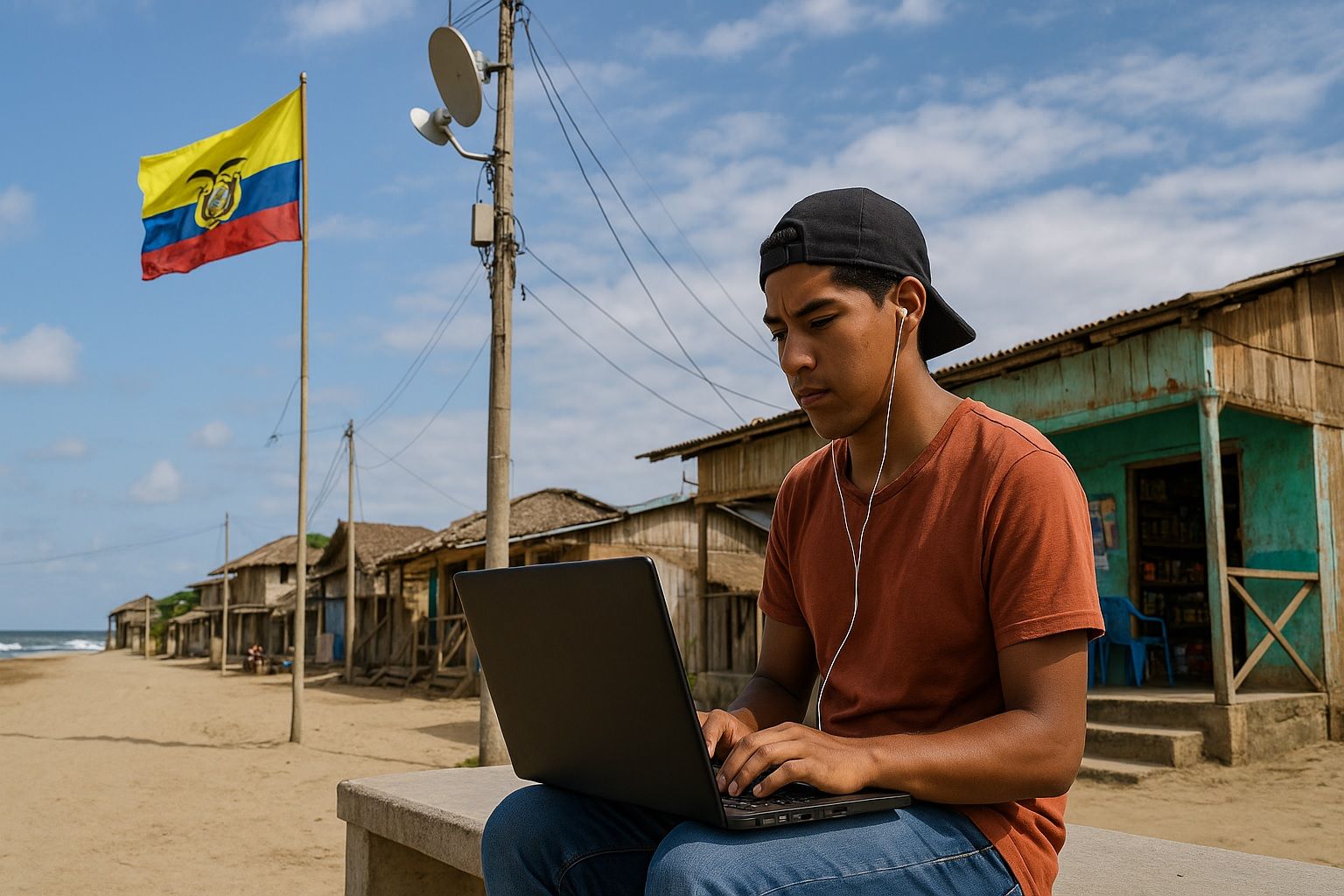
Ecuador’s internet infrastructure is a mix of fixed broadband networks, expanding mobile coverage, and a growing number of public Wi-Fi access points. Fixed broadband penetration remains relatively low – around 15% of the population had a fixed-line internet subscription as of late 2022 freedomhouse.org. This equated to roughly 2.75–2.9 million fixed broadband accounts in a country of 18 million people trade.gov statista.com. However, the country has been rapidly expanding its fiber-optic footprint: about 20,242 km of fiber-optic cable was laid in 2022 alone to improve broadband capacity trade.gov. Additionally, Ecuador recently boosted its international connectivity by activating the new Mistral undersea cable, in partnership with América Móvil and Telxius, to increase bandwidth. Further projects – including a dedicated Galápagos subsea cable and the Carnival Submarine Network linking Ecuador to the United States – are planned in the coming years trade.gov, which will strengthen the backbone of Ecuador’s internet infrastructure.
Connecting Colombia: Bridging the Digital Divide from Cities to the Amazon

Connecting Colombia: Bridging the Digital Divide from Cities to the Amazon

Colombia has seen rapid growth in internet access, reaching roughly three-quarters of the population online as of 2024 Datareportal. Mobile phones and home broadband have become common in urban areas, transforming how Colombians communicate, work, and learn. However, these gains also mask stark disparities – a deep digital divide separates well-connected cities from rural and remote regions. This report provides a comprehensive overview of internet access in Colombia, including penetration rates, urban vs. rural gaps, key service providers, typical speeds and pricing, the emergence of satellite internet, government initiatives, infrastructure challenges, and future trends. The tone is informative yet accessible, aiming to shed light on both progress and ongoing challenges in connecting all corners of Colombia to the digital world.
Austria’s Digital Autobahn: The State of Internet Access in 2025 (Including Satellite!)

Austria’s Digital Autobahn: The State of Internet Access in 2025 (Including Satellite!)

Austria’s internet infrastructure blends legacy copper lines with modern fiber optics, delivering broadband across the nation. Austria has made significant strides in digital connectivity, building a “digital Autobahn” of high-speed internet links across urban centers and alpine valleys. By 2025, Austrians enjoy internet access through a mix of technologies – from fiber-optic cables and upgraded DSL lines to cable broadband, widespread 4G/5G mobile networks, and even satellite services beaming internet from the sky. This report provides a comprehensive overview of Austria’s internet access landscape in 2025, covering the available access technologies, their coverage in urban and rural regions, key service providers and market share, typical performance, pricing models, government initiatives driving expansion, and emerging technologies like LEO satellite broadband. We also compare satellite internet to terrestrial options in terms of speed, reliability, latency, cost, and use cases. The goal is to paint a clear picture of how Austria is closing digital gaps and accelerating into the gigabit era on its path to nationwide connectivity.
State of Internet Access in Mexico: The Digital Divide, Ground and Sky

State of Internet Access in Mexico: The Digital Divide, Ground and Sky

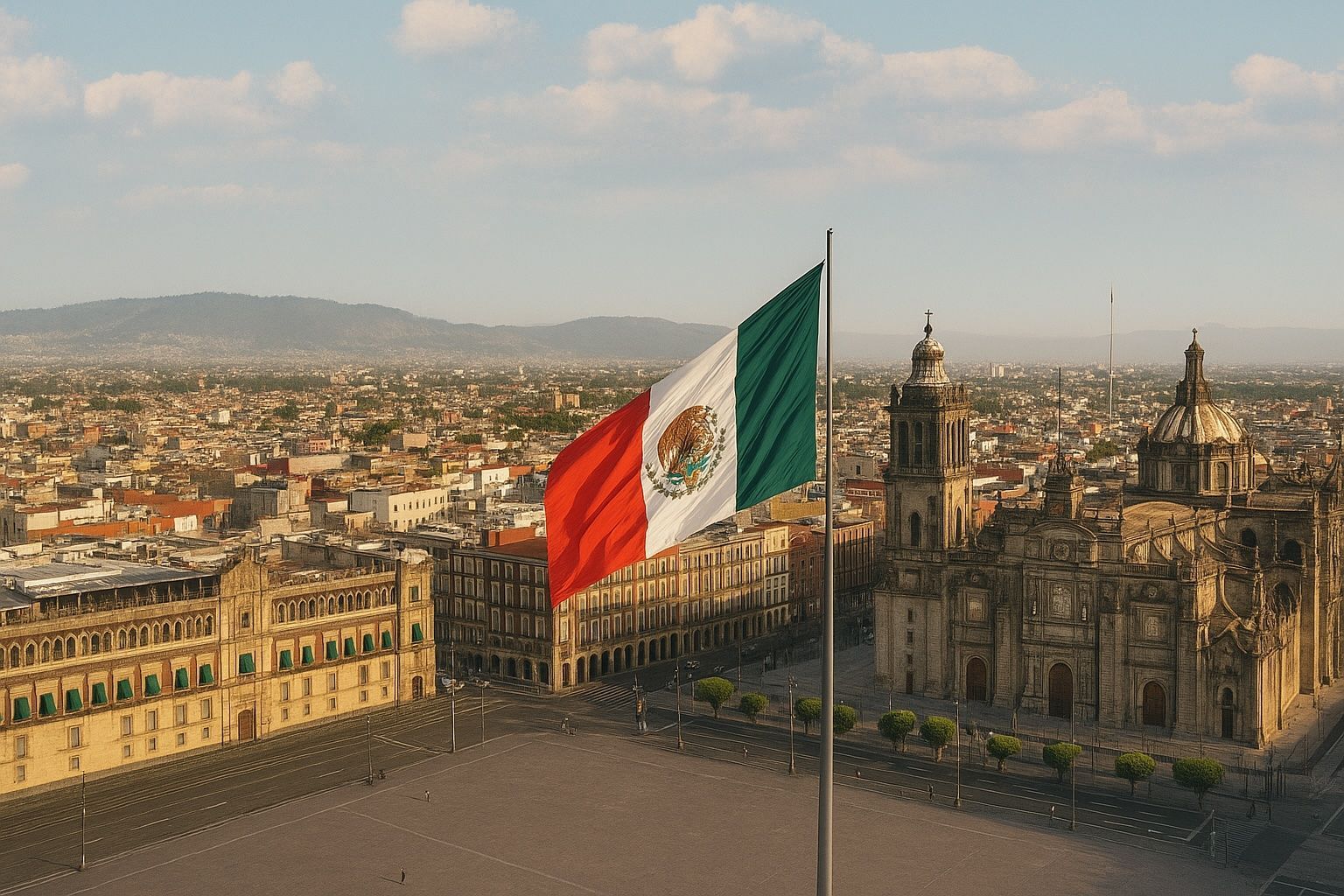
Introduction:Internet access in Mexico has expanded dramatically in recent years, reaching over 107 million users by early 2024 datareportal.com. The country has invested heavily in both ground-based infrastructure and emerging satellite services to connect its people. Yet a significant digital divide remains between well-served urban areas and underserved rural communities. This report provides a comprehensive overview of Mexico’s internet landscape as of 2025 – covering infrastructure developments, the urban–rural gap, key service providers, typical speeds and pricing, the rise of satellite internet, and the challenges and opportunities ahead. All data are the latest available, with sources including Mexico’s telecom regulator, government reports, and industry analyses.
29 May 2025
The Shocking Truth Behind Chile’s Internet Boom: 96% Connected (and Counting)

The Shocking Truth Behind Chile’s Internet Boom: 96% Connected (and Counting)

Introduction: Chile has experienced an internet access revolution over the past decade, becoming one of Latin America’s most connected countries. As of early 2024, an astonishing 96.5% of Chilean households have internet access – up from only about 70% in 2015 litoralpress.cl. This dramatic expansion has been fueled by nationwide infrastructure upgrades, aggressive broadband competition, and forward-looking government policies. Yet behind the headline figures are surprising details about urban–rural gaps, the technologies linking Chile’s remote corners, and the ongoing challenges of affordability and digital inclusion. The following report dives deep into the state of internet access in Chile, uncovering eight key insights – from coverage statistics and technology trends to provider market share, satellite internet growth, pricing, user experience, and government initiatives.
Brazil’s Digital Divide: The Real Story Behind Internet Access and the Race to Connect Everyone

Brazil’s Digital Divide: The Real Story Behind Internet Access and the Race to Connect Everyone

Internet connectivity in Brazil has grown tremendously over the past decade, transforming how Brazilians communicate, learn, and do business. Yet, beneath impressive national statistics lies a nuanced digital divide – gaps between rich and poor, urban and rural, and between well-connected regions and those still struggling for basic access. This report provides a comprehensive overview of internet access in Brazil, examining penetration rates, infrastructure developments, urban-rural disparities, key telecom players, government connectivity programs, affordability issues, and emerging trends. The goal is to unpack “the real story” behind Brazil’s connectivity landscape – highlighting both the achievements in closing the gap and the challenges that remain in the race to connect everyone.
29 May 2025
State of Internet Access in Argentina: Fiber, 5G, and Satellite in 2025

State of Internet Access in Argentina: Fiber, 5G, and Satellite in 2025

Introduction: Argentina stands among Latin America’s most connected countries, with over 40 million internet users and an individual internet penetration of about 88% as of early 2024 datareportal.com. The country’s telecom landscape is evolving rapidly: fiber-optic networks are expanding, 5G mobile services are rolling out, and new satellite options promise to reach remote areas. Yet significant disparities persist between urban and rural connectivity, and economic challenges influence both service deployment and affordability. This report provides a comprehensive overview of Argentina’s internet infrastructure and usage in 2025 – covering fixed broadband, mobile broadband, and satellite services – and examines penetration, speeds, major providers, government initiatives, the emerging role of satellite internet, regional comparisons, and the key challenges and opportunities in expanding access.
Go toTop