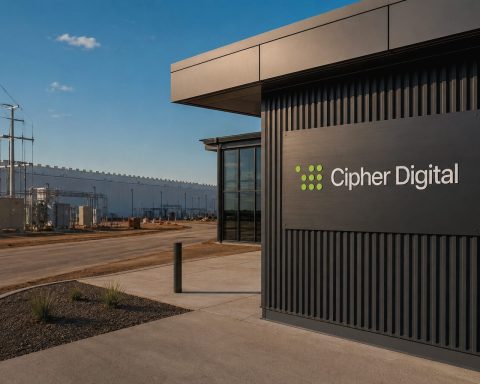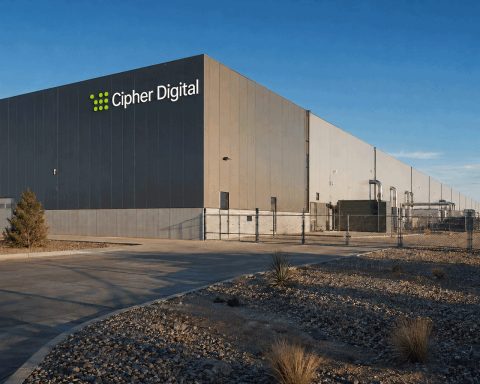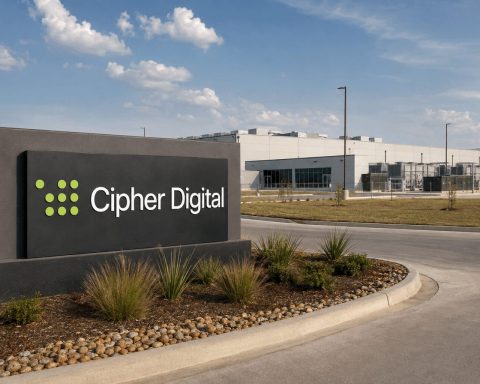

Cipher Mining Inc. (NASDAQ: CIFR) is having one of those “welcome back to crypto equities” days.
On Monday, December 15, 2025, Cipher Mining stock slid sharply—down roughly 13%—as investors repriced risk across bitcoin-linked names. CIFR traded around $14.8 after opening near $17, with the session’s low dipping into the mid-$14s on heavy volume.
The move matters not only because it’s big, but because Cipher is no longer just a bitcoin miner in the market’s imagination. Over the past few months, it has been rebranded (partly by its own dealmaking) into something stranger and more interesting: a bitcoin miner trying to evolve into an AI/HPC (high‑performance computing) data center landlord—with long-dated contracts, hyperscaler customers, and construction timelines that stretch well beyond the next crypto candle.
Below is what’s driving CIFR today, what the latest company updates say, and how Wall Street forecasts are shaping up as of 15.12.2025.
Why Cipher Mining stock is down today
The simplest explanation is usually the correct one: Bitcoin fell, and bitcoin miners fell harder.
Bitcoin dropped back into the mid‑$80,000s on Dec. 15, sliding below $87,000 in early-week trading as crypto weakness broadened.
That matters because miners are effectively leveraged plays on bitcoin (price, network difficulty, power costs, financing conditions, and investor risk appetite all pile onto the same trade). Even for a miner like Cipher that’s pitching an “AI infrastructure future,” the stock can still behave like a high-beta bitcoin proxy when crypto sentiment sours—especially on down days.
So, yes: today looks like a sector move as much as a company-specific headline.
The twist: Cipher is selling an “AI data center” story, not just a mining story
If Cipher were only a miner, today’s drawdown would be unpleasant but unsurprising. The reason CIFR is so widely watched into year-end 2025 is the company’s rapid shift toward HPC/AI colocation—and its string of headline-making contracts.
The AWS deal: a $5.5B, 15-year lease starting in 2026
In its Q3 2025 business update (Nov. 3, 2025), Cipher announced an approximately $5.5 billion, 15‑year lease with Amazon Web Services to deliver 300 MW of capacity in 2026 (with both air and liquid cooling), delivered in two phases starting July 2026, completing in Q4 2026, with rent commencing August 2026.
That timing is key for investors: the “AI landlord” revenue is meaningful, but much of it is not immediate. The market is trying to price a 2026–2027 cash-flow story into a 2025 trading vehicle that still whipsaws with bitcoin.
The Fluidstack + Google partnership expands
Cipher’s other major pillar is its relationship with Fluidstack (AI cloud) with Google providing significant credit support.
On Nov. 20, 2025, Cipher announced an additional 10-year HPC colocation agreement in which it will deliver an additional 39 MW of critical IT load, supported by up to 56 MW of additional gross capacity, at its Barber Lake site. The company said this expansion would bring Fluidstack to leasing the entire 300 MW Barber Lake site.
Cipher also said:
- The added agreement represents about $830 million of contracted revenue over the initial 10-year term (with extensions that could raise the total).
- Google will backstop an additional $333 million of Fluidstack’s lease obligations, increasing the total backstop to $1.73 billion (per Cipher).
And in an SEC filing tied to the amended agreements, Cipher disclosed details including Google warrants to purchase 24,178,576 shares at an exercise price of $0.01 per share (plus an adjusted “top-up” threshold). SEC
This is the heart of the bull case: long-duration, infrastructure-like revenue with big-name counterparties (or backstops) that look nothing like the typical miner’s quarterly-to-quarterly scramble.
Construction and delivery timelines: where execution risk lives
AI/colocation contracts don’t magically turn into cash because a PDF was signed. They turn into cash when the buildings are finished, powered, cooled, and operating.
From Cipher’s Nov. 20, 2025 SEC filing on the amended Fluidstack lease:
- Cipher expected to deliver Phase I of Barber Lake to Fluidstack by September 2026.
- Phase II (the additional 39 MW of critical IT load) was expected to be delivered by January 2027.
That gives investors a pretty crisp “prove it” schedule. The stock can re-rate upward if Cipher hits milestones—and it can re-rate downward fast if timelines slip or costs run hot.
Financing: building AI data centers is not cheap, and Cipher is using debt
Cipher has been building its HPC expansion with a mix of contracts and capital markets activity.
On Nov. 20, 2025, the company announced its subsidiary priced $333 million of additional 7.125% senior secured notes due 2030, intended to finance construction costs for additional facilities within the Barber Lake HPC data center. After the offering, Cipher disclosed $1.733 billion aggregate principal amount of 7.125% senior secured notes due 2030 outstanding.
This is not inherently “bad”—data center infrastructure is commonly financed—but it does raise the stakes:
- Execution matters more with leverage.
- Counterparty/backstop structures matter more.
- Interest-rate and refinancing conditions matter more.
What Cipher reported most recently: Q3 2025 results anchored in bitcoin mining
Even with all the AI headlines, Cipher’s most recent reported quarter (Q3 2025) still had a bitcoin-mining center of gravity:
- Cipher reported Q3 2025 revenue of $72 million and a net loss of $3 million (about $0.01 per share), alongside non-GAAP “Adjusted Earnings” figures in its company update. GlobeNewswire+1
- A Reuters/Refinitiv earnings summary reported revenue of $71.71 million for the quarter ended Sept. 30 and a reported EPS loss of $0.01.
That combination—bitcoin-driven quarterly financials + AI-driven long-term contracts—is exactly why CIFR can look like two stocks stapled together.
The “HPC takes over” forecasts: what analysts think the revenue mix could look like
A key analytical question for CIFR is when the AI/HPC segment becomes dominant.
A Visible Alpha / S&P Global Market Intelligence analysis (Nov. 18, 2025) described Cipher as positioning HPC as a core revenue engine starting in 2026, highlighting:
- The AWS lease to deliver 300 MW of HPC capacity in 2026 (rent beginning August 2026).
- A 10-year, 168MW AI hosting agreement with Fluidstack and Google (as described in that analysis).
- Forecasts suggesting HPC revenue could ramp materially from 2026 onward.
That same analysis cited consensus expectations that legacy mining could still show momentum in 2025, but that from 2026, HPC could become the primary growth driver.
The big takeaway for Dec. 15 readers: today’s selloff is about bitcoin, but the longer-term valuation debate is increasingly about data center execution.
Analyst ratings and price targets for CIFR stock on Dec. 15, 2025
Despite the volatility, published analyst sentiment across major aggregators remains broadly positive:
- On Dec. 15, 2025, MarketBeat reported Canaccord Genuity reiterated a Buy with a $27 price target, and summarized broader analyst sentiment as 13 Buys, 1 Hold, 1 Sell, with a consensus target around $24.73 (“Moderate Buy”). MarketBeat+1
- TradingView’s analyst-forecast aggregation listed an average target near $27.17, with estimates ranging widely (example min and max targets shown).
This range is not a typo—CIFR is a high-volatility equity. Price targets here are less like a GPS coordinate and more like a weather forecast in a coastal city: useful context, not destiny.
The bigger industry context: why miners are chasing AI
Cipher isn’t alone in pivoting from mining to AI/HPC. A broader narrative has been building across the sector: bitcoin miners repurposing powered sites and infrastructure for AI workloads.
A December 2025 Wired report described how multiple large U.S. bitcoin miners—including Cipher—have announced plans to pivot partly or wholly toward AI/HPC as mining economics tighten (competition, halving dynamics, and price swings).
That sector shift helps explain why CIFR can rally hard on AI contract headlines and still crater on a bitcoin drawdown: the market hasn’t fully decided what Cipher “is.”
What to watch next for Cipher Mining stock
Here are the catalysts that matter most after the Dec. 15 selloff:
Bitcoin direction (near-term): CIFR will likely remain highly sensitive to BTC moves while mining is still a major revenue source.
Barber Lake delivery milestones (execution risk): Phase I targeted delivery by September 2026 and Phase II by January 2027 are the kinds of dates that eventually become “make-or-break” reference points. SEC
AWS buildout timeline (re-rating moment): AWS capacity delivery beginning July 2026, finishing Q4 2026, with rent beginning August 2026 is when Cipher starts converting its biggest AI headline into recurring lease revenue.
Capital markets and dilution: Between secured notes and warrant structures tied to major counterparties, investors will track how Cipher funds buildouts and how that affects per-share economics.
Bottom line on Dec. 15, 2025: CIFR is volatile because it’s mid-metamorphosis
Cipher Mining stock dropping ~13% on Dec. 15 isn’t a mystery—it’s the miner trade reacting to a bitcoin pullback.
But what makes CIFR unusually consequential (and unusually twitchy) is that it’s trying to cross a tricky bridge:
- From: a bitcoin miner whose valuation is tethered to crypto cycles
- To: a data-center infrastructure business with long-term, contract-backed cash flows tied to AI demand
If Cipher executes its buildout timelines, the market may eventually price it less like a miner and more like digital infrastructure. If it stumbles, the stock risks snapping back toward “pure-play miner” valuation logic—especially on down-BTC days like today. SEC+3GlobeNewswire+3GlobeNewswire+3
Related articles: NASDAQ:CIFR