
NEW YORK, June 4, 2026, 08:03 EDT
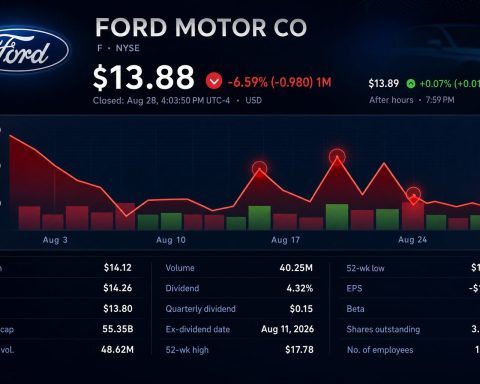
- Ford ended Wednesday down 2.7% at $15.71, but shares traded higher ahead of the open.
- U.S. sales dropped 13.6% in May. Ongoing recalls kept quality costs in the spotlight.
- Ford Energy has investor interest, but now the focus shifts to actual orders. Optimism alone isn’t enough at this stage.
Ford Motor shares tried to stabilize in early trade Thursday after sliding in the previous session. The move came as investors looked past a steep drop in May U.S. sales and recent recalls, focusing on Ford’s energy-storage business. Shares finished Wednesday at $15.71, down 2.7%. Pre-market quotes had the stock at $15.81, up 0.6%, according to MarketScreener.
Ford’s latest rally is coming more from hopes about its unused electric-vehicle battery capacity than its trucks. Investors are looking at the idea that Ford can use that extra capacity for a new power-storage business with higher growth. The normal NYSE session is 9:30 a.m. to 4:00 p.m. ET, and June 4 doesn’t appear on NYSE’s 2026 holiday schedule.
Ford’s May U.S. sales dropped 13.6% from a year ago, the company said, with 190,828 vehicles sold. Electric-vehicle sales plunged 43.9%. Hybrid sales dropped 15.7%, SUV sales fell 20.9%. Truck sales were down 8.4%. The auto business saw declines just about everywhere.
Ford’s sales miss followed another hit on quality, as Reuters said the company will recall 419,967 vehicles in the U.S. due to seat belts that might not work right and could boost crash injury risk. The recall affects some 2018-2022 Expedition and Lincoln Navigator models.
Ford is warning drivers not to drive about 4,600 Bronco Sport and Maverick models, the AP said, because of front lower control arm ball-joint issues that could cause drivers to lose control. The control arm is part of the suspension that keeps the wheel attached and aligned.
The main story for the stock is still Ford Energy. Reuters said last month that Ford’s energy arm made a five-year supply deal with EDF for as much as 20 gigawatt-hours of battery energy storage systems, or BESS. These are big battery packs that hold electricity for later. Reuters said data centers need more backup power as AI demand strains the U.S. grid.
Some analysts are paying attention. Morgan Stanley’s Andrew Percoco described Ford’s CATL tie-up as an “underappreciated strategic competitive advantage” in energy storage, Investing.com said. The Morgan Stanley team sees Ford Energy bringing in $500 million to $600 million in run-rate EBIT off 20 gigawatt-hours of capacity. Investing.com
Steve Man at Bloomberg Intelligence called the energy segment a “nice pivot to a higher margin business.” Matt Maley, Miller Tabak’s chief market strategist, pointed to the hyperscaler theme — meaning big cloud and data-center players — and said anything tied to those customers was drawing investor interest. The Economic Times
Investors still look at Tesla as the benchmark, using its energy-storage arm to set market value. Benzinga wrote that Ford Energy would mean direct competition with Tesla Energy in grid and home storage, but Ford hasn’t matched the same scale or orders so far.
Policy may shift again. Reuters said the Alliance for Automotive Innovation, a group with major automakers including General Motors and Toyota along with Ford, told the Environmental Protection Agency it supports delaying enforcement of vehicle pollution rules by two years. That move would cut compliance costs for now, but it leaves carmakers navigating changing regulations.
But there’s a clear risk. Delays in Ford Energy orders, shifts in tax-credit rules, or lingering recall and warranty expenses could push the stock down from its recent premium. Investors have priced in a business that’s still early and reliant on deliveries years away. Slower EV sales and weaker truck demand add to the pressure.
Ford is acting like a split stock these days—part traditional automaker facing sales and quality issues, part battery trade on rising power demand from AI data centers. Investors will have to pick a side in Thursday’s session.
Related articles: NYSE:F