
New York, June 1, 2026, 18:04 EDT
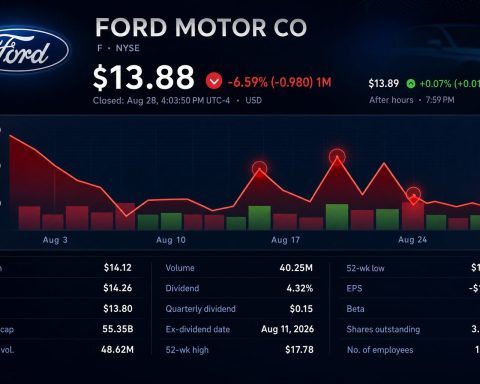
Ford Motor stock dropped 4.6% on Monday, putting an end to its eight-day run and backing off the 52-week high reached last week. Shares finished at $16.63, which is 6.5% under the May 29 high of $17.78. Trading volume was much higher than the 50-day average, while the broader market gained.
Ford’s stock has been on a run, but lately it isn’t trucks driving the move. Investors are focused on Ford Energy. The battery-storage arm drew attention after landing a five-year supply deal with EDF for up to 20 gigawatt-hours of storage. Now the market is working out what Ford Energy is worth.
The business is on the fringes of the AI trade. Battery energy storage systems, or BESS, are big battery units that hold electricity for later. BESS is in focus as data centers and utilities want backup power and extra grid help.
Ford lagged behind while Wall Street moved higher. The S&P 500 climbed 0.26% to 7,599.96. The Nasdaq was up 0.42% to 27,086.81. The Dow rose 0.09% to 51,078.88, with tech stocks and optimism over U.S.-Iran peace talks providing support.
Losses hit across the sector. General Motors dropped to $82.68. Tesla lost ground too, closing at $415.88. Ford’s slide matched the pulls seen in some auto names, though its fall was sharper than GM’s.
Ford Energy and EDF have signed a deal that lets EDF use up to 4 GWh per year of Ford’s DC Block storage systems. Deliveries are set to start in 2028. Ford Energy president Lisa Drake called the agreement proof of demand for suppliers with scale and full lifecycle responsibility.
Ford drew more interest in the market after Morgan Stanley’s Andrew Percoco said there was a “fairly high likelihood” the company lands an energy-storage deal with commercial customers or big cloud firms in the coming months. Bloomberg Intelligence’s Steve Man called the move a “nice pivot to a higher margin business.” Matt Maley of Miller Tabak said that plays linked to hyperscalers keep pulling in investors. The Economic Times
Ford plans to put $2 billion into its energy-storage arm and wants first customer deliveries by late 2027, with at least 20 GWh a year in deployments, Reuters reported. Morgan Stanley analysts noted Ford’s deal to license CATL battery tech as another positive.
Ford puts up another traditional earnings update behind its new-energy messaging. First-quarter revenue came in at $43.3 billion, with net income at $2.5 billion and adjusted EBIT — or operating profit — at $3.5 billion. The automaker bumped its full-year adjusted EBIT outlook to between $8.5 billion and $10.5 billion. CEO Jim Farley said the numbers reflect progress in Ford’s larger turnaround effort.
Ford’s energy-storage pitch may be outpacing its actual sales and earnings. The company is still projecting Model e electric-vehicle losses between $4.0 billion and $4.5 billion. It’s also warning on commodity and tariff costs, and its outlook does not include any possible fallout from a long Middle East conflict or a sharp U.S. slowdown.
Monday’s drop still looks more like a check on the re-rating than anything tied directly to changes in Ford’s reported numbers. Now attention turns to whether Ford can turn its AI story into real contracts and steady cash before the stock gets seen as just another cyclical automaker again.
Related articles: NYSE:F