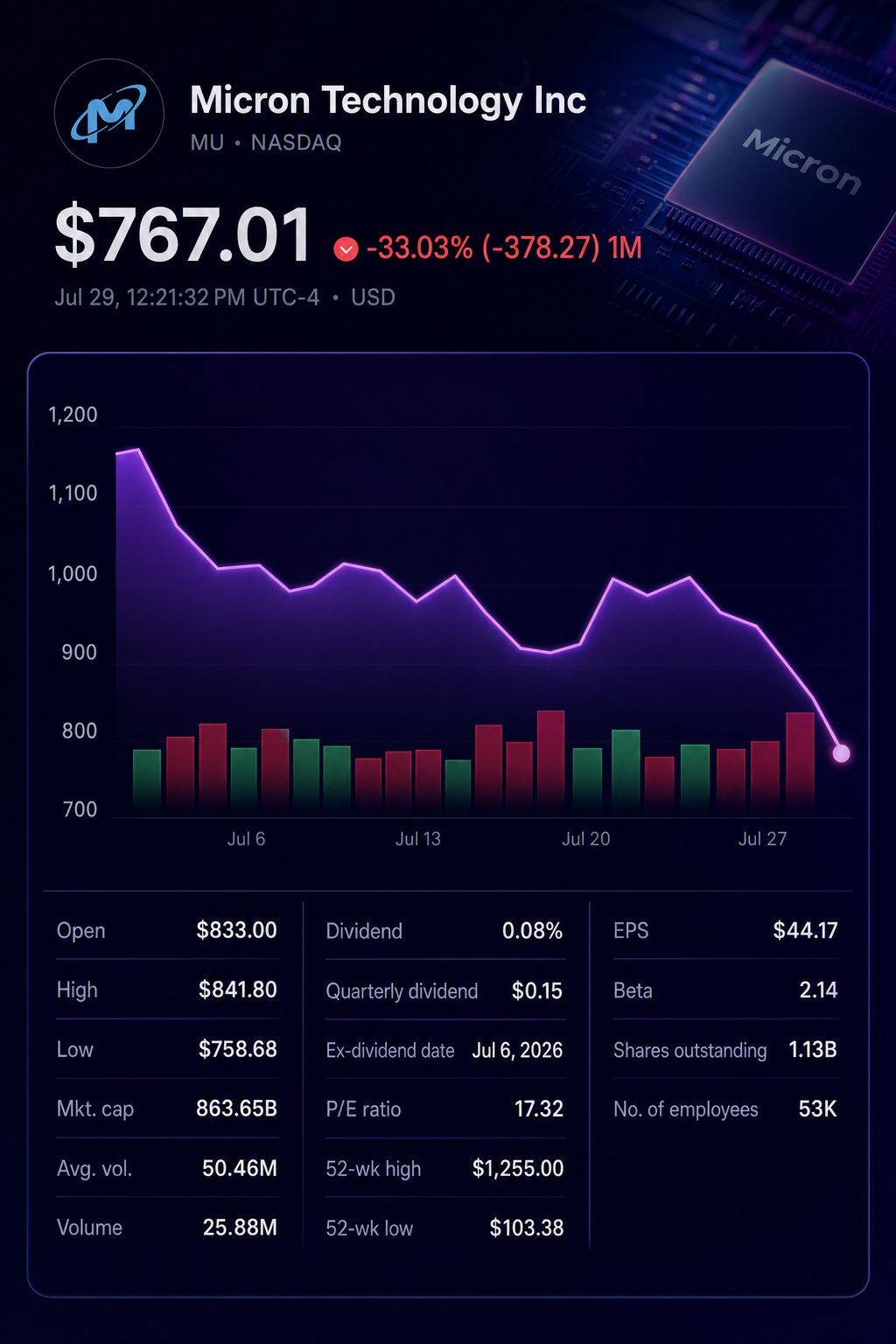
NEW YORK, July 29, 2026, 12:02 EDT — U.S. markets trade lower after open
By 11:45 a.m. EDT, Micron was down 5.4% at $776.13.
Fiscal fourth-quarter projections expect revenue of $50 billion and a gross margin of 86%.
Initial estimate: the price is roughly 6.7 times the annualized and 13-week-adjusted non-GAAP earnings for the fourth quarter.
Micron Technology declined 5.4% on Wednesday, pushing its losing streak over three sessions to roughly 15.8%. The stock slid 8.9% on Tuesday, following a 2.3% dip on Monday.
The drop runs counter to Micron’s near-term earnings outlook. The company projects fiscal fourth-quarter revenue to be 20.6% higher than the third quarter, while guidance for gross margin also lifts to approximately 86%.
This puts durability at the heart of investor concerns. Present demand is not the issue. The market is factoring in uncertainty over the longevity of peak pricing.
Measure
Fiscal Q3 actual
Fiscal Q4 guide or market level
Change or signal
Revenue
$41.46 billion
$50.0 billion midpoint
Up 20.6%
GAAP gross margin
84.6%
About 86%
Increase of 1.4 percentage points
Non-GAAP EPS
$25.11
$31.00 midpoint
Rises 23.5%
Share-price move
—
$776.13
Approximately -15.8% across three sessions
Indicative run-rate P/E
—
About 6.7 times
Early, 13-week basis
Micron’s disclosed figures are sourced from its official release and filings with regulators. The market computation is based on the intraday share price and the midpoint of guidance. Micron’s fourth quarter spans 14 weeks instead of the standard 13.
The 6.7-times number is not a consensus multiple. It adjusts the $31 earnings guidance to a 13-week period, and then annualizes that result. This is a stress test rather than a projection.
Peak-cycle risk appears within the third-quarter results. DRAM average selling prices climbed in the low-260% range, while NAND prices advanced in the mid-310% range. The surge was led by pricing rather than volume.
Chief Executive Sanjay Mehrotra believes contracts can help ease the impact of that cycle. He stated that multi-year deals should “significantly enhance the durability and predictability” of Micron’s results. SEC
China introduced new bearish sentiment. Shares of CXMT Corp SHA:688825 jumped 466% during its first day of trading in Shanghai on Monday, following an $8.6 billion fundraising. In 2025, the company held an estimated 7.7% share of the global DRAM market.
The risk varies within different segments of memory. Cameron Systermans of Mercer Investments described CXMT as an emerging rival in commodity DRAM. However, he noted that the company is still “years behind” in the area of high-bandwidth memory, or HBM. Reuters
SK Hynix KRX:000660 issued a fresh caution, posting all-time high quarterly revenue and a 76% operating margin. However, its stock dropped 9.6% as the results failed to meet high market expectations.
U.S. storage stocks continued to face selling. SanDisk NASDAQ:SNDK dropped 7.2% on Wednesday. Western Digital NASDAQ:WDC eased 0.2%, following a 6.9% decrease recorded on Tuesday.
Bullish reports released Wednesday portray the drop as a buying chance. One analyst raised Micron’s rating, while another projected a $2,000 stock price by 2030. Both outlooks are based on ongoing shortages and a successful HBM4E production scale-up.
Initial estimates show fiscal 2026 revenue at approximately $128.96 billion based on nine months of actual results and the midpoint for Q4. To triple this by fiscal 2030, revenue would need to hit close to $386.88 billion, implying about 31.6% yearly growth over four years.
That challenge accounts for the divided view on the stock. Micron appears inexpensive based on present earnings. The valuation looks higher if margins return to typical levels before demand matches capacity.
Risks: Commodity DRAM prices may come under pressure from expanding Chinese production prior to a slowdown in HBM demand. A reduction in spending or a potential HBM4E delay would undermine the bullish outlook. Conversely, extended shortages and longer contract terms could sustain all-time high margins.
Currently, the selloff reflects skepticism towards duration, rather than concerns over the fourth quarter. Investors require evidence that contracts will maintain pricing as fresh supply comes to market.
What is the current trading level of Micron shares, and how does their performance stack up against the broader market?
As of 11:50 a.m. Eastern, the most recent confirmed trade stood at $777.84, showing a 5.2% decline. Micron started the session at $833.64 before dropping to an intraday low of $774.77. The high for the day reached $841.76, resulting in a high-to-low range of nearly 8.6%. Technology stocks dropped 2.9%, with the S&P 500 shedding about 0.9%. Micron notably lagged behind both indexes.
What is causing Micron shares to decline even after strong earnings results?
Chip stocks are falling worldwide, hit hard by a drop in memory and AI-chip names. SK Hynix reported its best-ever results, yet fell short of investors' optimistic expectations. The launch of CXMT in China revived concerns around increasing DRAM rivalry and supply. Micron shares had already slid over 29% in July through Tuesday. The decline today appears driven by sentiment, though longer-term competitive pressures persist.
How did Micron perform in its most recent quarter?
Revenue for the fiscal third quarter climbed to $41.46 billion, up 74% from the prior quarter. Compared to the same period last year, revenue surged 346%. Non-GAAP earnings were $25.11 per share, with a gross margin of 84.9%. Adjusted free cash flow was $18.3 billion, following $7.1 billion in capital expenditures. The results stand out, even by memory-cycle peak standards.
What are Micron’s projections for the fiscal fourth quarter?
Management forecasts fiscal fourth-quarter revenue of $50 billion, with a margin of error of $1 billion. The company projects a gross margin of approximately 86%, up from 84.9% in the prior quarter. Guidance for non-GAAP earnings is set at $31.00 per share, plus or minus $1.00. This midpoint would mark another quarterly record. However, Micron’s forecast does not account for any impacts from potential trade or geopolitical issues.
Does demand for AI and HBM continue to underpin the investment rationale for Micron?
Data-center revenue surpassed $25 billion last quarter, putting the annual run rate over $100 billion. Micron reported HBM4 revenue shipments above $1 billion. The company’s HBM4 12-high ramp is advancing at double the pace of HBM3E. Management anticipates DRAM and NAND supply constraints to persist past calendar 2027. This outlook underpins pricing, though a significant slowdown in AI spending could alter the scenario.
Do Micron's strategic customer deals help lessen memory-cycle risk?
Micron has entered into 16 multi-year deals spanning data-center, consumer, and automotive clients. These contracts account for close to 20% of DRAM output and around one-third of NAND output. Approximately $100 billion in minimum contracted revenue is covered by 14 of these agreements. Associated deposits and financial obligations are about $22 billion. The contracts employ take-or-pay frameworks, frequently incorporating price floors and caps. While they offer better visibility, they do not remove pricing or execution risk.
What level of risk do Chinese memory manufacturers pose?
CXMT is currently China's fourth-largest memory maker and is significantly ramping up its capacity. Reuters notes the company still lags far behind top competitors in advanced HBM technology. Its increasing presence in DRAM could place downward pressure on standard memory pricing in the future. Micron is also exposed to risks from evolving export regulations and customer eligibility. The challenge appears to be a long-term issue, not an indication that present HBM demand is weakening.
Does Micron trade at a discount following the recent decline?
Micron's trailing price-to-earnings ratio was about 17.6 times near $778. FactSet's consensus estimate for fiscal 2027 earnings was $154.67 per share. This would indicate a forward multiple of around five, provided projections remain intact. Memory industry earnings are highly cyclical, and top-line estimates can decline rapidly. Valuations appear low only if robust pricing endures.
What are the short-term and one-year projections for Micron stock?
I expect considerable volatility next week, with trading mainly between $750 and $850. If the price rebounds above $842, it could challenge $900, which was the closing area on Monday. A daily close under $750 would increase the likelihood of a drop toward $700 under my bearish outlook. FactSet’s median 12-month target stands at $1,600, with projections spanning from $361 to $2,200. The median suggests potential gains of about 106% over the last verified price. However, the wide range means any target is subject to uncertainty.
Mateusz Kaczmarek is a financial and technology journalist at TS2.tech. His coverage ranges from stocks and artificial intelligence to semiconductors and developments across global markets. He graduated from the Poznań University of Economics and Business and worked in financial analysis before becoming a business journalist. Follow Mateusz Kaczmarek on Google News.