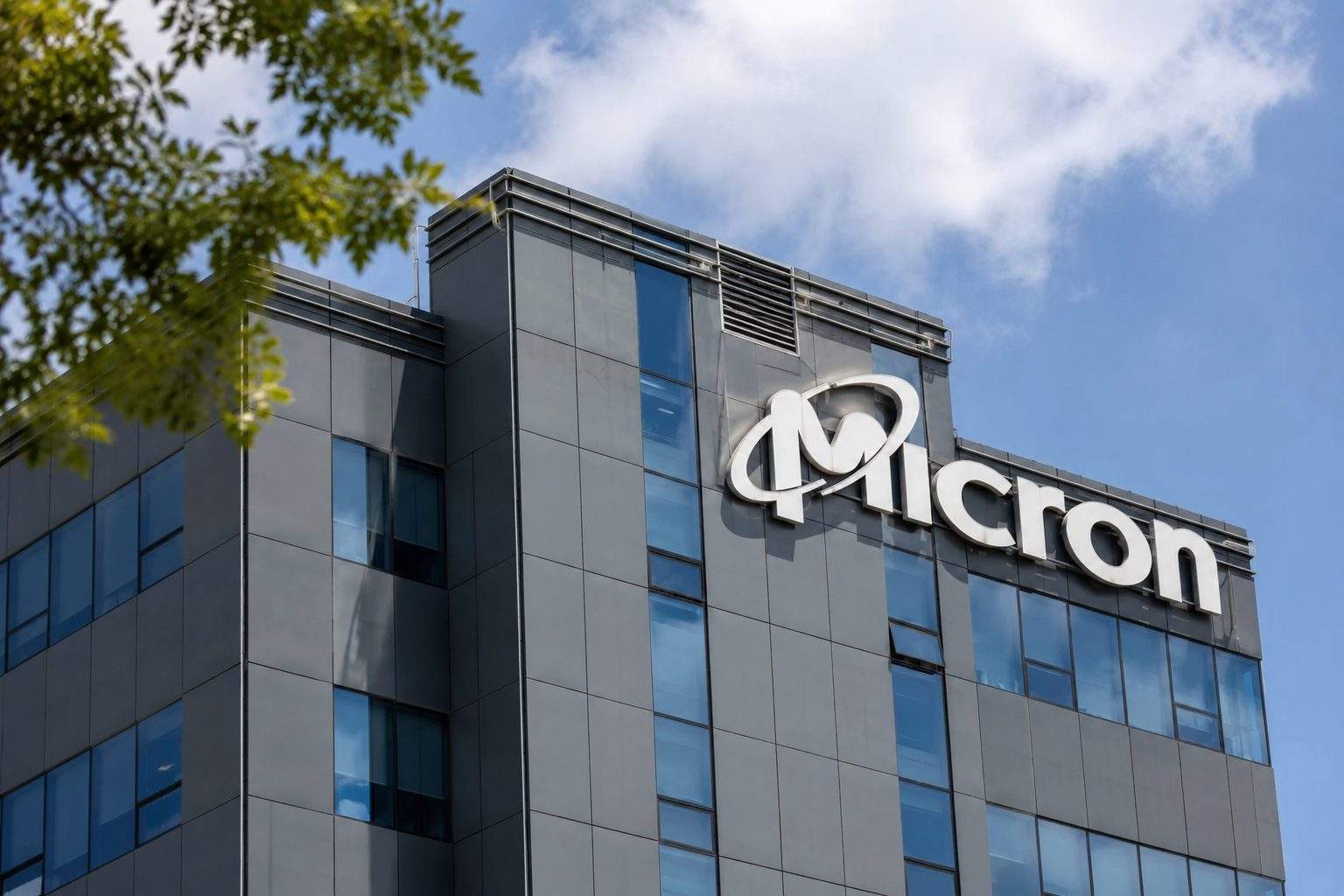

New York, July 12, 2026, 16:05 (EDT)
With U.S. markets shut for the weekend, Micron Technology, Inc. NASDAQ:MU ended Friday at $979.30, just 0.4% above its previous weekly close. That calm finish hid a rough five sessions: the shares traded from $891.66 on Tuesday to $1,035.50 on Thursday, a low-to-high swing of 16.1%.
The gap with the wider chip market matters. The PHLX Semiconductor Sector Index gained 2.7% over the week, leaving Micron behind by about 2.3 percentage points, even though Micron’s trading range was half again as wide as the index’s. That points to a stock-specific argument over valuation and future spending, not simply a change in appetite for semiconductors.
| July 6-10 market comparison | Micron | PHLX Semiconductor Index |
|---|---|---|
| Previous close, July 2 | $975.56 | 12,626.22 |
| Friday close | $979.30 | 12,967.16 |
| Weekly change | +0.4% | +2.7% |
| Week’s low-to-high span | 16.1% | 10.8% |
Micron said on Thursday it had raised planned U.S. fabrication-plant and technology spending to more than $250 billion through 2035, from $200 billion. It aims eventually to make 40% of its dynamic random-access memory, or DRAM — the working memory used in servers and other devices — in the United States. Construction at its Clay, New York, site reached its first concrete pour more than a quarter ahead of schedule. Chief Executive Sanjay Mehrotra said “data and memory are foundational to the modern economy.” Micron Technology
For shareholders, however, the smaller number may be more useful: up to $3 billion for the domestic supply chain. That includes $500 million of financing for GlobalWafers Co., Ltd. (TPEX:6488) and a 10-year agreement securing raw silicon wafers. Micron reported $18.3 billion of adjusted free cash flow — cash left after operations and capital spending — and $30.2 billion of cash, marketable investments and restricted cash in its latest quarter.
| Announced commitment | Amount | Share of Q3 adjusted free cash flow | Share of reported cash and investments |
|---|---|---|---|
| GlobalWafers financing | $0.5 billion | 2.7% | 1.7% |
| Supply-chain programme ceiling | $3.0 billion | 16.4% | 9.9% |
The ratios compare scale only. The commitments are not necessarily payable in one quarter.
That arithmetic makes the supply-chain programme look more like input insurance than an immediate funding problem. Micron climbed 4.5% on Thursday as the semiconductor index rose 3.1%, but the stock surrendered 1.2% on Friday. Investors appeared willing to reward tighter control over supplies without granting a lasting valuation increase for spending that may be needed to defend production and market share.
SK hynix Inc. KRX:000660 sharpened that valuation question with its Nasdaq debut on Friday. Its American depositary receipts — U.S.-traded certificates representing foreign shares — finished about 13% above their offer price. LSEG data cited by Reuters valued SK hynix at about 5.8 times expected earnings, against roughly seven times for Micron, leaving Micron at a 21% premium. “Demand for the US share sale has been stronger than some people might have expected,” said Dan Coatsworth, head of markets at AJ Bell. Reuters
The cheaper rival is also the world’s largest producer of high-bandwidth memory, or HBM, stacked high-speed memory used alongside AI processors. SK hynix CEO Kwak Noh-jung expects the industry’s worst supply shortage in 2027 and demand to remain above the company’s capacity beyond 2030. “Our customer demand continues to go up, while our capacity has limitations,” he told Reuters. That supports Micron’s scarcity case, but it also explains why both companies are pressing ahead with large capacity plans. Reuters
Friday’s retreat did not come with heavy turnover. About 31.8 million Micron shares changed hands, roughly 38% below the stock’s 65-day average of 50.9 million. The lighter volume does not establish a floor, but it makes the decline less conclusive and leaves last week’s broad range unresolved.
But the downside case is plain. Should AI investment slow while Micron and its rivals add capacity, memory prices and cash generation could weaken before the new U.S. plants earn adequate returns. Micron’s latest quarterly filing says capital projects may fail to produce expected cash flows and warns that government incentives can be reduced, terminated or clawed back when spending, employment or construction conditions are missed.
Micron’s investor page lists no upcoming company event, shifting attention to external tests. The U.S. consumer-price report is due Tuesday, July 14, at 8:30 a.m. EDT, followed by producer prices on Wednesday; Taiwan Semiconductor Manufacturing Co. TPE:2330 reports second-quarter results at 2 a.m. EDT on Thursday. Inflation could reset bond yields and technology valuations, while TSMC’s comments on AI orders and capital spending will offer another check on the demand assumptions beneath Micron’s $891.66-to-$1,035.50 weekly range.
Related articles: NASDAQ:MU