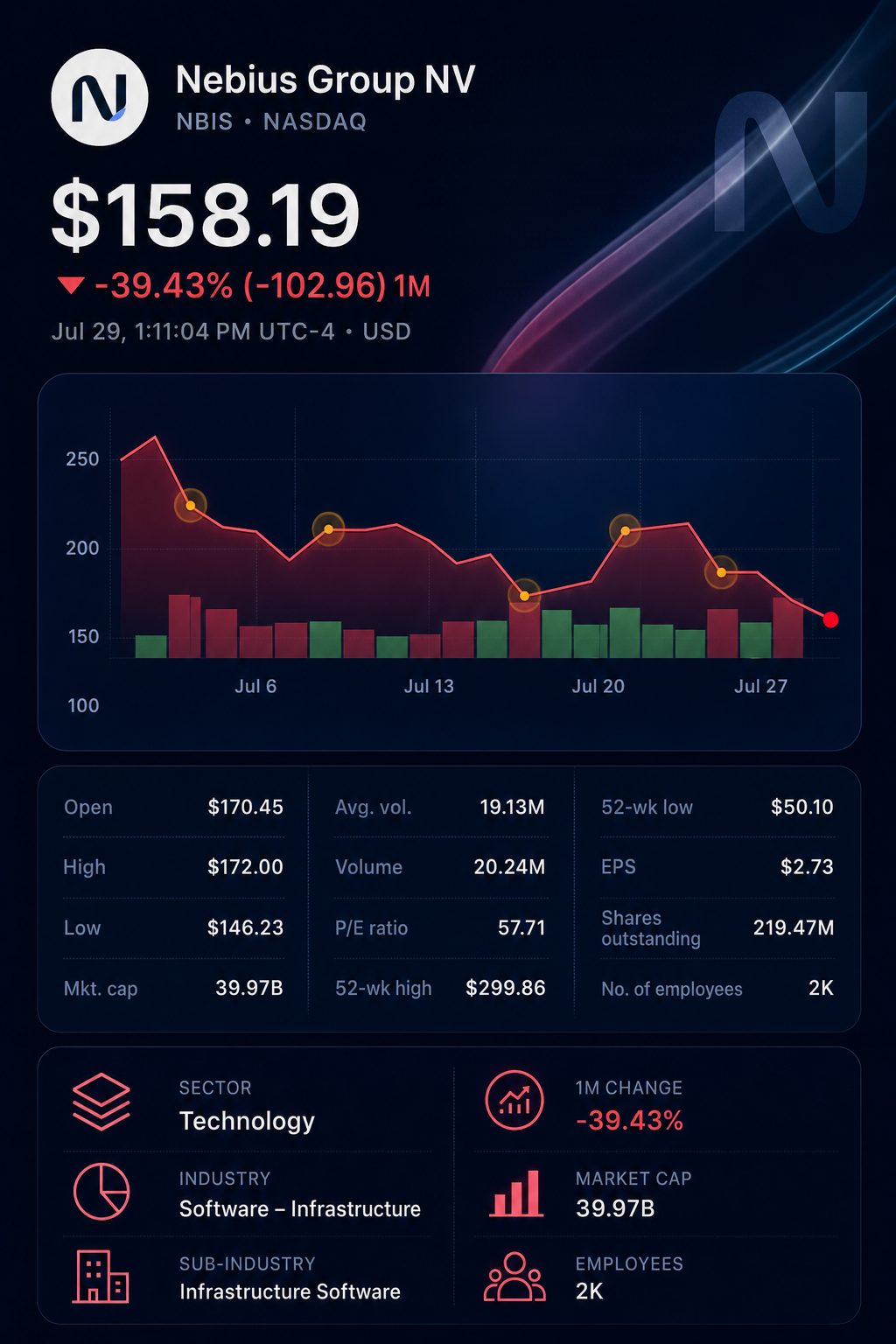
NEW YORK, July 29, 2026, 12:58 p.m. EDT – Nebius NASDAQ:NBIS stock slid 10% as the company’s asset-light approach came under pressure from funding requirements, prompting investor caution.
Nebius stock dropped 9.9% to $152.97 by midday Wednesday, according to delayed data. U.S. markets stayed open. The company previously scheduled its second-quarter results for August 12.
The decline extended across multiple stocks. CoreWeave NASDAQ:CRWV slipped 8.5%, IREN NASDAQ:IREN decreased 10.6%, and Nvidia NASDAQ:NVDA was off 2.8%. At 11:39 a.m. EDT, the Nasdaq was lower by 1.1%.
The market is focusing on a single issue. Can Nebius transfer a sufficient portion of its expansion expenses away from its balance sheet? Its cash expenditures far exceed existing revenue, even with robust client support.
Revenue for the first quarter totaled $399 million. The company spent $2.47 billion on property, equipment, and intangible assets, a figure 6.2 times higher than revenue, according to filings. Interest expense amounted to 16% of sales.
Customer cash eased that pressure. Advances from customer agreements reached $3.20 billion, amounting to 129% of cash capital expenditure in total. These advances resulted in positive operating cash flow of $2.26 billion.
The first-quarter results have not been audited. The ratios listed below are derived from company reports.
Nebius funding measure
Q1 2026
Investor comparison
Revenue
$399 million
Baseline
Cash capital spending
$2.473 billion
Represents 6.2 times revenue
Customer advances
$3.198 billion
Equal to 129% of cash capital spending
Interest expense
$63.7 million
Accounts for 16.0% of revenue
Expenditures on property, equipment, and intangible assets.
The arrangement provides a time buffer, but not extra funds. As of March 31, deferred revenue totaled $4.78 billion. Outstanding performance commitments amounted to $33.59 billion. Nebius projected that 29% would be recognized as revenue within the next 24 months.
Nebius reported $9.30 billion in cash as of March 31. Principal from convertible notes totaled $10.04 billion. The amount heightens the importance of execution and refinancing.
Nvidia remains a key backer. The company’s July disclosure indicated a 9.3% beneficial interest, largely via a warrant. As of Wednesday’s postponed trade, Nebius was 61% higher compared to the $94.94 price seen in March.
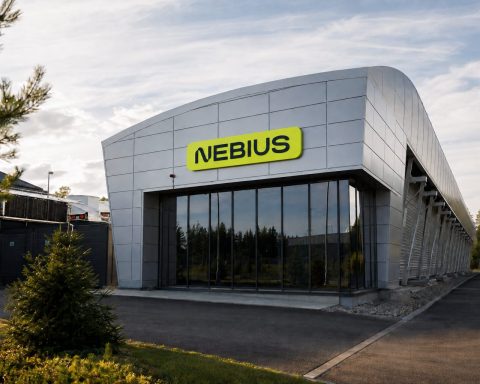
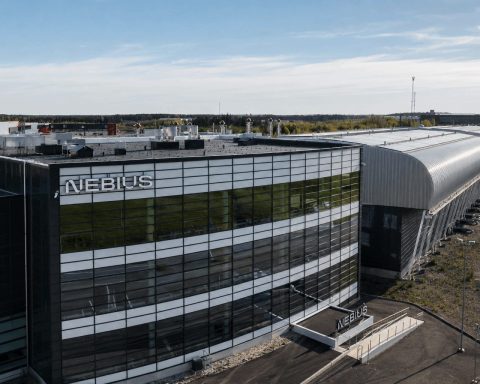
The company’s approach is to pursue an asset-light expansion strategy. Partners provide the funding, ownership, and operation of the data centers and hardware, while Nebius delivers the architecture, software, and customer base.
Chief Executive Arkady Volozh stated that partners have the potential to access “a much wider customer base with much better margins.” The first deals feature revenue sharing, licensing fees, as well as committed-capacity arrangements. Nebius
Nebius arranged a $775 million facility secured by graphics processors and future contracted cash flows. The facility carries an interest rate 2.5 percentage points over SOFR, which is a key short-term funding rate in the United States. According to Nebius, the loan combined with customer cash flows fully covers the capital costs for that deployment.
A release on July 17 referenced over $40 billion in contracted revenue from investment-grade clients, such as Microsoft NASDAQ:MSFT and Meta Platforms NASDAQ:META. This amount should not be simply combined with March commitments, as the timing and criteria are not the same.
Credit conditions have deteriorated. According to Reuters, major technology firms sold $194 billion in bonds by July 7, a figure 79% higher than the total issued throughout 2025.
Colby Stilson, who leads fixed income at Brown Advisory, stated, “We’re already seeing fatigue within credit markets in supporting this massive debt issuance.” This year, the yields on most similar hyperscaler bonds have been higher. Reuters
August 12 marks the initial key test. Investors are expected to monitor metrics including capital expenditure, customer prepayments, secured loans, and asset-light income. Guidance on margins could prove more significant than any new contract announcement.
Risks: There is a possibility that partners might not fund or manage sites in line with Nebius expectations. Challenges such as customer attrition, competitive pricing, and more restrictive capital availability may put pressure on returns. Additionally, convertible notes pose a risk of dilution.
The benchmark is straightforward. Nebius needs growth driven by software to surpass its requirements for hardware funding. Until this happens, valuation will stay heavily linked to credit conditions.
At about 12:50 p.m. Eastern, NBIS changed hands at approximately $155.14, down 8.6%. The stock traded between $146.38 and $175.78 on 19.7 million shares. CoreWeave slipped 7.8%, while Nvidia declined 2.7% in the same session. The moves pointed to wider selling pressure on those leveraged to AI infrastructure. Reuters said the cost of credit insurance was increasing for firms funding extensive AI expansion. Nebius's official statement earlier today only set August 12 for its results announcement. The specific cause remains undetermined.
Did Nvidia’s disclosed 9.3% ownership represent a fresh $2 billion stake?
Mostly not. Nvidia’s filing showed it holds 22.26 million Nebius shares on a beneficial basis. Of those, about 21.07 million are connected to a pre-funded warrant from March. Nvidia’s previous filing had listed another 1.19 million ordinary shares. The July disclosure was intended to clarify Nvidia’s holdings, not to indicate another $2 billion investment. Nvidia is restricted from exercising or selling the warrant shares until September 11.
What key points should investors look for in the August 12 earnings release?
Nebius will release results prior to the market opening, followed by a conference call at 8 a.m. Eastern. Key metrics include AI-cloud revenue, ARR, margins, capex, and connected power. AI-cloud revenue for the first quarter was $389.7 million, with ARR reported at $1.92 billion. Management maintains guidance for revenue between $3.0–$3.4 billion and ARR of $7–$9 billion. The company is also aiming for an adjusted EBITDA margin of about 40% from AI-cloud. Any adjustment to guidance could have a greater impact than quarterly figures.
Is Nebius still on track to achieve its 2026 revenue and ARR goals?
The AI-cloud revenue achieved in the first quarter leaves $2.61–$3.01 billion to be earned in the quarters ahead, implying that the average revenue per quarter must be between $870 million and $1.00 billion. Management has indicated a substantial capacity boost is expected in the third quarter. AI-cloud revenue for December would need to total approximately $583–$750 million for the month. Using Nebius’s ARR definition, March’s monthly revenue run-rate was around $160 million. Consequently, monthly revenue must grow by approximately 3.6–4.7 times. Achievable, but challenging.
What was the underlying strength of first-quarter results aside from stated net income?
Group revenue surged by 684% to $399.0 million. Income from AI-cloud climbed 841% to $389.7 million. Group adjusted EBITDA totaled $129.5 million. AI-cloud adjusted EBITDA reached $174.0 million, delivering a margin of 45%. Net income reported featured a $780.6 million gain from ClickHouse revaluation. Adjusted net loss stood at $100.3 million, and depreciation totaled $212.0 million. Operations saw substantial improvement, though headline profit overstated the underlying recurring performance.
Is Nebius able to cover $20–$25 billion in capital expenditures planned for 2026?
While funding options look viable, a fully secured financing bridge is still not assured. In March, Nebius reported $9.30 billion in cash and about $8.45 billion in debt. Capital expenditure for the first quarter totaled nearly $2.5 billion. Operating cash flow was $2.26 billion, supported by $3.20 billion in customer advances. The $775 million secured loan arranged in July is priced at SOFR plus 2.50%. The company’s shift to an asset-light approach could see some infrastructure moved to partners. The 25-million-share ATM facility remained untouched at end-March, suggesting additional capital raising is still on the table.
What is the level of security for the contracts with Microsoft and Meta?
Microsoft’s main agreement is valued at roughly $17.4 billion until 2031, with the potential for the amount to reach around $19.4 billion if extra services are added. Meta has pledged $12 billion over a five-year term, with initial deployments planned for early 2027. An additional $15 billion applies to designated Nebius capacity in other first-entry markets. These deals offer clear demand outlook and facilitate asset-backed financing. Nevertheless, if deliveries are delayed, fees may be reduced or capacity could be canceled. While these contracts are significant, they do not guarantee risk-free revenue.
Is NBIS costly at its current price level?
With 253.9 million shares from March, the estimated basic equity value stands at around $39.4 billion. On the basis of 2026 projections, that translates to approximately 11.6–13.1 times sales. Such a valuation is high for infrastructure that relies heavily on capital and ongoing outside funding. The estimate does not include Nvidia’s 21.1 million pre-funded warrant shares, nor does it factor in potential dilution from $4.34 billion in convertible-note proceeds. Investors must commit funds now in expectation of a multi-year stretch of swift, effective delivery.
What is a practical forecast for the NBIS share price?
I see a base range between $140 and $180 for the August 12 earnings date. By the end of 2026, my main scenario falls within $165 to $220, assuming guidance and revenue in the $3.0–$3.4 billion bracket and steady margins. If the company delivers a strong earnings beat, maintains margins, and secures financing, shares could rise above $250. If guidance is lowered or there is a significant delay in deliveries, the price could drop to the $110–$130 range. Analyst price targets are widely spread from $120 to $410, with a mean of $258, reflecting high uncertainty around execution.
Shan Ahmed Khan is a senior markets reporter at TS2.tech. His coverage ranges from stocks and technology to economic developments across global markets. He worked in investment research and market analysis before becoming a financial journalist and is a graduate of the Lahore University of Management Sciences (LUMS).
Surprising starts and permits data can impact homebuilders, mortgage-sensitive stocks, Treasury yields, and the dollar if results deviate significantly from consensus estimates.
#02
Home Depot Q2
The results and outlook provide key insights into housing turnover, renovation demand, professional customer activity, and U.S. discretionary spending.
#03
09:15 ET industrial production
A robust or disappointing factory or utilities report can shift expectations for economic growth, cyclical stocks, bond yields, and the Federal Reserve’s policy direction.