
HELSINKI, August 5, 2026, 12:06 EEST —
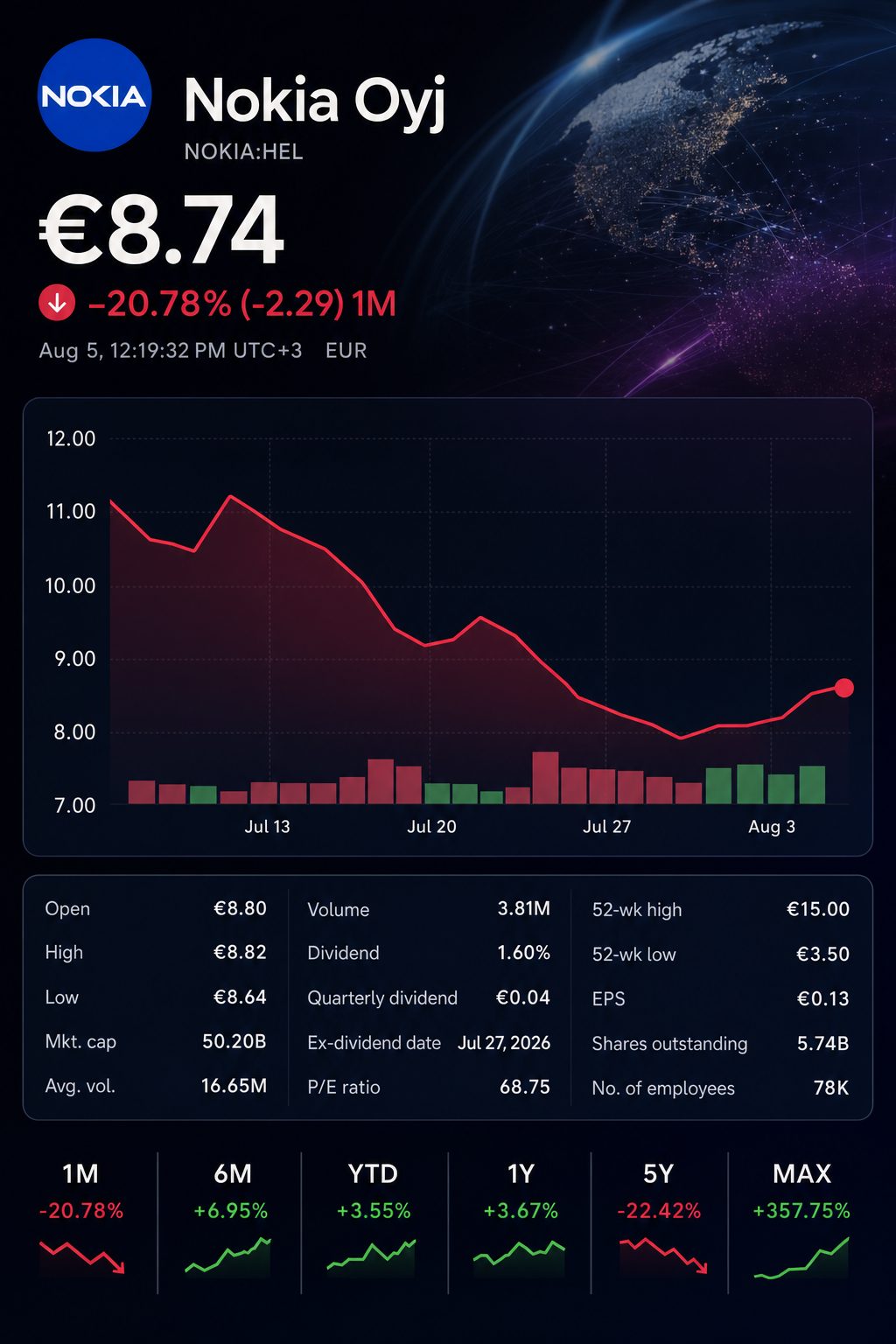
- Nokia traded 0.7% higher at €8.69 by 11:32 EEST. The STOXX 600 gained 0.4% earlier.
- First-half AI and cloud orders were about 4.7 times preliminary estimated sales.
- Nokia expects around half of Q2 orders to become revenue within 12 months.
Nokia Oyj HEL:NOKIA rose 0.7% Wednesday in open Helsinki trading. The gain extended a 15% rebound from its July 29 close.
Yet the share move is secondary. The sharper investor signal comes from Nokia’s order intake.
First-half AI and cloud orders totalled €3.8 billion. Preliminary estimated sales to those customers were about €806 million. Orders therefore equalled roughly 4.7 times sales.
The ratio rose from about 2.8 times in Q1 to 6.3 times in Q2. Demand visibility is widening faster than reported revenue. It is not a formal backlog figure.
The order-to-sales bridge shows the acceleration.
| Period | AI/cloud sales | Order intake | Orders divided by sales |
|---|---|---|---|
| Q1 2026 | About €360 million | €1.0 billion | About 2.8 times |
| Q2 2026 | €446 million | €2.8 billion | 6.3 times |
| First half 2026 | About €806 million | €3.8 billion | About 4.7 times |
Preliminary estimate. Q1 sales equal 8% of disclosed €4.50 billion group sales. Ratios are arithmetic, not company-reported backlog measures.
“Demand remains strong, while supply continues to be the main industry constraint,” Chief Executive Justin Hotard said. Customers are responding with longer-term orders. Nokia Corporation | Nokia
Nokia expects around half of Q2 order intake to convert within 12 months. That equals roughly €1.4 billion, or 3.1 times Q2 AI sales. Timing matters.
The operating scorecard gives those orders more weight. Q2 comparable operating profit beat the LSEG estimate by 13.6%.
| Comparable metric | Q2 2026 | Q2 2025 | Change or benchmark |
|---|---|---|---|
| Net sales | €4.815 billion | €4.448 billion | Up 8% |
| Gross margin | 46.0% | 45.3% | Up 70 basis points |
| Operating profit | €434 million | €367 million | Up 18%; 13.6% above LSEG |
| Diluted EPS | €0.07 | €0.04 | Up 75% |
Network Infrastructure carried the improvement. Sales rose 12%, while operating margin reached 8.1% from 6.4%. Mobile Infrastructure sales rose 6%, but margin slipped 60 basis points.
Optical Networks grew 20%; IP Networks grew 16% at constant currency. Nokia said Q2 AI orders spanned both businesses. That connects the order surge with its fastest-growing operations.
The rally repaired the post-results selloff, but not the earlier decline. Wednesday’s quote was almost level with the July 23 close. It remained 42% below the 52-week high.
| Reference point | Price | €8.69 versus reference |
|---|---|---|
| July 23 earnings-day close | €8.700 | Down 0.1% |
| July 29 close | €7.556 | Up 15.0% |
| August 4 close | €8.626 | Up 0.7% |
| 52-week high | €15.000 | Down 42.1% |
Against Ericsson STO:ERIC-B, Nokia’s Q2 growth gap widened. The comparison favors Nokia on growth, though Ericsson retained a higher adjusted gross margin.
| Q2 measure | Nokia | Ericsson |
|---|---|---|
| Reported group sales growth | Up 8% | Down 6% |
| Main network-unit sales growth | Up 12% | Down 8% |
| Adjusted/core profit growth | Up 18% comparable operating profit | Down 7% adjusted EBITA |
| Adjusted gross margin | 46.0%, up 70 bp | 48.4%, up 40 bp |
| AI supply effect | Longer customer orders | Higher component-cost pressure |
The companies use different adjusted metrics and reporting currencies.
“The whole AI build-out is putting quite the pressure on the whole industry,” Ericsson CFO Lars Sandström said. Nokia’s immediate effect was longer orders, not weaker comparable margins. Reuters
Nokia assumes Q3 sales will rise 3% to 7% sequentially. Comparable operating profit should remain broadly flat before a meaningful Q4 increase. Full-year guidance stands at €2.1 billion to €2.6 billion after a technical reclassification.
Risks remain. Supply constraints may delay conversion, while component inflation could erode margins. Nokia expects €800 million of restructuring charges and €700 million to €800 million of related cash outflows. Reported Q2 operating loss was €50 million.
The next test is simple. Nokia must convert its long orders without giving back margin. That will determine whether the rebound rests on earnings rather than orders.
Related articles: HEX:NOKIA