
NEW YORK, August 3, 2026, 05:11 EDT —
NVIDIA Corporation NASDAQ:NVDA starts Monday trading at about 22.3 times projected fiscal 2027 earnings. The firm’s price-to-earnings ratio was 28.5 times in May, based on the $8.28 consensus from three months ago.
This represents a 22% reduction. Shares declined 14.8% compared to their close on May 14. In contrast, the EPS consensus increased by 8.8% to reach $9.01.
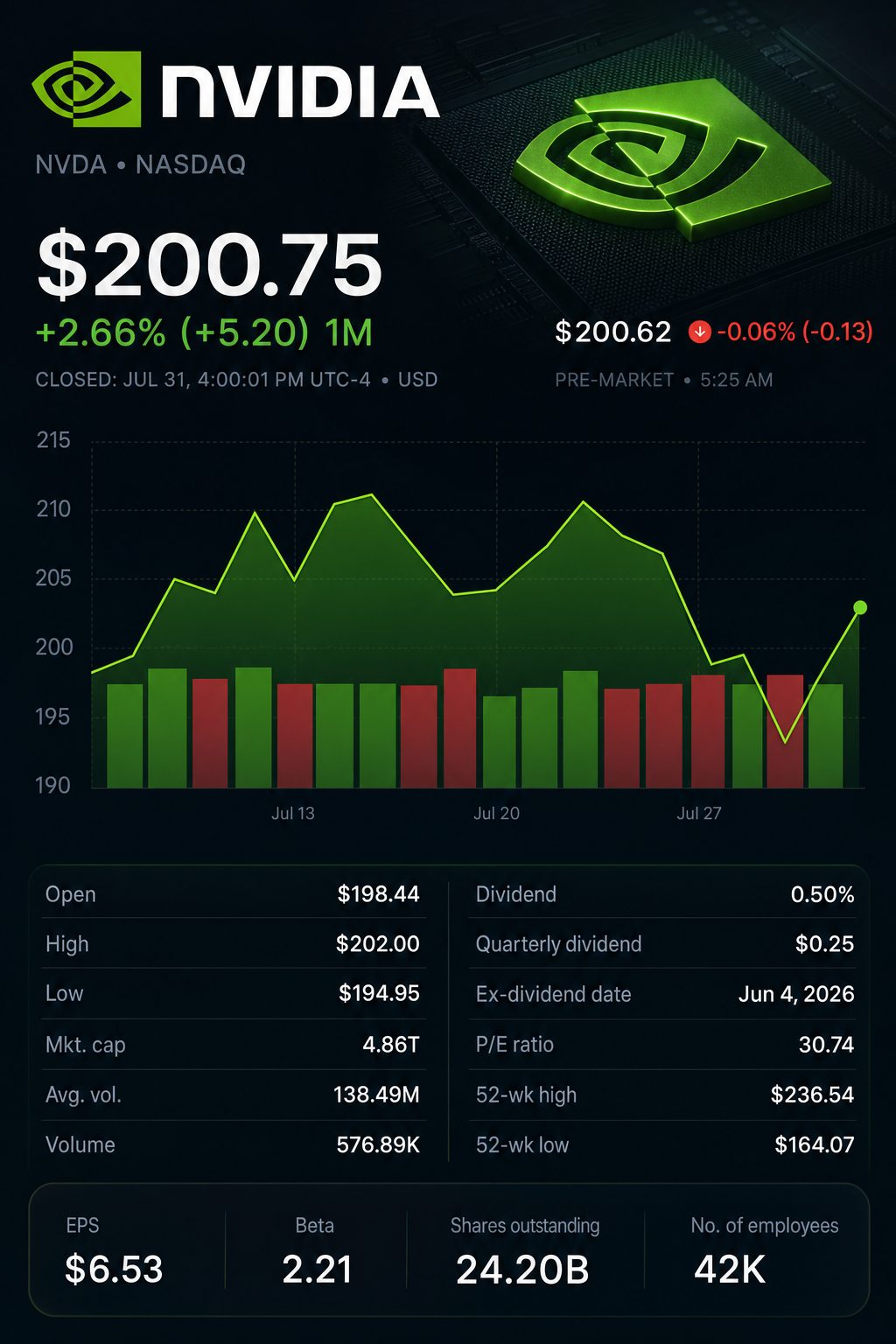
Nvidia finished Friday at $200.75, rising 2.9% during the session. In premarket trading at 5:02 a.m. EDT, the shares were quoted at $200.55. Regular U.S. markets remained closed. Over the past week, the stock fell 2.9%.
This is significant as client budgets continue to grow and shareholders seek clear returns. Bill Birmingham, managing director at REX Financial, referred to short-term growth in revenue and margins as the “new dividing line.” Reuters
Friday’s bounce failed to offset a turbulent week for semiconductor stocks. Nvidia outpaced both Advanced Micro Devices, Inc. NASDAQ:AMD and the chip index. Broadcom Inc. NASDAQ:AVGO also advanced.
The calculation is based on closing prices from July 24 and July 31. Weekly returns reflect the difference between those closing figures.
| Security | July 24 close | July 31 close | Weekly move | Friday move |
|---|---|---|---|---|
| Nvidia | $206.84 | $200.75 | -2.9% | +2.9% |
| AMD | $521.95 | $476.15 | -8.8% | -1.9% |
| Broadcom | $381.92 | $389.28 | +1.9% | +0.4% |
| PHLX Semiconductor Index | 11,818.89 | 11,311.08 | -4.3% | +0.1% |
The weekly tape indicates relative resilience. The estimate table displays a more significant valuation reset.
The following current-year comparison is based on analyst projections and closing prices as of July 31. Fiscal years vary.
| Company | Fiscal year | Current EPS consensus | Three months ago | Revision | Price/consensus EPS |
|---|---|---|---|---|---|
| Nvidia | FY2027 | $9.01 | $8.28 | +8.8% | 22.3x |
| AMD | FY2026 | $7.51 | $6.88 | +9.2% | 63.4x |
| Broadcom | FY2026 | $11.59 | $11.33 | +2.3% | 33.6x |
Nvidia is priced at 35% of AMD’s multiple for the current year and at 66% of Broadcom’s multiple.
The reduced multiple does not indicate soft stated demand. First-quarter revenue amounted to $81.6 billion, with Data Center accounting for 92% of that figure. Straightforward annualization yields $326.4 billion. This is not company guidance.
Four key clients are projecting capital expenditures of $720 billion-$745 billion for 2026, amounting to 2.2-2.3 times Nvidia’s annualized revenue from the first quarter. Microsoft’s estimate incorporates updated lease accounting.
| Customer | 2026 capex guidance | Latest operating evidence | Latest cash-flow signal |
|---|---|---|---|
| Amazon.com, Inc. NASDAQ:AMZN | $220 billion | AWS revenue climbed 37% reaching $42.2 billion | Trailing free cash flow posted an outflow of $7.6 billion |
| Microsoft Corporation NASDAQ:MSFT | $175 billion | Azure revenue up 43%; guidance for next quarter stands at +45% | Quarterly free cash flow at $19.6 billion, a decrease of 23% |
| Alphabet Inc. NASDAQ:GOOGL | $195 billion-$205 billion | Google Cloud advanced 82% to $24.8 billion | Quarterly free cash flow reflected an outflow of $5.9 billion |
| Meta Platforms, Inc. NASDAQ:META | $130 billion-$145 billion | Revenue increased by 28% to $60.8 billion | Free cash flow totaled $784 million, falling 91% |
| Combined | $720 billion-$745 billion | — | — |
Amazon and Microsoft cleared the market’s payback bar in the past week. AWS revenue grew by 37%, and Azure’s income climbed 43%. Amazon CEO Andy Jassy stated, “AWS is booming.” He added that both the AI and chip segments have each reached $25 billion run rates. Amazon Investor Relations
Alphabet revealed a negative free cash flow of $5.9 billion, while Meta’s free cash flow dropped by 91% to $784 million.
The capex figure does not represent an estimate of the addressable market. Some of this expenditure may not involve Nvidia. Alphabet started reporting direct sales of TPUs, and Amazon’s chips unit reached a run rate of $25 billion.
AMD’s results on Tuesday serve as the key semiconductor update this week. Visible Alpha projects revenue at $11.34 billion and adjusted EPS of $1.61. Options are pricing in an approximately 10% swing by Friday.
Nvidia is not set to announce earnings this week. The company will release its fiscal second-quarter results on August 26. Analysts project earnings of $2.08 per share.
Risks: Weak cash conversion may dampen cloud expenditure. Custom accelerators might absorb a larger share of spending. A disappointing AMD update has the potential to trigger renewed de-rating pressure across the sector.
At present, Nvidia’s outlook offers some protection. Investors are paying a lower price for every projected profit dollar. This boosts the premium on strong performance—and amplifies the impact of any disappointment.
Related articles: NASDAQ:NVDA