
Rivian (RIVN) unveiled a custom autonomy chip, LiDAR-backed driver assistance, and Autonomy+ pricing—then the stock fell. Here’s the latest news, analyst targets, and 2026 outlook.
December 12, 2025 — Rivian Automotive, Inc. NASDAQ:RIVN spent this week trying to change the narrative from “cash-burning EV maker” to “software-defined vehicle platform with recurring revenue.” On Friday, investors responded with skepticism.
Rivian shares were down about 6% in midday trading, hovering around $16.43, as markets digested the company’s first Autonomy & AI Day announcements and the costs implied by a deeper push into in-house chips, AI models, and advanced driver assistance.
What’s driving Rivian stock today
The immediate catalyst is Rivian’s Autonomy & AI Day (held December 11), where management outlined a roadmap that looks increasingly “Tesla-like” in ambition—yet different in its technical philosophy, particularly its decision to use LiDAR along with cameras and radar. Reuters+2The Wall Street Journal+2
The market reaction suggests two competing interpretations:
- Bull case: Rivian is building a defensible software and autonomy stack that could enable subscription revenue and higher lifetime value per vehicle.
- Bear case: The roadmap is expensive, timelines are long, and Rivian still has to scale production of a mass-market vehicle (R2) in a tougher incentive environment.
That tension is visible in the stock move: big vision, but investors want proof—especially around margins, cash burn, and launch execution.
The headline reveals: a custom autonomy chip and a lower-priced Autonomy+ package
Rivian Autonomy Processor: moving beyond Nvidia
Rivian introduced its first custom chip for autonomy, the Rivian Autonomy Processor, produced with TSMC, as part of a shift away from relying solely on third-party silicon for its next generation of driver-assistance computing.
Tech coverage described the chip as 5nm and highlighted performance claims reaching up to 1,600 TOPS (INT8) for Rivian’s third-generation autonomy compute—positioning it as a cornerstone of the company’s “vertical integration” strategy. The Verge+1
Rivian also emphasized training and inference improvements through an end-to-end AI approach (including what it calls a Large Driving Model), consistent with broader industry momentum toward foundation-model-style autonomy stacks.
Autonomy+: pricing set at $2,500 or about $50/month
Rivian announced a paid driver-assistance package called Autonomy+, priced at $2,500 one-time or $49.99 per month, undercutting Tesla’s widely discussed Full Self-Driving pricing structure.
Rivian’s own autonomy page states the subscription is available in February 2026 (with a 60‑day trial on deliveries). Major media coverage has also framed monetization beginning in early 2026, with The Wall Street Journal reporting a start in March 2026 for charges.
This is strategically important for the stock: subscriptions are one of the clearest paths to lifting Rivian’s revenue mix toward higher-margin software—an area where investors are increasingly willing to pay up, if the product sticks.
LiDAR is the “one exception” to the Tesla playbook
Rivian’s autonomy stack will incorporate LiDAR, plus high-resolution cameras and radar, especially in its future Generation 3 platform that’s expected to debut on the R2.
That choice aligns Rivian more closely with sensor-redundant approaches used by other autonomy players (and contrasts sharply with Tesla’s camera-only strategy). It also raises a familiar investor question: Does better redundancy and safety come with higher hardware cost per vehicle? The market’s initial reaction suggests that question remains unresolved.
“Universal Hands-Free” expands to 3.5 million miles of roads
A near-term product update is Rivian’s plan to expand hands-free driving coverage dramatically on second-generation R1 vehicles. Media reports put the expanded network at more than 3.5 million miles of North American roads—roughly a 20x expansion versus today—bringing Rivian closer to the “hands-free on mapped highways” paradigm many consumers now expect. The Wall Street Journal+2Investors.com+2
Rivian’s pitch is straightforward: improve functionality quickly through OTA updates, then monetize once the feature set feels “subscription-worthy.” Whether customers pay at scale is a 2026 catalyst investors will watch closely.
The financial backdrop: Q3 2025 results and 2025 guidance still matter
Even with AI Day headlines, Rivian’s stock remains anchored to fundamentals—production scale, gross profit trajectory, and liquidity.
In its third-quarter 2025 results, Rivian reported:
- 10,720 vehicles produced and 13,201 delivered
- $1.558B total revenue (+78% YoY)
- $24M consolidated gross profit
- $416M software and services revenue (+324% YoY)
- 2025 guidance: 41,500–43,500 deliveries, Adjusted EBITDA loss of $2.0B–$2.25B, CapEx $1.8B–$1.9B Business Wire
Crucially for the “Rivian is a software company too” narrative, Rivian’s software and services segment posted $154M gross profit in Q3, and the company attributed gains in part to its joint venture work with Volkswagen. Business Wire
Some reporting also indicated that around $214M of software and services revenue came from the Volkswagen joint venture contributions during the quarter—illustrating just how meaningful the partnership has become to Rivian’s near-term mix.
R2 timing: the single biggest operating catalyst for 2026
Rivian’s long-promised move downmarket hinges on R2, with the company reiterating that deliveries remain on track for the first half of 2026.
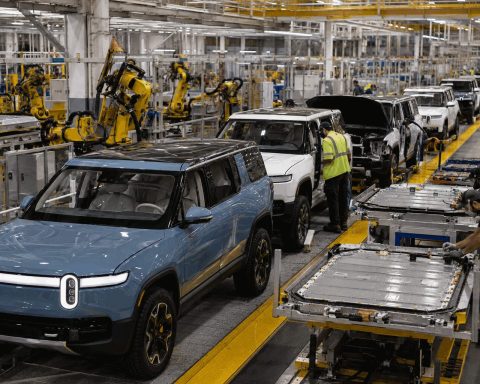
In its Q3 update, Rivian said it completed major build-outs in Normal, Illinois—including a 1.1M sq ft R2 body shop and general assembly facility and a 1.2M sq ft supplier park/logistics center—and expects manufacturing validation builds to begin at year end. It also said paint shop updates support 215,000 units/year of capacity.
For investors, R2 is the make-or-break bridge between today’s premium R1 volumes and the scale needed for sustainable margins and (eventually) free cash flow.
Volkswagen partnership: why it keeps showing up in forecasts
Rivian’s relationship with Volkswagen spans both cash and credibility. Reuters reported Volkswagen agreed to invest $5.8 billion tied to the partnership, with the joint venture (“RV Tech”) developing next-generation software and electrical architecture that could eventually extend beyond BEVs to internal combustion platforms—though the stated focus remains BEVs. Reuters
Volkswagen’s own communications say the joint venture is preparing reference vehicles from Volkswagen, Scout, and Audi for winter testing in Q1 2026 to validate the developed SDV features under cold conditions.
If that technology road map stays on schedule, it could:
- Keep Rivian’s software/services revenue elevated before R2 scales
- Reduce engineering duplication across brands
- Provide incremental funding/validation milestones that matter to the stock’s longer-term risk premium
But if milestones slip, the market may treat the partnership less like a tailwind and more like “non-core revenue masking automotive margin weakness.”
Risks investors are weighing right now
1) Incentives just got harder
A major macro overhang is the change in U.S. EV incentives. The IRS updated guidance indicating the New Clean Vehicle Credit is not available for vehicles acquired after Sept. 30, 2025, with limited exceptions tied to binding contracts.
Reuters has also reported that the legislative changes reduced federal support and could slow near-term U.S. EV uptake, even as longer-term investments and competition continue.
That matters for Rivian because R2’s launch will arrive in a post-credit environment—raising the bar for pricing, financing offers, and consumer demand elasticity.
2) Recall headline risk
Rivian also faced safety-related headlines this month. Reuters reported a recall covering more than 34,000 vehicles tied to a seatbelt pretension issue, and NHTSA documentation describes the affected models and remedy process.
Recalls happen across the industry, but for a scaling EV maker, they can still pressure sentiment—especially when Wall Street is already focused on execution.
3) Cash burn vs. “AI ambitions”
Several market commentators emphasized that autonomy investments are costly, and that Rivian isn’t expected by many analysts to reach positive free cash flow for years. Barron’s framed this as a key reason the stock fell despite what looked like a “positive” product narrative. Barron’s+1
Wall Street forecasts and analyst moves as of Dec. 12, 2025
Rivian’s analyst landscape is unusually divided for a large-cap EV name: big spread in price targets, mixed ratings, and frequent changes tied to EV demand assumptions.
Notable actions and price targets in the current news cycle
- Needham raised its price target to $23 (from $14) and kept a Buy, citing the AI and autonomy roadmap.
- Morgan Stanley turned more cautious on the EV space and downgraded Rivian, with reporting pointing to a $12 target and concerns around the R2 launch environment and incentives.
- RBC Capital reiterated a more cautious stance, keeping a Hold and $14 target heading into AI Day, framing Rivian as a “show-me story.” Yahoo Finance
- Stifel raised its target to $17 and maintained a Buy after Q3 results.
- Tigress Financial raised its target to $25 and maintained a Buy, pointing to AI innovation and strategic partnerships.
- Mizuho downgraded Rivian to Underperform and cut its target to $10, citing slowing EV demand and delivery risk.
Where consensus sits
Consensus targets vary by dataset, but one widely cited snapshot puts Rivian’s average analyst target around the mid-$14 range with a Hold-leaning consensus and a wide spread between low and high targets.
For readers tracking “Rivian stock forecast” headlines, the takeaway is simple: the Street is not arguing about whether autonomy is important—it’s arguing about whether Rivian can fund and ship it profitably while launching R2 on time.
What to watch next for Rivian stock
Here are the catalysts most likely to drive RIVN headlines (and volatility) into early 2026:
- Timing and customer reception of Autonomy+ (availability and conversion rates) Rivian+1
- R2 manufacturing validation builds and any updates to first-half 2026 delivery timing Business Wire+1
- Gross margin durability (is software growth offsetting auto margin pressure?) Business Wire+1
- VW joint venture winter testing in Q1 2026 and downstream platform adoption plans Volkswagen Group+1
- EV demand post-tax-credit and how Rivian prices/finances vehicles to maintain volume IRS+1
Bottom line
Rivian’s Autonomy & AI Day delivered exactly what long-term bulls wanted to see: deeper vertical integration, a credible sensor strategy (including LiDAR), and a clearer path to subscription monetization.
But the stock’s decline on Dec. 12 shows the market is still prioritizing near-term realism: execution risk, a tougher incentive landscape, and the ongoing challenge of scaling EV manufacturing profitably—before autonomy dreams become a financial drain.
Related articles: NASDAQ:RIVN