
ATLANTA, August 18, 2026, 09:13 EDT
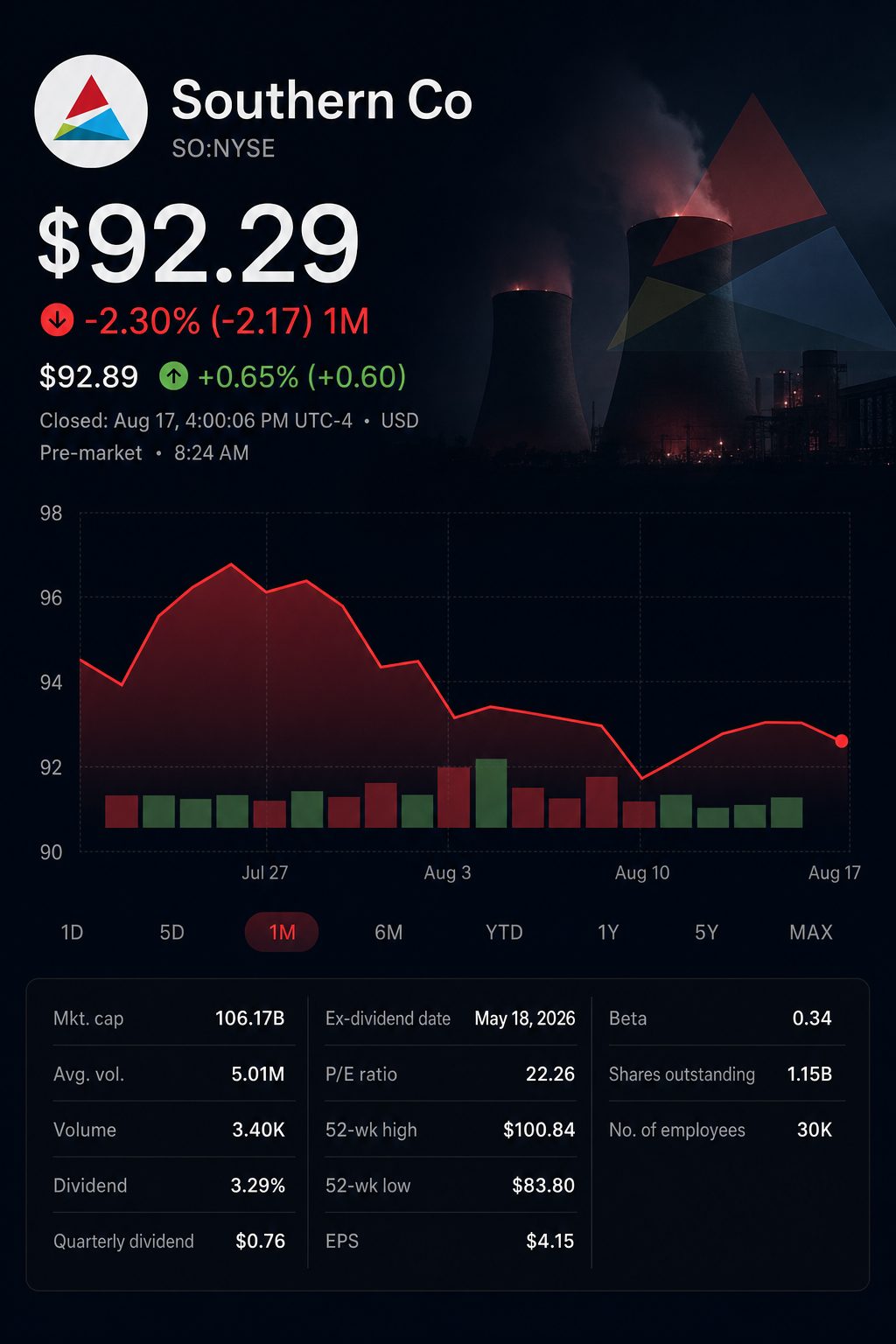
The Southern Company NYSE:SO traded 0.2% higher at $92.48 before Tuesday’s opening bell. The move followed a fresh Hold call from Truist, while surging electricity demand kept the utility in focus.
The demand case is large. Southern has more than 17 gigawatts of contracted large-load demand through the mid-2030s. Its current data-center load exceeds 1.2 GW, implying a contracted pipeline about 14 times the installed base.
Yet the financing hurdle rose again Tuesday. The 10-year Treasury yielded 4.7319%, about 144 basis points above Southern’s 3.29% dividend yield. That gap weakens the stock’s income appeal as Southern funds an $81 billion capital program.
| Capital and yield measure | Value | Investor implication |
|---|---|---|
| Five-year capital plan | $81 billion | 7% above prior plan |
| Market capitalization | $106.17 billion | Capital plan equals 76% of equity value |
| Southern dividend yield | 3.29% | Below risk-free benchmark |
| 10-year Treasury yield | 4.7319% | About 144 basis points above SO |
Truist analyst Richard Sunderland maintained a Hold rating and set a $97 target. Google Finance lists the action on August 17. The target offers 5.1% upside from Monday’s $92.29 close, before dividends.
| Analyst | Firm | Rating | Target | Move versus $92.29 close |
|---|---|---|---|---|
| Richard Sunderland | Truist | Hold | $97 | +5.1% |
| Anthony Crowdell | Mizuho | Buy | $106 | +14.9% |
| James Thalacker | BMO Capital | Buy | $104 | +12.7% |
| Ross Fowler | Bank of America | Hold | $100 | +8.4% |
| Sophie Karp | KeyBanc | Sell | $79 | -14.4% |
The wider analyst split remains cautious. Three of 12 analysts tracked by Google Finance rate the shares Buy. Seven say Hold and two say Sell. Their average target is $98.27.
Operations support the bulls. Weather-normalized retail electricity sales rose 2.3% in the first half. Commercial sales climbed 7.4% in the second quarter, while data-center use jumped 55% from a year earlier.
| Demand measure | Period | Change |
|---|---|---|
| Weather-normal retail electricity sales | First half of 2026 | +2.3% |
| Weather-normal commercial sales | Second quarter | +7.4% |
| Data-center electricity use | Second quarter | +55% |
| Data-center electricity use | First half of 2026 | +49% |
Chief Executive Chris Womack called the region’s economic-development momentum “extraordinary.” Southern added more than 6 GW of contracts since the first quarter. Another 8 GW sits in late-stage development, management said. Utility Dive
| Large-load measure | Capacity | Status |
|---|---|---|
| Current data-center load | More than 1.2 GW | Operating |
| Contracted large load | More than 17 GW | Expected through mid-2030s |
| Late-stage projects | 8 GW | Not yet contracted |
| Near-term contract candidates | 3 GW | Included in late-stage total |
The contracts are not current revenue. They require generation, transmission and distribution assets to arrive on schedule. Southern’s $81 billion plan covers 2026 through 2030, with roughly half directed toward generation.
Second-quarter adjusted earnings reached $1.13 a share, up from $0.92. That beat the $1.01 consensus estimate. Revenue was $6.98 billion, about 4% below the $7.27 billion estimate.
| Second-quarter measure | Reported | Comparison | Result |
|---|---|---|---|
| Adjusted EPS | $1.13 | $1.01 estimate | 11.8% beat |
| Adjusted EPS | $1.13 | $0.92 year earlier | 22.8% higher |
| Revenue | $6.98 billion | $7.27 billion estimate | 4.1% miss |
| 2026 adjusted EPS outlook | $4.50-$4.60 | Near or at top | Management view |
Higher interest expense and share dilution already offset part of the operating gain. Southern raised $700 million through its equity program during the quarter. It now estimates $1.1 billion of remaining equity needs through 2030.
Risks: Large-load projects can be delayed, resized or cancelled. Higher yields can lift funding costs and compress utility valuations. Cost overruns or slow regulatory recovery would weaken the earnings benefit from new demand.
The near-term test is therefore financial, not electrical. Investors need contract conversion and regulated returns to outrun a risk-free yield that now pays more than Southern’s dividend.
Related articles: Energy