
NEW YORK, August 3, 2026, 12:06 p.m. EDT — Trading began in U.S. equity markets, with the New York Stock Exchange opening for the session.
- Brent crude slipped 5.0% to $83.52 per barrel. WTI slid 6.1% to $79.49 as Iran rejected claims that discussions with the U.S. were ongoing.
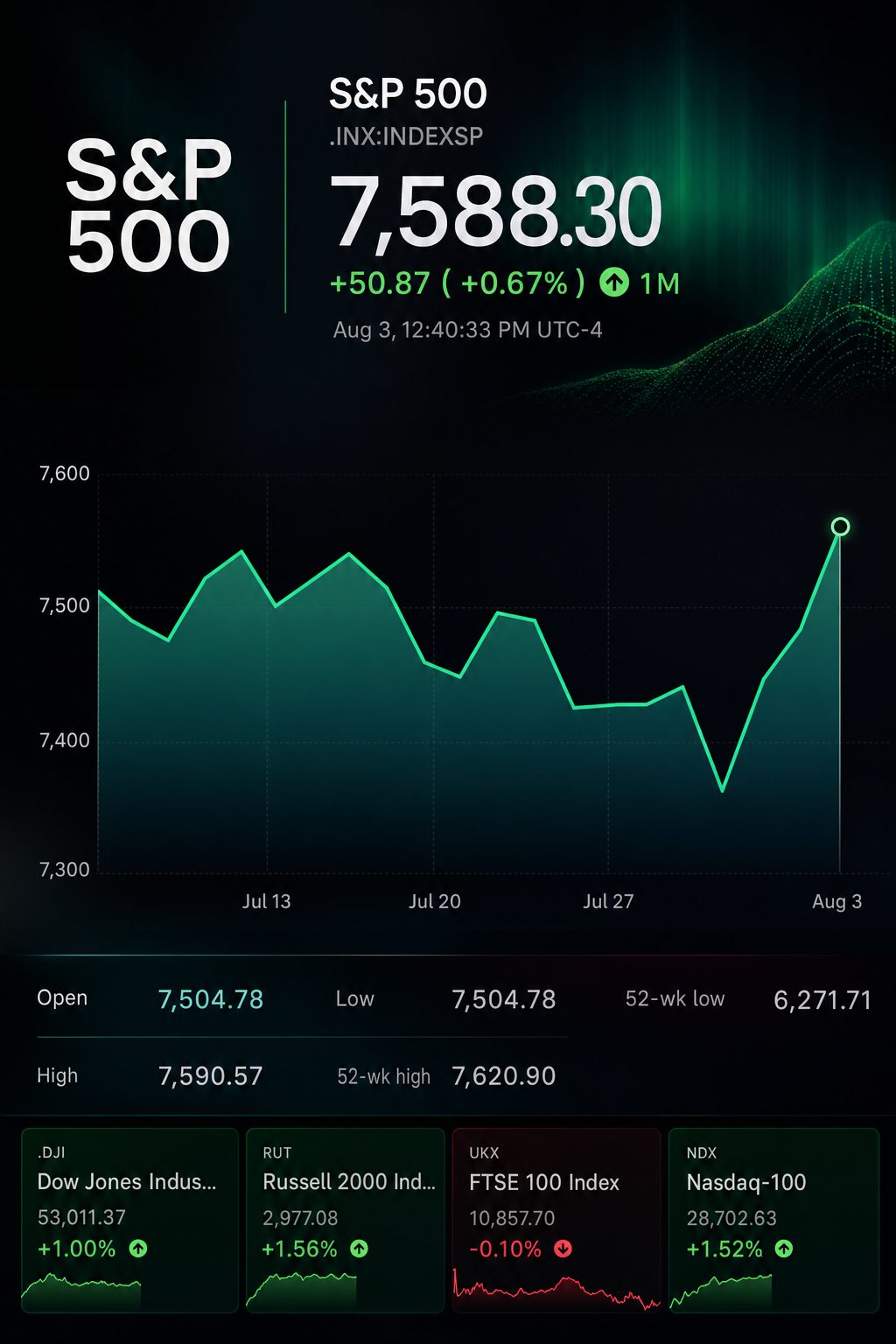
- By 11 a.m. EDT, the S&P 500 was up 1.2%. The Dow climbed 1.1% and the Nasdaq increased 1.8%.
- The airline ETF gained 3.80%, while the energy ETF declined 0.71%. This resulted in a spread of 4.51 percentage points.
Monday’s rally on Wall Street was widespread, but the range among sectors provided more insight. The U.S. Global Jets ETF NYSEARCA:JETS surpassed the Energy Select Sector SPDR Fund NYSEARCA:XLE by 4.51 percentage points.
The trend points to investors unwinding a geopolitical supply premium, rather than anticipating an overall drop in demand. Fuel buyers increased, growth stocks gained, and Treasuries also moved higher at the same time.
Liquid market indicators validated the risk-on sentiment. Among the three major equity funds, the Nasdaq tracker outperformed.
| Market gauge | Latest level | Session move |
|---|---|---|
| SPDR S&P 500 ETF Trust NYSEARCA:SPY | $756.02 | up 1.20% |
| Invesco QQQ Trust NASDAQ:QQQ | $697.16 | rising 1.33% |
| SPDR Dow Jones Industrial Average ETF Trust NYSEARCA:DIA | $530.06 | advancing 1.10% |
| U.S. Global Jets ETF | $32.47 | gaining 3.80% |
| Energy Select Sector SPDR Fund | $59.13 | down 0.71% |
| Brent crude | $83.52 a barrel | falling 5.0% Reuters |
| WTI crude | $79.49 a barrel | dropping 6.1% Reuters |
| U.S. 10-year Treasury yield | 4.682% | decreasing 5.8 basis points The Wall Street Journal |
Declining crude prices also moved through the rate channel. QQQ outperformed DIA by 0.24 percentage points, with the 10-year yield dropping.
The direct operating-cost trade picked up momentum. Three major U.S. airlines rose by an average of 4.92%.
| Fuel-sensitive company | Price | Session move |
|---|---|---|
| United Airlines Holdings NASDAQ:UAL | $128.07 | up 5.56% |
| American Airlines Group NASDAQ:AAL | $16.02 | higher by 4.91% |
| Delta Air Lines NYSE:DAL | $91.20 | rose 4.30% |
| Norwegian Cruise Line Holdings NYSE:NCLH | $19.28 | advanced 4.05% |
| Carnival Corporation NYSE:CCL | $28.32 | added 1.83% |
The five travel stocks saw an average rise of 4.13%, outperforming SPY by 2.93 percentage points. The movement aligns with a trade based on relief in fuel margins.
Economic data released Monday reinforced the demand-side perspective, with manufacturing, orders, and factory employment all showing gains in July.
| U.S. manufacturing measure | July | June | Change |
|---|---|---|---|
| ISM Manufacturing PMI | 55.6 | 53.3 | up 2.3 points |
| New orders | 56.7 | 56.0 | rise of 0.7 points |
| Manufacturing employment | 52.8 | 49.7 | increased 3.1 points |
| Prices paid | 71.1 | 73.0 | fell by 1.9 points |
The headline PMI climbed to its strongest reading since May 2022. Employment returned above the 50-point mark, signaling expansion. Input inflation moderated, but the prices index stayed elevated.
The oil move was driven by politics. President Donald Trump halted additional attacks and announced that talks would begin Monday. Iran, however, stated no discussions were underway or planned.
Risks to physical supply persist. Six Saudi supertankers changed course to sail around southern Africa, and transit through the Strait of Hormuz has decelerated. OPEC+ agreed to add 188,000 barrels per day starting in September.
The respite is only partial. Brent crude is still 16% higher than its $72 low reached in July, even though it is 18% under its $102 peak. The 10-year yield is around 71 basis points above where it was before the conflict.
Kathleen Brooks, research director at XTB, stated that a decline in oil prices would help to “ease inflation fears.” She also anticipated continued impact on bond yields. The Guardian
Chris Larkin from E*TRADE stated that earnings and employment figures now need to “do the heavy lifting” for bullish investors. The U.S. government’s payrolls report will be released on Friday. Reuters
Risks: The surge relies on a still-uncertain diplomatic outcome. If tanker attacks resume, negotiations break down or labor data comes in stronger, the oil premium might rise again. That scenario could swiftly unwind the airline-energy divergence.
For investors, that spread serves as the clearest near-term measure. A broad gap combined with declining yields would indicate ongoing oil relief, while a swift reversal would point to rising Hormuz risk.
Related articles: NASDAQ:UAL