
NEW YORK, July 8, 2026, 12:05 EDT
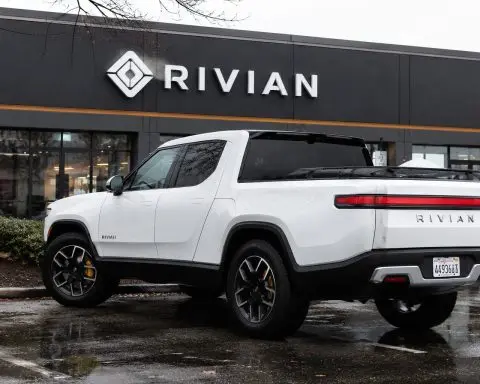
- Rivian was down 1.0% at $16.33 around midday in New York after pricing its 75 million-share sale at $15.50.
- The offering will boost the Class A share count by around 5.2%, or about 6.0% if underwriters take up their option.
- Rivian’s Q2 deliveries topped its forecast, and the EV maker lifted its full-year delivery target.
- Investors are watching costs as Q1 operating cash burn plus capex ran over $1 billion even before the R2 ramp was running at full speed.
Rivian Automotive, Inc. NASDAQ:RIVN started trading Wednesday after confusion over Nasdaq’s 2026 calendar was cleared. Nasdaq listed July 3 as the last U.S. exchange holiday, not July 8. The stock traded around $16.33 in late morning, moving between $15.46 and $16.34 so far. Volume was above 60 million shares. Traders saw no panic selling under the offer price, but no rally either.
Rivian sold 75 million shares at $15.50, looking to bring in about $1.2 billion. The EV maker said it plans to use the money for general corporate needs, with some earmarked for equity contributions tied to a U.S. Department of Energy loan. The pricing matters here—it’s 23% under Monday’s $20.14 close and a bit below the $16.49 finish on Tuesday. The deal got done, but only after buyers pushed for a lower level to reset the stock’s rally.
| Item | Figure | Read-through |
|---|---|---|
| Base offering | 75.0 mln shares | Company drops fresh shares after a run-up |
| Underwriter option | 11.25 mln shares | Full take-up pushes total to 86.25 mln |
| Offer price | $15.50 | Comes in 23% under where it closed Monday |
| Gross proceeds | $1.16 bln | Reuters sources round it to about $1.2 bln |
| Class A shares after base deal | 1.432 bln | Base scenario puts dilution at roughly 5.2% |
| Class A shares after full option | 1.443 bln | Full greenshoe bumps dilution to about 6.0% |
The bear case isn’t about weak R2 demand. Rivian put out 12,613 vehicles in the second quarter and delivered 12,194, beating its old delivery guide of 9,000-11,000. The company also bumped up its 2026 delivery target to 65,000-70,000, up from 62,000-67,000. That was the first demand news in months to move the stock. But with the new equity sale, the focus is shifting. Now investors are asking if demand is moving up fast enough to cover the cost of building out another factory and ramping a cheaper model.
Rivian’s own SEC filing painted a starker picture. The company put Q2 revenue at $1.55 billion to $1.65 billion, up from $1.30 billion last year. But most of that increase is from a bigger share of lower-priced commercial vans, Rivian said, not from higher prices. Software, services, and regulatory credits helped a bit. Higher output matters, but a weaker mix does not help. For a company that still has to prove it can make money building cars, beating on unit sales is more straightforward than beating on profits.
| Measure | Latest verified figure | Why it matters |
|---|---|---|
| Q2 deliveries | 12,194 vehicles | Beat what the company told markets |
| 2026 delivery guide | 65,000-70,000 | Picks up pace in later quarters |
| Q2 revenue estimate | $1.55 bln-$1.65 bln | Tops last year, but numbers aren’t final |
| Cash and short-term investments, June 30 est. | $5.3 bln | Sits higher than before new share sale |
| Q1 operating cash used | $703 mln | Shows big outflows keep running |
| Q1 capital expenditures | $372 mln | Spending on R2 and factories keeps draining cash |
This is why the shares dropped even though Rivian posted stronger delivery numbers. In the first quarter, Rivian’s automotive segment posted a gross loss of $62 million. Software and services had gross profit of $181 million. Net loss for the quarter was $416 million. The market sees Rivian as an automaker that gets some boost from software—not a software company that also builds cars. That matters because scaling up auto production eats cash before it helps margins.
HSBC’s Neil Churchill cut it down in a note quoted by MarketWatch: Rivian “is loss making and cash burning.” That’s direct. The offering doesn’t kill the R2 thesis, it sets a price for it. If Rivian trades below the offer, people will call it desperate fundraising. If shares stay up, the sale could help Rivian push ahead on R2 without loading up on debt. MarketWatch
Traders are talking technicals as part of the fundamental story now. Rivian’s 20-day average is $16.31, the 50-day sits at $15.64, and the 200-day is $15.84, according to Barchart. With shares trading near $16.33, the price is right up on its short-term line and just a bit above the other two averages. Not a lot of room if volume stays strong. If the stock drops below the offer, that price becomes resistance. Closing above the 20-day would suggest buyers are fine backing more dilution for the R2 push.
| Stock or proxy | Price near midday | Change | Signal |
|---|---|---|---|
| Rivian Automotive, Inc. NASDAQ:RIVN | $16.33 | -1.0% | Shares trade heavy after deal, volume above average |
| Tesla Inc. NASDAQ:TSLA | $392.58 | -2.6% | Tesla down again, EVs off |
| Lucid Group, Inc. NASDAQ:LCID | $5.89 | -1.8% | Lucid slides, pressure on smaller player |
| SPDR S&P 500 ETF Trust NYSEARCA:SPY | $740.41 | -1.0% | S&P 500 weaker, risk-off day |
| Invesco QQQ Trust NASDAQ:QQQ | $702.53 | -1.0% | QQQ lower, growth stocks don’t catch buyers |
The peer group also weighs. Tesla and Lucid slipped, while the S&P 500 and Nasdaq ETFs each dropped roughly 1%. Rivian’s decline isn’t just a company story, but the company’s move hit harder. Growth names can ride out soft markets if their cash plans stay on hold. Rivian went to the market for new equity just as risk demand slumped. Tough timing, but maybe it was the only chance after the rally on deliveries.
JPMorgan’s Rajat Gupta upped his 2026 delivery forecast after the Q2 report but stayed with a Sell on the stock. “We are now forecasting 2026 deliveries of about 68,100 versus about 64,900 units prior,” he wrote. That’s inside Rivian’s new guidance. Still, Rivian’s equity story stays tied to execution, not just demand. The market might credit Rivian for the delivery numbers but hold back on the stock as long as losses stick around. TradingView
Morningstar’s Seth Goldstein had expected the offering to price “not too far below” his fair value estimate, which he said would keep dilution in check. The actual $15.50 price now puts that to the test. Dilution is not big in percentage terms, but it adds to existing convertible notes, RSUs, warrants, and other future investment terms Rivian says could cause more dilution. Morningstar, Inc.
The setup here is tight. If Rivian trades above $15.50, bulls can say the company took advantage of strength, sold stock to keep R2 on track, and dodged bigger balance sheet risks down the road. If shares slip under $15.50, the market is betting R2 isn’t enough to justify new equity at this price. That level is now the main story, not the delivery numbers.
Related articles: NASDAQ:RIVN