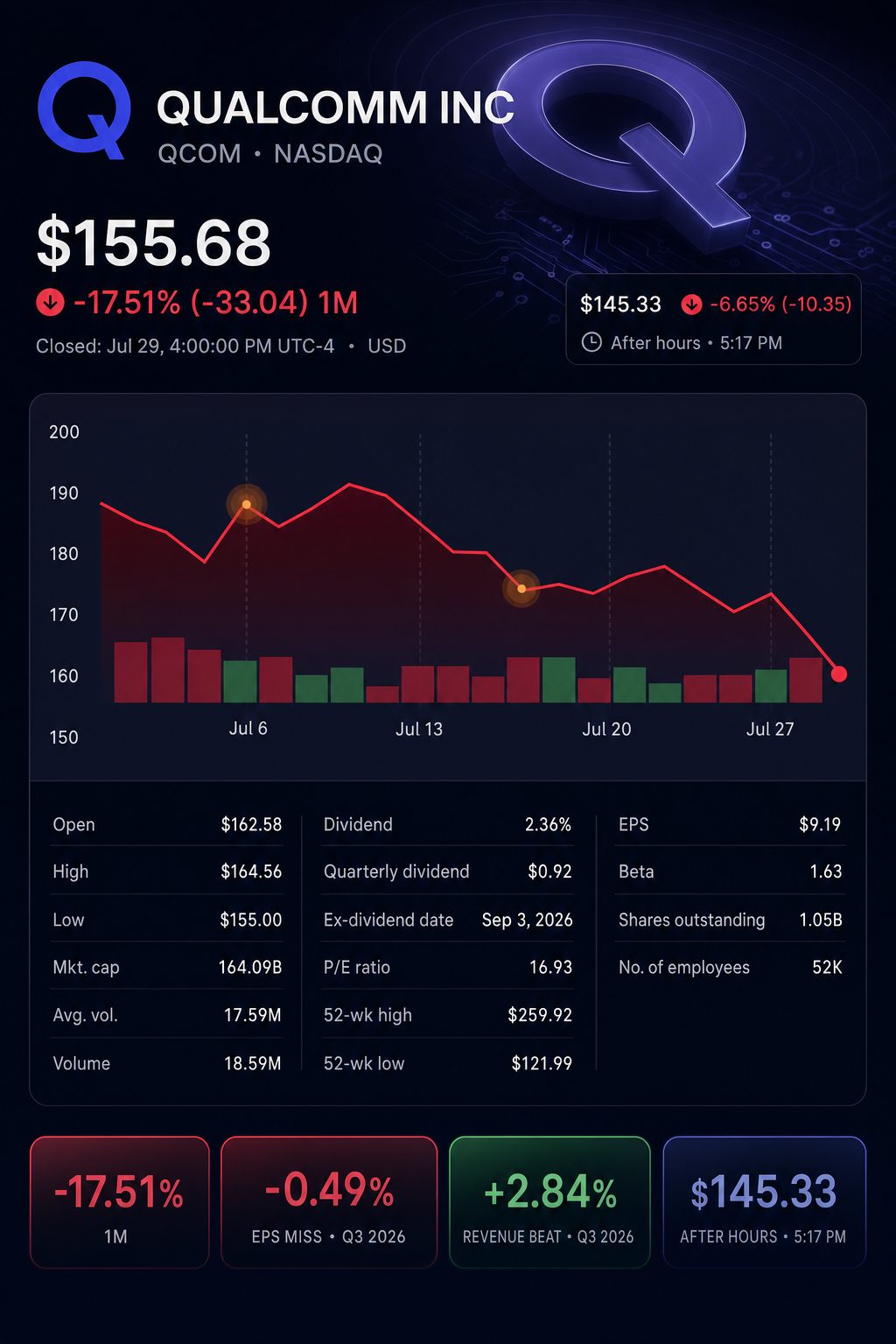
NEW YORK, July 29, 2026, 16:59 EDT – Qualcomm NASDAQ:QCOM stock declined as soft demand in the handset segment highlighted the company’s efforts to broaden its business beyond smartphones.
- The stock finished the session down 4.4% at $155.68 and declined almost 5% after markets closed.
- Qualcomm has been chosen by BMW (ETR:BMW) as the primary provider of processors for cockpit features and automated driving systems.
- Growth in Automotive and IoT segments helped counterbalance around 61% of the handset revenue drop for the quarter.
U.S. markets have finished for the day. Qualcomm shares finished down 4.4%, and slid close to 5% in after-hours trade as cautious profit guidance overshadowed two recent diversification gains.
BMW has selected Qualcomm as its primary compute-silicon supplier for upcoming vehicle platforms. The deal includes digital cockpit technology and advanced driver-assistance systems for the coming decade.
Qualcomm has finalised its purchase of Modular, a company specialising in AI software infrastructure. Modular’s platform supports and accelerates AI workloads over multiple types of computing architectures.
Qualcomm’s quarterly segment figures already show the investor test. Gains in automotive and IoT segments made up $753 million of the $1.24 billion drop in handset revenue, covering around 61% of the shortfall.
| QCT revenue stream | Q3 FY2026 revenue | Year-on-year | Share of QCT | Dollar change |
|---|---|---|---|---|
| Handsets | $5.086 billion | down 20% | 59.8% | decrease of $1.242 billion |
| Automotive | $1.588 billion | up 61% | 18.7% | increase of $604 million |
| Internet of Things | $1.830 billion | up 9% | 21.5% | increase of $149 million |
| Total QCT | $8.504 billion | down 5% | 100% | decrease of $489 million |
Qualcomm’s figures form the basis for all share and dollar changes shown.
The composition shifted significantly. Automotive and IoT accounted for 40.2% of QCT revenue, increasing from 29.6% the previous year. Handsets remained at 59.8%.
Automotive revenue surged 61% to reach $1.59 billion, while IoT increased 9% to $1.83 billion. However, overall QCT revenue declined by 5%.
BMW’s deal includes Snapdragon Cockpit and Snapdragon Ride chips, in addition to AI accelerators and model projects launching in the coming decade. No financial details were shared.
Qualcomm’s automotive head Nakul Duggal said BMW’s decision showed its trust in Qualcomm’s plans. He stated the partnership allows the firms to “define the future of mobility.” Qualcomm
Qualcomm’s purchase of Modular delivers a software component that supports its edge-to-cloud approach. The Mojo, MAX and Modular Cloud offerings will remain distinct brands and products.
At its announcement in June, the all-stock deal carried a valuation of $3.92 billion. Under the terms, Qualcomm may issue as many as 19.2 million shares.
The actions focus on markets where Nvidia NASDAQ:NVDA and Mobileye Global NASDAQ:MBLY compete. Qualcomm is providing BMW with a more comprehensive vehicle-computing platform, and Modular is supplying AI software that works across different hardware.
Short-term profit continues to be a limiting factor. Revenue for the fiscal third quarter declined by 4% to $9.95 billion. Adjusted earnings were $2.21 per share, missing the LSEG consensus estimate by two cents.
Qualcomm projects fourth-quarter adjusted earnings in the range of $2.05 to $2.25 per share, with the midpoint of $2.15 roughly 9% under analysts’ forecast of $2.36. Expected revenue is set between $9.7 billion and $10.5 billion, surrounding the consensus estimate of $10.02 billion.
Handset revenue dropped by 20% to $5.09 billion. Revenue linked to Apple NASDAQ:AAPL products is projected to decrease more quickly than previously anticipated. Chief Executive Cristiano Amon stated, “We kind of replaced Apple with the data center.” Reuters
Qualcomm’s forward-looking company goal aims to reach $40 billion in non-handset revenue by fiscal 2029. The company projects that non-handset revenue will grow by over 60% in fiscal 2027. These projections are reliant on achieving targets in automotive, IoT, and data-centre divisions.
Risks: Rising costs for wafers, packaging and memory could weigh on margins ahead of the impact from planned price hikes. BMW did not reveal any contract value, modular integration has yet to be proven, and reliance on handset customers remains significant.
Related articles: NASDAQ:QCOM