NEW YORK, July 30, 2026, 11:07 EDT
- Alphabet was last at $332.47, a decline of 1.3%, in active U.S. trading. Intraday figures are provisional.
- Following results, targets set at $425 to $435 suggest an upside in the range of about 28% to 31%.
- Equity-related disclosures accounted for 47% of trailing EPS. Excluding just these effects raises the illustrative P/E to 31.8 times.
Alphabet shares underperformed during Thursday’s rally driven by AI stocks. The Nasdaq was up 2.2% earlier, supported by revived optimism about technology investment. Alphabet was down 1.3% at $332.47 at 10:52 EDT.
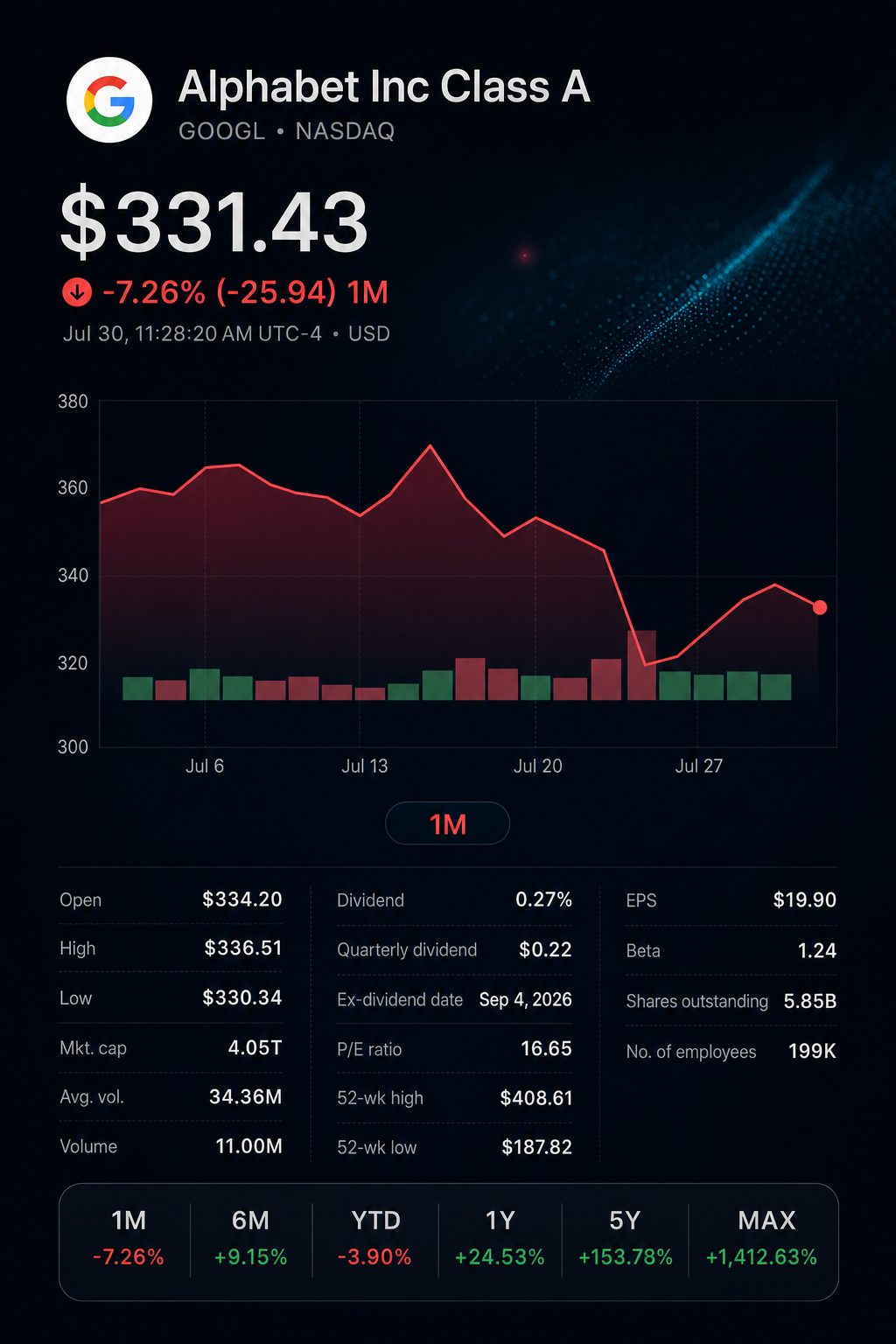
The difference is significant, with Wall Street targets still notably above current levels. Phillip Securities has raised its rating to Buy, assigning a $425 target. Goldman Sachs NYSE:GS also kept a Buy rating, but reduced its target to $435. The average among 64 analysts was $427.59.
The options suggest gains between 28% and 31%. However, the usual 16-to-17-times earnings scenario depends on fluctuating investment valuations.
Alphabet disclosed trailing diluted earnings per share of $19.91, filings show. Equity-related items disclosed made up $9.44, accounting for 47% of the overall figure.
| Quarter | GAAP diluted EPS | Disclosed equity-related EPS effect | EPS adjusted for equity-related effect |
|---|---|---|---|
| Q3 2025 | $2.87 | $0.68 | $2.19 |
| Q4 2025 | $2.82 | $0.15 | $2.67 |
| Q1 2026 | $5.11 | $2.35 | $2.76 |
| Q2 2026 | $9.11 | $6.26 | $2.85 |
| Trailing four quarters | $19.91 | $9.44 | $10.47 |
The last column shows an example calculation, rather than adjusted earnings reported by the company. This figure subtracts just the stated equity-linked EPS impacts, and does not account for additional non-operating factors. Alphabet noted that Q2’s $99 billion equity gain was largely unrealized.
The trailing multiple as of Thursday’s price stood at roughly 16.7 times. Factoring in the illustrative $10.47 increases that to 31.8 times. If the price hits $420, the static multiple climbs to 40.1 times.
| Price reference | Price | Upside from $332.47 | P/E on current GAAP EPS | Illustrative P/E on $10.47 |
|---|---|---|---|---|
| Current price | $332.47 | — | 16.7x | 31.8x |
| 24/7 Wall St. projection | $420.00 | 26.3% | 21.1x | 40.1x |
| Phillip Securities projection | $425.00 | 27.8% | 21.3x | 40.6x |
| Average of 64 analysts | $427.59 | 28.6% | 21.5x | 40.8x |
| Goldman Sachs estimate | $435.00 | 30.8% | 21.8x | 41.5x |
The valuation figures presented here are fixed estimates and do not represent earnings projections. The $420 value serves as an editorial scenario, not an analyst’s target.
The targets demand more than just a valuation recovery. Achieving them will require quicker operating earnings and improved cash conversion from AI infrastructure.
Evidence from operations is robust. Cloud revenue increased by 82%, with Cloud operating profit climbing over threefold. Both Search and YouTube advertising recorded double-digit growth rates.
| Q2 operating metric | 2025 | 2026 | Change |
|---|---|---|---|
| Total revenue | $96.43 billion | $119.80 billion | up 24.2% |
| Search and other revenue | $54.19 billion | $63.27 billion | up 16.8% |
| YouTube advertising | $9.80 billion | $11.06 billion | up 12.9% |
| Google Cloud revenue | $13.62 billion | $24.77 billion | up 81.8% |
| Cloud operating income | $2.83 billion | $8.81 billion | up 211.9% |
| Cloud operating margin | 20.7% | 35.6% | gain of 14.9 points |
Cloud backlog increased to $514 billion, up by more than $50 billion quarter-on-quarter. Alphabet anticipates that a little over half of this sum will convert into revenue in the next 24 months, providing future visibility but not instant cash. Chief Executive Sundar Pichai stated management had “gotten more bullish on the opportunities ahead.” Alphabet Investor Relations
Cash conversion trended in the opposite direction. For four straight quarters, capital spending outpaced growth in operating cash. In the June quarter, capital spending surpassed operating cash flow.
| Quarter | Operating cash flow | Capital expenditure | Free cash flow | Capex/operating cash |
|---|---|---|---|---|
| Q3 2025 | $48.41 billion | $23.95 billion | $24.46 billion | 49% |
| Q4 2025 | $52.40 billion | $27.85 billion | $24.55 billion | 53% |
| Q1 2026 | $45.79 billion | $35.67 billion | $10.12 billion | 78% |
| Q2 2026 | $39.07 billion | $44.92 billion | -$5.86 billion | 115% |
Chief Financial Officer Anat Ashkenazi stated that “free cash flow will remain under pressure.” Alphabet boosted its 2026 capital spending outlook to a range of $195 billion to $205 billion and continues to anticipate a further substantial rise in 2027. Meanwhile, external computing capacity will weigh on Cloud margins in the short term. Alphabet Investor Relations
Microsoft NASDAQ:MSFT sets the present standard in the market. Azure’s growth reached 43%, trailing behind Google Cloud. However, Microsoft generated $19.6 billion in free cash flow following $41 billion in capital expenditures.
| June-quarter comparison | Alphabet | Microsoft |
|---|---|---|
| Cloud revenue increase | 82% | 43% |
| Spending on capital assets | $44.9 billion | $41.0 billion |
| Free cash flow | -$5.9 billion | $19.6 billion |
| Thursday intraday stock change | -1.3% | +15.5% |
The divide was evident in Thursday’s market action. Investors favored AI investments backed by ongoing positive free cash flow.
“Capital has a real cost again,” Investing.com analyst Thomas Monteiro said following Alphabet’s results. The comment underscores the challenge confronting the $420 case. Reuters
Risks persist. Equity valuations could decline, swiftly increasing the effective earnings multiple. Cloud margin may narrow if rented capacity is reduced. Delays in backlog conversion or softer Search growth would push back the cash return.
The key indicator for investors is not headline GAAP profit. Capital expenditure should stay lower than operating cash flow, and Cloud margins need to remain steady. Achieving positive free cash flow would bolster the argument for $425-$435. In its absence, the 16.7-times headline multiple continues to offer limited valuation insight.
Related articles: NYSE:GS