NEW YORK, July 31, 2026, 07:07 EDT Keel Infrastructure NASDAQ:KEEL shares climbed 27% after a stake filing was made public, but the disclosure had been dated to June.
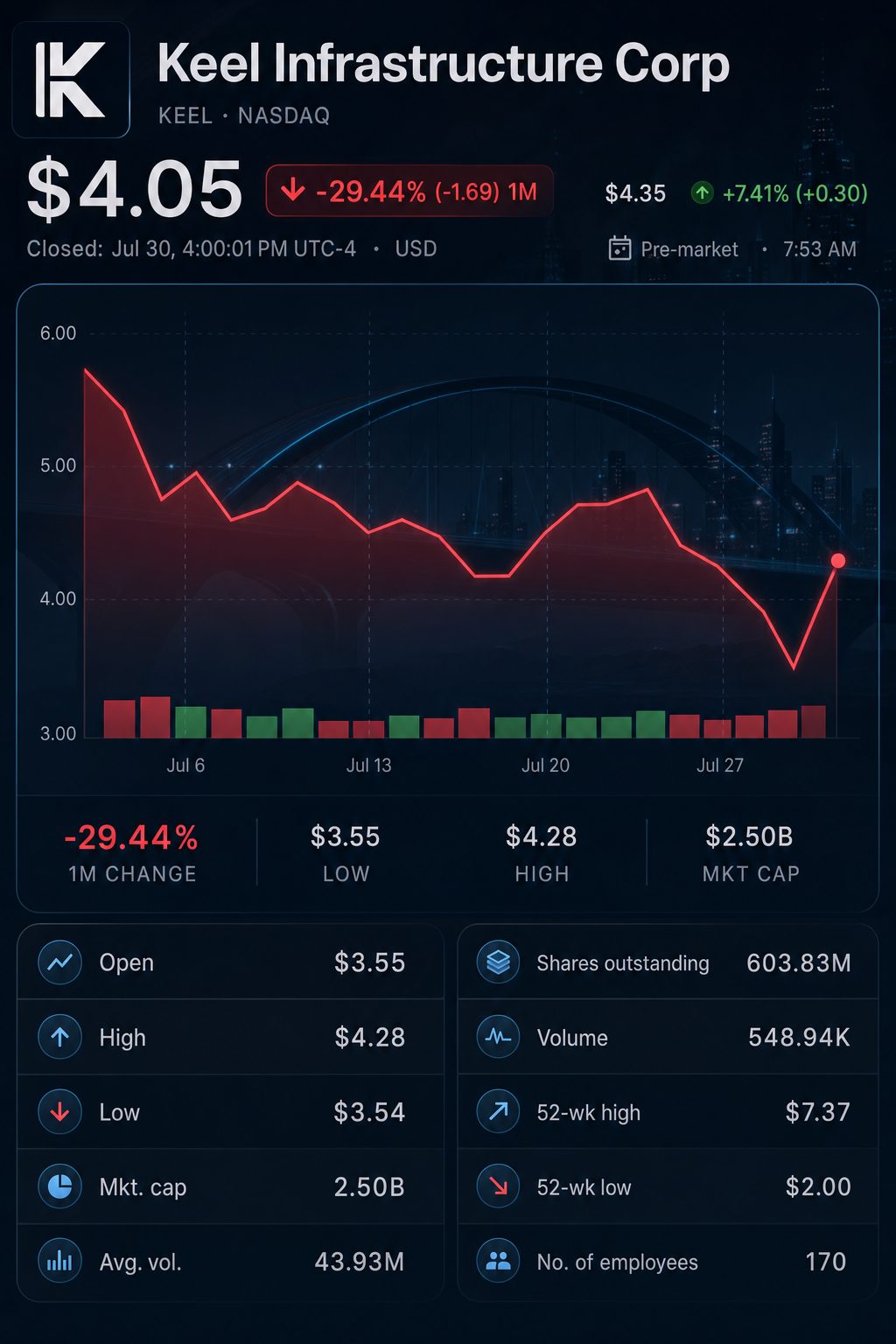
Keel ended the session at $4.05, gaining 27.4%, and advanced to $4.33 during Friday’s Nasdaq premarket. Regular U.S. markets were still shut.
BlackRock Inc. NYSE:BLK disclosed holding 50.95 million shares, representing 8.4%. The ownership event in the filing was dated June 30.
Keel was still down 4.9% compared to its close a week earlier. The company is set to report second-quarter earnings on August 10.
Shares of Keel Infrastructure surged following the disclosure of BlackRock’s ownership position. However, the stake’s crucial reporting date is a month earlier than Thursday’s stock surge.
The SEC recorded June 30 as the date of the ownership event, which was a day after Keel joined the Russell 3000.
BlackRock submitted its filing under Rule 13d-1(b), confirming its stake was acquired in the ordinary course of business and not with the intention to affect Keel’s control.
The filing omits mention of particular funds or exact purchase timings. While index-based accumulation is possible, this is only an assumption. In June, CEO Ben Gagnon described the Russell inclusion as a “meaningful milestone.” SEC
An initial estimate shows Thursday’s increase in equity value at around $525 million, about 2.5 times the closing value of the reported holding.
BlackRock’s filing compared to Thursday’s market response
Measure
Reported or estimated value
Comparison
BlackRock reported holding
50.95 million shares
8.4% of outstanding class
Value of stake at $4.05
$206 million
Closing value on Thursday
Increase in Keel equity value
$525 million
2.5x the value of the stake
Date of ownership / filing made
June 30 / July 29
Gap of 29 days
Initial estimate based on 603.83 million declared shares and a $0.87 closing increase.
The rally was broad-based. Shares in AI-focused data-center firms and ex-mining companies climbed. Most maintained gains by 07:00 EDT on Friday.
Keel took third place. Its increase of 27.6% surpassed the median of its six peers by 5.9 percentage points. The range of results undercuts an explanation focused solely on BlackRock.
Microsoft Corp. NASDAQ:MSFT played a key role in shaping the market tone. Shares climbed over 15% following an improved cloud forecast. The Nasdaq advanced 2.8%, and the PHLX chip index surged 8.2%. Argent Capital portfolio manager Jed Ellerbroek described AI-related stocks as “true battleground stocks.” Reuters
Keel’s shares have shown significant swings. The stock advanced 7.8% over the prior full week but fell 4.9% between last Friday and Thursday, even after jumping higher on Thursday.
A total of 66.3 million shares were traded, marking a 48% increase from the stock’s 65-day average volume.
Keel’s fundamentals continued to be soft amid its transition, with first-quarter revenue down 23% to $37 million. Adjusted EBITDA came in at negative $17 million, and liquidity as of May was $533 million.
In June, Keel finalized a $458 million offering of convertible notes. The notes have a 1.25% interest rate and are due to mature in 2032, with an initial conversion price set at $7.41.
An initial share-equivalent estimate results in approximately 61.8 million shares, representing 10.2% of the presently disclosed shares. The final amount of dilution will be determined by settlement methods and the extent of the capped-call protection.
Reference levels for pricing and financing
Reference level
Price
Above Thursday close
Thursday close
$4.05
Baseline
52-week high
$7.37
82.0%
Initial note conversion price
$7.41
83.0%
Capped-call cap
$11.86
192.8%
The two levels are almost identical. The conversion price is only 0.5% higher than Keel’s 52-week peak. Capped calls are designed to limit possible dilution up to $11.86.
Keel is set to announce second-quarter results on August 10 before markets open, with the release scheduled shortly after the upcoming week. Market participants are expected to watch closely for updates on lease execution across the company’s 2.2-gigawatt pipeline.
Risks: Keel is required to convert development sites into formal AI lease agreements. Any setbacks such as project delays, unplanned expenses, Bitcoin price swings or dilution of shareholders’ equity may swiftly halt the stock’s advance.
What is KEEL's current trading price, and how exceptional was Thursday’s market activity?
KEEL ended its latest regular session on July 30 at $4.05, a rise of 27.36%. Trading volume hit 66.3 million shares, 2.41 times the 20-session average. In premarket trade on July 31 at 6:58 a.m. EDT, shares changed hands at $4.32, another 6.67% higher. The 52-week span remains broad, ranging from $1.14 to $7.37. Thursday’s elevated volume means the premarket gain may fade quickly. (MarketScreener)
What drove the over 27% jump in KEEL?
No formal source identified a single reason for Thursday’s marked surge. A filing on July 29 revealed BlackRock held 50.95 million shares, representing 8.4%. The date of the ownership event was June 30, rather than July 29. BlackRock confirmed the stake was taken in the ordinary course and was not for control purposes. Some market analysts attributed the rally to the disclosure and possible index-related flows. That theory is plausible but unconfirmed. (SEC)
What do analysts’ price targets suggest based on the $4.05 closing price?
FactSet gives an average target price of $6.41, suggesting an upside of about 58%. The reported target spread is $4.50 to $10.00 from twelve analysts. Of those, eleven rate the stock as Buy, with one at Hold. Markets Insider pulls from six analysts, showing a $5.17 median and a range between $3 and $8. The overall consensus stays upbeat, though the number of analysts and target histories across providers vary significantly. (Barron's)
Is KEEL priced highly compared to its present financial performance?
Keel had a market capitalization near $2.45 billion at $4.05 per share. That figure values the company at about 10.7 times its projected 2025 sales of $229.3 million. First-quarter 2026 revenue declined 23% to $37.0 million, and net loss expanded to $145.4 million. With those losses, traditional P/E analysis is not applicable to the stock. Comparing current sales figures is also imprecise as Keel transitions its business model. The present valuation is largely based on expectations for future AI lease revenues rather than existing profits. (MarketScreener)
What can investors anticipate from the August 10 earnings announcement?
Keel is scheduled to release second-quarter results before markets open on August 10. The management will hold a conference call at 8:00 a.m. Eastern the same day. Analysts polled by FactSet estimate revenue of roughly $31 million, with a projected per-share loss of $0.068. In the first quarter, Keel posted revenue of $37.0 million and a continuing loss of $0.21 per share. The company’s management has previously aimed to secure leases at three locations in the near term by 2026. Securing a new tenant may be more significant for Keel than its historic mining performance. (Keel Infrastructure)
To what extent has Keel shifted away from the original Bitfarms mining operations?
On April 1, 2026, Keel took over as the U.S. parent of Bitfarms. Bitcoin mining accounted for $29.9 million out of the $37.0 million revenue in Q1, making up roughly 81% of the quarter’s total sales. Energy sales delivered an additional $5.9 million. Company leadership intends to wind down Bitcoin mining activities over 2026 and 2027. The business direction has shifted, but the revenue transformation is not yet complete. (SEC)
What portion of the 2.2-gigawatt AI pipeline can be considered truly de-risked?
Keel outlines a pipeline amounting to 2.2 gigawatts across Pennsylvania, Washington and Quebec. BTIG notes about 575 megawatts of approved power at four sites. These numbers reflect prospective development, not agreements with customers. The 96-megawatt power transfer in Sherbrooke still requires the Quebec ministry’s approval. Its land deal is conditional, with an expected close in early 2027. The $128 million Washington agreement pertains to equipment and materials rather than a customer lease. (barchart.com)
Does Keel possess sufficient capital, and how significant is the risk of dilution?
As of May 8, Keel reported liquidity of $533 million. According to management, the company has secured funding for three imminent sites through leasing, along with G&A expenses through 2028. In June, Keel issued an additional $458 million in 1.25% notes maturing in 2032. The outstanding 1.375% notes total $588 million and come due in 2031. This brings total principal to $1.046 billion, with annual interest payments of about $13.8 million. The initial conversion prices are $6.86 and $7.41, both exceeding $4.05. Capped calls help lower potential dilution, but financing risk remains. (SEC)
How does Russell 3000 inclusion impact KEEL?
Keel was added to the Russell 3000 at the start of trading on June 29. Inclusion often brings benchmark-linked buying by funds tracking the Russell indexes. BlackRock’s passive 8.4% stake may partially reflect such index-driven flows. That correlation is inferred and not proven causation. Becoming a member can enhance trading liquidity and visibility with institutional investors. However, inclusion does not generate revenue, boost earnings, or increase project returns. (Keel Infrastructure)
What is the most clear-cut bull versus bear scenario for stocks?
A single significant AI lease deal would confirm the strength of Keel’s power strategy and development approach. BTIG has set an $8 price target, citing prospects tied to about 575 megawatts of approved capacity. The bullish scenario points to FactSet’s $6.41 consensus or as high as $10. On the downside, risks include slow leasing activity, ongoing losses, and increased reliance on financing. Keel reported a first-quarter adjusted EBITDA loss of $17 million, highlighting the earnings shortfall. Analysts’ published price targets reach as low as $3.00, leaving a notably broad range of potential outcomes. (TradingView)
Michał Rogucki is a senior markets reporter at TS2.tech, specializing in stocks, technology and macroeconomic developments. A graduate of Humboldt University of Berlin, he previously worked in investment research and market analysis before transitioning to financial journalism. He covers the trends and events that matter most to investors worldwide.