Amazon.com (NASDAQ:AMZN) Cloud Profit Lift Pushes Nasdaq Futures Higher, Redefining Wall Street’s AI Benchmark

Amazon.com (NASDAQ:AMZN) Cloud Profit Lift Pushes Nasdaq Futures Higher, Redefining Wall Street’s AI Benchmark

NEW YORK, July 31, 2026, 09:10 EDT

  • Nasdaq 100 futures rose 1.15%, while S&P 500 futures were up 0.40%.
  • Amazon jumped 11% ahead of the opening bell, as Apple Inc. dropped 7.8%.
  • U.S. labor costs increased by 0.9% in the second quarter, surpassing expectations.

U.S. stock futures rose on Friday, driven by gains in Amazon’s cloud segment that offset Apple’s softer outlook. The Nasdaq 100 outperformed. The main session was set to open at 9:30 a.m. EDT.
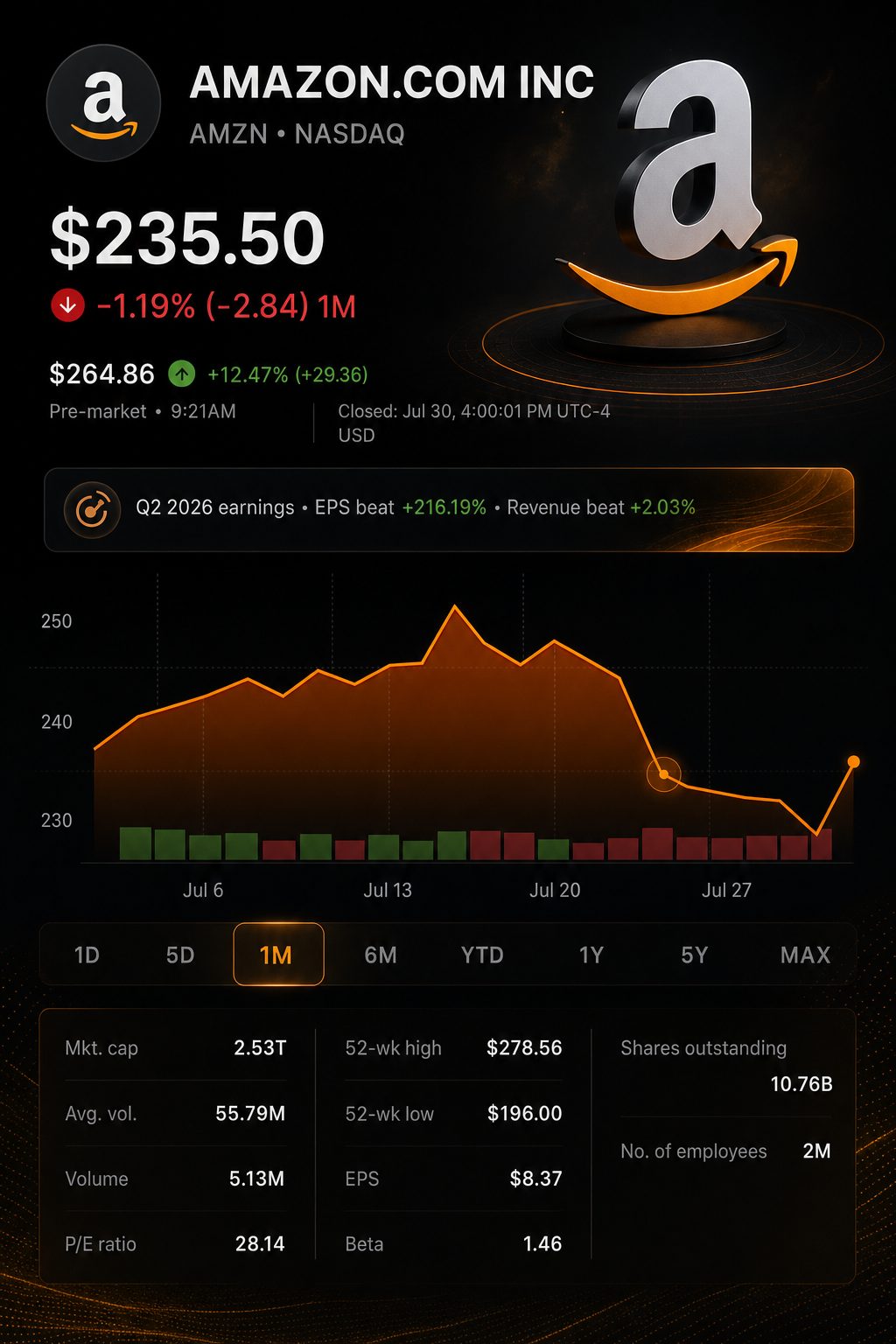
Stock chart for NASDAQ:AMZN

Investors are starting to distinguish between companies that are effectively monetizing artificial intelligence investments and those that are struggling financially, rather than dismissing hefty AI budgets across the board. On Thursday, Microsoft Corp. met this investor standard. Meta Platforms Inc. fell short.

GaugePre-open moveThursday cash close
Dow futures / Dowup 0.54%rose 1.19% to 52,208.06
S&P 500 futures / S&P 500up 0.40%climbed 1.66% to 7,437.63
Nasdaq 100 futures / Nasdaq Compositeup 1.15%advanced 2.78% to 25,122.18

Futures levels were recorded at 7:23 a.m. EDT, with cash closings taken from Thursday.

Technology shares led Thursday’s recovery, climbing 5.2%, and the market saw more advancers than decliners by a ratio of 2.2 to one. Trading volume exceeded the average from the last 20 sessions, with overall breadth also positive.

Each of the three major indexes was set to close the week higher, despite posting declines for the month. July proved difficult overall. The Philadelphia Semiconductor Index dropped over 20% during the month. Meanwhile, the equal-weight S&P 500 was on track for a fourth consecutive monthly gain.

Amazon’s quarterly results shed light on Friday’s buying interest. AWS accounted for 21% of total sales, yet contributed 60% of operating income. Its margin, at a calculated 39.3%, was almost three times the group’s overall margin.

Amazon Q2 metricAWSExcluding AWSGroup
Revenue$42.2 billion$158.4 billion$200.6 billion
Operating income$16.6 billion$10.9 billion$27.5 billion
Operating margin39.3%6.9%13.7%

Calculated through subtraction. Totals may vary due to rounding. Figures are based on Amazon’s disclosed data.

Chief Executive Andy Jassy said, “AWS is booming.” Shares rose despite a $7.6 billion outflow in trailing free cash flow. Investors backed a $220 billion plan for capital spending. The AWS backlog reached $496 billion. Reuters

Microsoft reported a similar deal. Azure increased by 43%, while executives projected 45% growth excluding currency fluctuations. Meta’s revenue climbed 28%, but free cash flow dropped by 91%.

CompanyGrowth evidenceMain concernShare response
AmazonAWS revenue increased by 37%Trailing twelve months FCF: -$7.6 billion; capital expenditure: $220 billionShares up 11.0% in premarket trading
MicrosoftAzure revenue rose by 43%Capital spending for 2026 reported at $175 billionShares gained 15.6% on Thursday
MetaRevenue grew by 28%Second-quarter FCF at $784 million, a 91% declineShares dropped 8.0% on Thursday
AppleRevenue rose 16.4%September outlook: +9%-11% compared to +12%Shares declined 7.8% in premarket

The figures reflect a mix of company disclosures, analyst projections, and initial market valuations.

Apple delivered a performance that stood apart from the cloud sector. Revenue increased by 16.4%, with iPhone sales climbing 21.7%. However, services revenue fell short of expectations, and guidance for September lagged behind analyst forecasts. Chief Executive Tim Cook pointed to “very significant supply constraints.” Reuters

Apple’s bigger valuation shifted the math. Its estimated premarket drop was greater than Amazon’s advance by straightforward calculation.

CompanyPrior-close market valueEarly movePreliminary implied change
Amazon$2.56 trillionup 11.0%increase of $282 billion
Apple$4.91 trilliondown 7.8%decrease of $383 billion
Combinednet loss of $101 billion

These initial estimates rely on previous session capitalisations and early premarket moves. They do not serve as predictions of closing values.

Nasdaq futures advanced regardless. This indicates that buying was not limited to a single positive earnings result. It further highlights that evidence of cloud strength held greater significance than overall spending on Friday.

Labor costs put a brake on the rally as rate-sensitive sectors reacted. The Employment Cost Index climbed 0.9%, topping the projected 0.8%. Wages were up 3.2% year-on-year. June’s core PCE inflation was at 3.3%, with second-quarter growth cooling to 1.5%.

Cash trading remains halted, setting the stage for the week-ahead test. July payrolls, anticipated on August 7, are forecast by economists at 91,000 jobs. Over a quarter of S&P 500 firms are scheduled to release results as well.

John Plassard at Cité Gestion summed up the requirement concisely. “Companies must also reassure investors about the drivers of future growth,” he said. Friday’s pricing reflected that principle. Reuters

Risks: Premarket gains may not hold once trading begins. Accelerating wage growth or robust payroll figures could renew expectations of rate hikes. Amazon continues to post significant cash burn, and Apple could still face ongoing supply issues.

TS2 TECH • EXTENDED COVERAGE

Further analysis

What is the expected opening level for the US stock market today?
Dow futures were up 0.54% at 7:23 a.m. ET. S&P 500 futures advanced 0.40%, and Nasdaq-100 futures increased 1.15%. The S&P 500 ended Thursday at 7,437.63, gaining 1.7%. The Dow finished the session at 52,208.06, while the Nasdaq closed at 24,122.18. These figures are premarket indicators and not final trading session prices. Reuters
What factors are influencing index movements today?
Amazon surged 11% in premarket trading following its fastest revenue rise in four years. Robust cloud performance helped ease worries about the payoff from AI-related investments. Apple slipped 7.8% amid cautions that supply issues could hamper its growth. Microsoft edged down 0.6% after a record market-value rally on Thursday. Nvidia advanced 1.2%, while Micron was up 4.4%. The Nasdaq is showing the biggest gains. Reuters
Is the surge widespread, or is it mainly focused on mega-cap tech?
Thursday’s sharp rally had an unusually limited breadth. The S&P 500 climbed 1.7%, but the equal-weighted index dropped 0.8%. Over 70% of S&P 500 stocks closed lower. Technology surged 5.6%, outpacing all other sectors by a wide margin. Only nine Dow Jones components finished higher. This divergence leaves the index’s recovery looking less robust. Barron's
Which leading index has seen the strongest performance in 2026?
As of Thursday, the Russell 2000 posted an 18.7% increase for 2026, outpacing other indexes. Both the S&P 500 and Dow climbed 8.6%, while the Nasdaq Composite advanced 8.1%. Gains among small-caps stood in stark contrast to the losses seen in technology stocks in July. The Philadelphia Semiconductor Index stayed down over 20% in the month. Leadership widened throughout the year. Thursday marked a shift. AP News
What action did the Federal Reserve take, and what is expected after that?
The Federal Reserve kept its target range steady at 3.50%–3.75% on July 29, with the decision splitting 9–3. Three officials favored raising rates by a quarter point. Markets saw a 33% chance of another pause in September, up from 18% the previous week. Policy expectations continue to react sharply to each new inflation report. Federal Reserve
Is the current progress on inflation sufficient to uphold stock prices?
Headline PCE prices declined 0.1% in June compared to May, but were still 3.7% higher than in June 2025. Core PCE posted a 0.1% month-on-month gain and climbed 3.3% over the year. Labor costs in the second quarter rose 0.9%, surpassing expectations of a 0.8% increase. Annual labor cost growth stayed at 3.4%, with wages up 3.2%. The ten-year U.S. Treasury yield hovered around 4.69% premarket. Data show inflation continues to cool in an uneven fashion. Bureau of Economic Analysis
Is the US economic slowdown significant enough to put earnings at risk?
Real GDP expanded at a 1.5% annual rate in the second quarter, down from 2.1% in the first quarter. Private domestic demand increased to 3.9%, compared with 1.7% previously. Real consumer spending for June rose by 0.4%. The personal saving rate dropped to 2.7%. Economic growth is cooling, but core demand stays solid. Lower savings put households at risk from additional price shocks. Bureau of Economic Analysis
Do present S&P 500 valuations align with the pace of earnings expansion?
FactSet’s July 24 data showed earnings trading at 20.1 times, above the five-year average of 19.9 and the ten-year average of 19.0. Analyst forecasts called for 27.3% earnings growth in calendar 2026. Blended growth for the second quarter reached 37.9%. That number was boosted by Alphabet's significant $98 billion securities gain. Excluding Alphabet, FactSet estimated growth at 25.9%. Profits remain strong, but valuation support is weak. FactSet Insight
What are analysts' projections for the S&P 500 at the end of the year?
A recent wide Reuters survey placed the median year-end forecast at 7,620, based on responses from 47 analysts between May 15 and 26. That marks an increase of about 2.5% over Thursday's 7,437.63 finish. Goldman Sachs projects a level of 8,000, indicating a potential gain of roughly 7.6%. UBS forecasts 7,900, suggesting around 6.2% upside. The range of estimates remains large, highlighting ongoing uncertainty over inflation, concentrated earnings, and bond yields. Reuters
What data releases on the horizon might alter the market outlook?
The JOLTS report is set for August 4, with productivity figures coming August 6. July payroll numbers will be published August 7, and July CPI is scheduled for August 12. Payrolls and CPI are expected to have the most significant effect on the indexes. Higher wage growth or stronger inflation could lead to higher yields and stricter policy. If hiring weakens while prices hold steady, rate-sensitive stocks may benefit. Forecast reliability remains low until these releases are published. bls.gov

Iwona Majkowska is a financial markets journalist at TS2.tech, specializing in stocks, artificial intelligence and technology. A graduate of the Warsaw School of Economics, she previously worked in equity research and financial analysis before focusing on market reporting. Her daily coverage helps investors follow major developments across U.S. and global markets. Follow Iwona Majkowska on Google News.

Previous Story

Micron Shares Top $900 as Apple, Samsung Highlight Widening Memory Supply Strain

SpaceX Starship Flight 13 advances V3 rollout, but booster landing failure raises questions over cost benefits
Next Story

SpaceX wins $1.6 billion Space Force contract; significant for rockets, but minimal impact on valuation