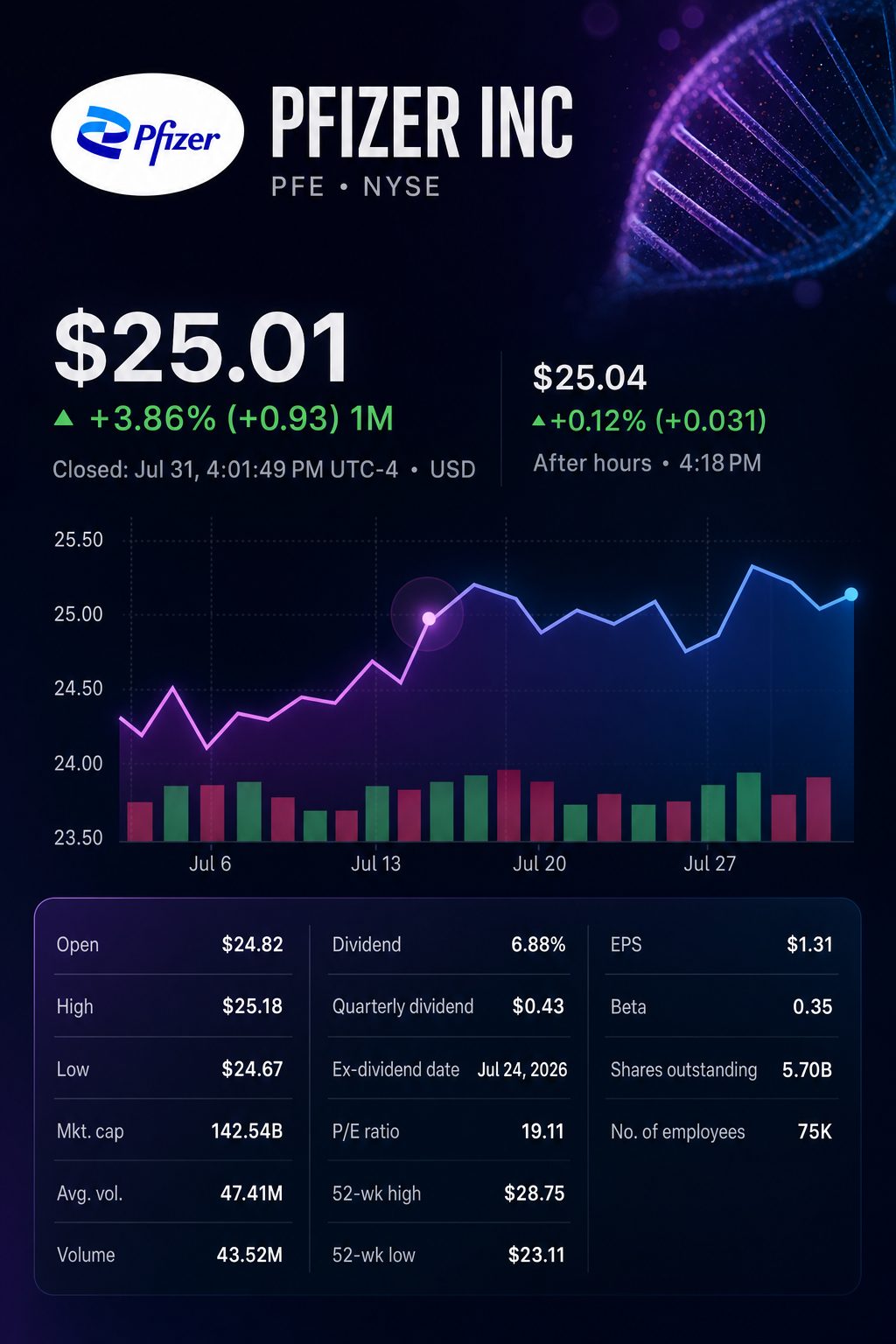
Pfizer’s unofficial close was $25.04, up 0.5% Friday and 2.0% for the week.
Bristol Myers Squibb NYSE:BMY reported 22% Eliquis growth and raised its 2026 outlook.
Preliminary estimates center near $14.4 billion in revenue and $0.68 adjusted EPS.
Pfizer Inc. NYSE:PFE enters Tuesday’s results with a stronger Eliquis signal. Its partner posted a 22% sales jump before Pfizer’s own report.
U.S. regular trading had just closed. Pfizer was marked at an unofficial $25.04, up 0.5% Friday. The stock gained 2.0% from the prior Friday.
Trading day
Close
Daily move
July 24
$24.54
-1.88%
July 27
$24.67
+0.53%
July 28
$25.25
+2.35%
July 29
$25.15
-0.40%
July 30
$24.91
-0.95%
July 31
$25.04
+0.52%
Friday’s figure was an unofficial close.
Bristol Myers reported $4.48 billion of quarterly Eliquis sales. It raised 2026 growth guidance to 20%-25%, from 10%-15%. “Our growth portfolio grew 15% in Q2,” Chief Commercialization Officer Adam Lenkowsky said. Reuters
Pfizer recognized $2.166 billion from Eliquis in its first quarter. That was up 8% operationally and equaled 15.0% of revenue.
Eliquis measure
Pfizer Q1 2026
Bristol Myers Q2 2026
Recognized revenue or sales
$2.166 billion
$4.48 billion
Year-on-year growth
+8% operational
+22%
Share of company revenue
15.0%
34.5%
2026 Eliquis growth outlook
Not separately disclosed
+20% to +25%
Pfizer’s figure includes alliance and product revenue. The two accounting bases are therefore not directly comparable.
The read-through is positive, but not mechanical. Bristol Myers’ raised forecast still reduces one near-term demand concern.
Pfizer will release results before Tuesday’s opening bell. Its analyst call begins at 10:00 a.m. EDT. Preliminary published estimates range from $14.40 billion to $14.45 billion in revenue. Adjusted EPS estimates center near $0.68.
Measure
Q2 2026 preliminary consensus
Q2 2025 actual
Implied change
Revenue
$14.40-$14.45 billion
$14.653 billion
-1.7% to -1.4%
Adjusted EPS
About $0.68
$0.78
-12.8%
The prior-year figures come from Pfizer’s reported results. Consensus estimates remain preliminary and can change.
The sales hurdle is low. The guidance hurdle is higher. Pfizer reaffirmed 2026 revenue of $59.5 billion to $62.5 billion and adjusted EPS of $2.80 to $3.00 in May.
Measure
Full-year midpoint
Q1 actual plus Q2 estimate
Second half required
Quarterly H2 average
Revenue
$61.0 billion
$28.85-$28.90 billion
$32.10-$32.15 billion
$16.05-$16.08 billion
Adjusted EPS
$2.90
About $1.43
About $1.47
About $0.74
The bridge uses Pfizer’s first-quarter results and preliminary Q2 consensus. It shows why full-year guidance may matter more than a routine earnings beat.
At Friday’s unofficial close, the annualized dividend implies a 6.9% yield. The stock trades at 8.6 times Pfizer’s adjusted EPS midpoint.
Investor calculation
Value
Friday’s unofficial close
$25.04
Quarterly dividend
$0.43
Annualized dividend
$1.72
Indicated dividend yield
6.9%
2026 adjusted EPS midpoint
$2.90
Price to guidance midpoint
8.6 times
Dividend divided by guidance midpoint
59.3%
These calculations use current guidance, not a new earnings forecast.
Pfizer paid $2.4 billion in first-quarter dividends. Current guidance assumes no share repurchases during 2026. That leaves operating execution carrying more of the equity case.
Thursday’s pipeline news also helped. Both pivotal LITFULO vitiligo studies met their co-primary endpoints at week 52. Michael Vincent, Pfizer’s inflammation chief, said the findings “give us confidence.” The release provided no numerical response rates, and regulatory filings remain ahead. Pfizer
Pfizer and BioNTech SE NASDAQ:BNTX also secured European authorization Wednesday. The XFG-adapted vaccine covers people aged six months and older. Shipping will begin soon. However, Pfizer’s 2026 plan already assumes about $5 billion of COVID-product revenue.
Risks remain clear. Bristol Myers’ Eliquis results will not translate one-for-one into Pfizer revenue. Pfizer also expects a $1.5 billion exclusivity-related sales drag during 2026. LITFULO’s positive studies still require regulatory review.
The week ahead turns on Tuesday. Investors will watch Eliquis, Padcev, Vyndaqel and operating costs. A guidance raise would change the setup. A routine beat may not.
What is the current performance of Pfizer shares, and are they outperforming the market?
Pfizer shares were last changing hands around $25.10 late Friday, up approximately 0.8%. In comparison, the S&P 500 advanced 0.7% by the close. The XLV healthcare fund was recently down about 0.2%. Intraday, Pfizer traded between $24.69 and $25.17. The stock remains around 13% below its 52-week peak of $28.75. AP News
What are Wall Street analysts anticipating for Pfizer's earnings on August 4?
Analysts project adjusted quarterly earnings at around $0.68 per share, with consensus revenue seen at about $14.45 billion. The current forecasts reflect a 13% drop in earnings and a 1.4% decline in revenue. Pfizer reported earnings of $0.78 per share on $14.65 billion in revenue for the same period a year ago. With slight discrepancies among provider estimates, company guidance is expected to influence market response. Pfizer
Can Pfizer still meet its full-year 2026 outlook?
Pfizer maintains its full-year revenue outlook at $59.5 billion to $62.5 billion. Adjusted earnings per share are still projected at $2.80 to $3.00. Revenue for the first quarter totaled $14.45 billion, with adjusted earnings per share at $0.75. The company kept all main guidance targets unchanged following these results. Adjusted EPS declined by 18% compared to the same period last year, while cost of sales increased to 24.6% of revenue from 20.7%.
Is Pfizer seeing growth in its business aside from COVID products?
Excluding Comirnaty and Paxlovid, revenue rose 7% operationally in the first quarter. Newly launched and acquired products contributed 22% operational revenue growth. Eliquis brought in $2.17 billion, while Nurtec sales rose 41%. Padcev sales advanced 39% to $591 million. In comparison, combined sales for Comirnaty and Paxlovid fell by $638 million. Select product growth was supported by positive pricing and supply factors.
Is the oncology approach led by Seagen producing outcomes?
Oncology sales climbed 7% on an operational basis to $3.83 billion in Q1. Padcev advanced 39%, while Lorbrena and Elrexfio each posted 32% growth. Padcev gained expanded approval in July for muscle-invasive bladder cancer, supported by a trial that lowered the risk of recurrence, progression, or death by 47%. However, Adcetris declined 13%, and Xtandi sales slipped 3%. Sigvotatug vedotin did not meet the overall survival endpoint in its full Phase 3 cohort. Pfizer Investors
What upcoming pipeline events might impact Pfizer shares?
The FDA has given Talzenna combined with Xtandi a priority review for an additional prostate cancer use. Study results showed the regimen cut the risk of radiographic progression or death by 52%. The FDA aims to make a decision in the fourth quarter of 2026. Litfulo achieved primary endpoints in two Phase 3 trials in vitiligo. Pfizer intends to submit regulatory applications; however, detailed efficacy data have not been released. About 20 pivotal trials are set to start, making 2026 an especially busy year for catalysts. Pfizer
Will Pfizer’s cost reductions balance patent expirations and increased R&D expenses?
Pfizer plans to cut $5.7 billion from its cost base by the end of 2026, with approximately $5.1 billion already realized by December 2025. Manufacturing-related efficiencies are set to deliver $1.3 billion in savings by the end of 2026. The integration of Metsera is expected to produce $600 million in annual cost synergies. Operating costs for sales and administration dropped 4% in the first quarter, but research expenditure increased 12%, driven in part by obesity and oncology projects. Adjusted earnings nevertheless fell 18%. SEC
Is Pfizer’s current dividend yield secure?
Pfizer issues a quarterly dividend of $0.43 per share, totaling $1.72 annually. Based on a share price around $25.10, this suggests an indicated yield close to 6.9%. The payout amounts to 57% to 61% of Pfizer’s adjusted earnings outlook. For the first quarter, the company reported $2.62 billion in operating cash flow. Dividend payments totaled $2.45 billion, while capital expenditures reached $436 million. As a result, free cash flow after capex was marginally below the reported dividend amount. Share buybacks remain off the table as the company prioritizes debt reduction. Pfizer
Is Pfizer stock trading below its intrinsic value at present levels?
Pfizer is valued at nearly 8.7 times the midpoint of its adjusted earnings forecast. Its trailing GAAP price-to-earnings ratio stands close to 19. The use of different earnings measures means the ratios are not directly comparable. According to analyst aggregators, average price targets range from $28.50 to $28.75, suggesting a potential upside of about 14% to 15%. Individual analyst targets span from $25 up to $35. Consensus ratings shift between Hold and Buy, depending on the source. MarketBeat
What are the main risks facing Pfizer investors at this time?
Upcoming patent expirations may cut 2026 revenue by around $1.5 billion. Gross debt stood at approximately $64.5 billion as of March 29, with net debt—after accounting for cash and short-term investments—at about $51 billion. The sigvotatug failure highlights how swiftly anticipated pipeline value can diminish. Comirnaty sales fell 59%, while Paxlovid dropped 63% operationally in the first quarter. These factors contribute to Pfizer’s current low valuation and elevated dividend yield. Reuters
Mateusz Kaczmarek is a financial and technology journalist at TS2.tech, covering stocks, artificial intelligence, semiconductors and global market developments. A graduate of the Poznań University of Economics and Business, he previously worked in financial analysis before moving into business journalism. His reporting focuses on technology companies, market trends and the forces shaping global investment markets. Follow Mateusz Kaczmarek on Google News.