NEW YORK, August 3, 2026, 06:04 EDT — Intel NASDAQ:INTC traded close to $90, supported by server business expansion based on firmer pricing and a greater share of premium products.
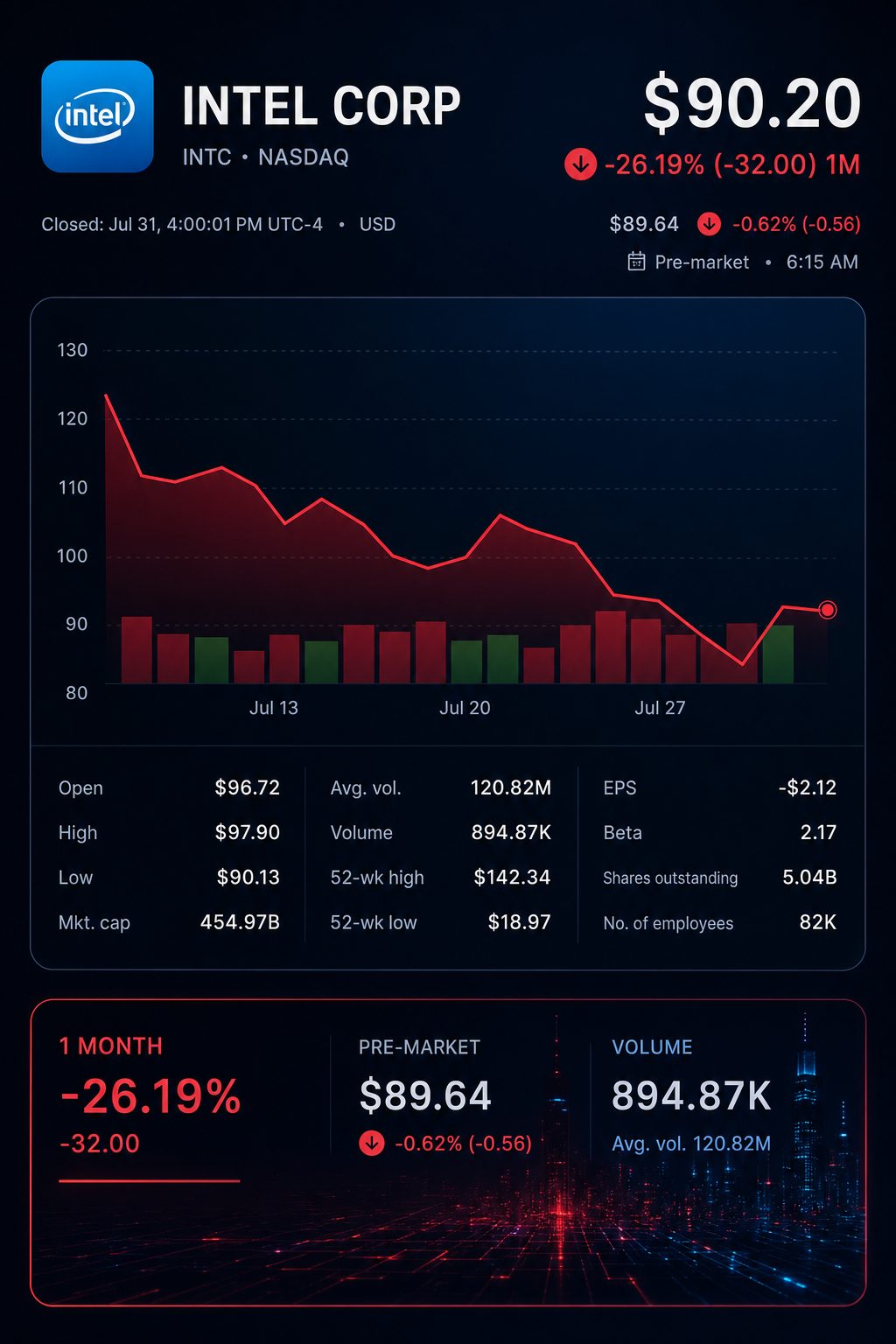
- Intel finished Friday at $90.20, falling 2.3% over the week.
- Server unit volume climbed 9%, with average selling prices up 48%.
- Advanced Micro Devices NASDAQ:AMD is due to report after the market closes on Tuesday.
Intel’s server performance in the second quarter was primarily driven by higher prices rather than an increase in units sold. The average selling price climbed 48%, while server unit volume was up 9%.
A price-times-volume bridge indicates about 61.3% growth in server revenue. Average selling price accounted for 48 percentage points, representing 78% prior to the interaction term. This serves as the immediate earnings benchmark.
| Server revenue bridge | Year-on-year change | Implied contribution |
|---|---|---|
| Average selling price | +48.0% | +48.0 points |
| Unit volume | +9.0% | +9.0 points |
| Price-volume interaction | — | +4.3 points |
| Implied server revenue | +61.3% | +61.3 points |
Based on author’s analysis of Intel filings. Numbers rounded.
Intel reported that the majority of the ASP rise was driven by premium products. According to the company, demand-based pricing had less influence and only partially countered increased input expenses.
Demand remained strong. Orders from hyperscalers drove up volume, although internal capacity restricted shipments. Intel forecasts that industry-wide component shortages will continue until 2027.
Chief Financial Officer Dave Zinsner pointed to “higher factory yields and improved cycle times.” Intel is increasing equipment, expanding clean-room area and boosting substrate capacity. SEC
Nasdaq was yet to begin regular trading. In premarket, quotes hovered close to $90 following Friday’s $90.20 finish. Intel slipped 2.3% over the past week but was 1.9 points ahead of the chip ETF.
| Security | July 24 close | July 31 close | Weekly change |
|---|---|---|---|
| Intel | $92.32 | $90.20 | -2.3% |
| Advanced Micro Devices | $521.95 | $476.15 | -8.8% |
| NVIDIA Corporation NASDAQ:NVDA | $206.84 | $200.75 | -2.9% |
| Taiwan Semiconductor Manufacturing Co. NYSE:TSM | $403.41 | $404.25 | +0.2% |
| iShares Semiconductor ETF NASDAQ:SOXX | $527.01 | $504.89 | -4.2% |
Weekly variations are calculated from the closing value of the prior Friday.
A higher proportion of advanced servers directly boosted profits. Data Center and AI operating margin climbed to 40%, representing an increase of 24 percentage points.
| Intel segment | Q2 revenue | YoY change | Operating margin | Prior-year margin |
|---|---|---|---|---|
| Client Computing and Physical AI | $8.88 billion | +13% | 26% | 26% |
| Data Center and AI | $6.26 billion | +59% | 40% | 16% |
| Intel Foundry | $5.77 billion | +31% | -36% | -72% |
Revenue for the segment reflects intersegment transactions.
Foundry performance was better, though the headline misses detail. The division posted a loss of $2.09 billion. External sales reached $293 million, or about 5% of total segment revenue.
Futurum Group strategist Shay Boloor said “The stock can continue revaluing if Intel converts the current data center shortage into sustained revenue growth.” He also mentioned foundry economics and external customer wins. Reuters
Intel’s third-quarter forecast continues to serve as a key support. The revenue midpoint surpassed the preliminary LSEG consensus by 7.9%. Adjusted EPS guidance came in roughly 41% higher than consensus.
| Metric | Intel outlook | Previous benchmark | Difference |
|---|---|---|---|
| Q3 revenue | $15.8–$16.8 billion | $15.1 billion LSEG estimate | Up 7.9% at midpoint |
| Q3 adjusted EPS | $0.38 | $0.27 LSEG estimate | Increase of 40.7% |
| 2026 capital expenditure | $20 billion | Prior plan: $18 billion | Up 11.1% |
*Initial analyst consensus issued following Intel’s earnings release.
The revised spending plan shifts some potential profit gains into operational risk. Management increased the 2026 capital expenditure target to $20 billion. CEO Lip-Bu Tan further pledged that Intel would achieve high-volume 14A production in 2028.
Reuters reported last week that Intel granted RosaicLabs access to Atom processor technology. Intel rarely licenses its x86 technology. The company would not comment.
The next peer test is set for Tuesday. AMD projects quarterly revenue of $11.2 billion, with a possible variation of $300 million. The company anticipates an adjusted gross margin around 56%.
Intel has no investor events scheduled for this week. As a result, AMD’s comments on server demand provide the most transparent public view of market demand.
Risks: Additional supply may put pressure on prices until demand recovers. Foundry operations are still running at a loss and third-party sales are limited. Increased capital expenditures heighten cash requirements and execution risk.
The next piece of evidence is straightforward. Intel needs to convert limited demand into increased unit output while maintaining its premium product mix.
Related articles: NASDAQ:INTC