
NEW YORK, August 7, 2026, 04:42 EDT — Nasdaq premarket action is underway, with the main session set to start at 09:30 EDT.
- Texas approved over $16.8 billion for the initial phase and expects 3,000 jobs.
- SpaceX transactions accounted for 10.1% of Tesla Energy’s revenue in the second quarter.
- An initial $119 billion total build would surpass the cash and securities SpaceX held as of June.
SpaceX NASDAQ:SPCX and Tesla NASDAQ:TSLA plan to make an initial investment exceeding $16.8 billion in Terafab, their upcoming semiconductor facility in Texas. Local JETI tax deals have been finalized and are currently in force. Texas authorities have also granted $30 million in state funding.
This makes chip shortages a challenge in capital allocation. Firms anticipate that computing demand will exceed one terawatt. Terafab aims to integrate logic, memory, packaging, and testing.
Tesla Energy’s less prominent investor connection is SpaceX, which accounted for $318 million of the division’s second-quarter revenue. This represented 10.1% of the segment’s total, rising from 3.6% in the previous quarter.
Tesla Energy’s link to SpaceX
| Period | SpaceX Megapack revenue | Share of Energy revenue | Implied order margin | Tesla Energy margin |
|---|---|---|---|---|
| Q1 2026 | $87 million | 3.6% | 25.3% | 39.5% |
| Q2 2026 | $318 million | 10.1% | 23.9% | 20.4% |
| First half | $405 million | 7.3% | 24.2% | 28.7% |
Provisional estimate: first-quarter numbers are derived by subtracting second-quarter outcomes from first-half aggregates. Margins calculated based on revenue and cost data reported by Tesla.
The business in the second quarter posted a gross margin of 23.9%. This was 3.5 percentage points higher than the margin reported by Tesla Energy’s segment. As a result, SpaceX contributed approximately 11.9% of the segment’s gross profit for the quarter. Tesla recorded the deals as regular Megapack sales, making no connection to Terafab.
The planned 100-million-square-foot facility is set to deliver Tesla robots and Cybercabs, as well as back SpaceX’s upcoming orbital data centers. Intel NASDAQ:INTC is involved in the chip initiative, building on a prior collaboration. Musk stated Terafab will “produce AI chips at scale for use on Earth and in space.” Reuters
Terafab compared to SpaceX assets
| Project scope | Stated investment | Versus SpaceX June cash and securities | Versus SpaceX first-half capex |
|---|---|---|---|
| Phase one announced | Over $16.8 billion | No less than 16.8% | No less than 0.59 times |
| May filing plan | $55.0 billion | 55.0% | 1.93 times |
| Full potential build — initial | $119.0 billion | 119.0% | 4.18 times |
SpaceX’s $100.01 billion in cash and marketable securities and $28.48 billion in first-half property investments are the basis for the comparisons. Project totals are combined figures. The proportion each company has contributed has not been revealed.
The comparison shown is meant for illustration. It does not attribute the entire bill to SpaceX. However, the initial phase remains substantial compared to an already ambitious construction cycle.
SpaceX invested $28.48 billion in property and equipment in the first half. The company generated $3.47 billion from operating activities, resulting in a capex ratio of 8.2 times and leaving a $25.01 billion gap to be covered before financing. SpaceX also reported a loss of $541 million on $7.81 billion in revenue for the second quarter.
Comparison of capital intensity
| Company | First-half operating cash flow | First-half capex | Capex-to-cash-flow ratio | June cash and liquid securities |
|---|---|---|---|---|
| SpaceX | $3.47 billion | $28.48 billion | 8.2 times | $100.01 billion |
| Tesla | $8.63 billion | $8.28 billion | 1.0 times | $43.52 billion |
All figures are rounded. SpaceX reported June liquidity after $85.68 billion in net IPO proceeds.
Tesla projects capital expenditures to exceed $25 billion in 2026, driven largely by investments in AI infrastructure and factory growth. Spending in the first half of the year nearly matched the company’s operating cash flow. The launch of Terafab comes amid substantial capital investment by both firms.
Power is the next hurdle for execution. SpaceX intends to construct natural-gas facilities at the location. The company assured residents that this project will not raise ERCOT prices. Plans also call for closed-loop water systems drawing from the Gibbons Creek Reservoir, rather than using local groundwater.
Terafab’s Riley Trennell stated, “Now with the JETI done, we are going to be moving nearly immediately.” Renderings might be released in the coming days. Construction could start in the next few months. https://www.kbtx.com
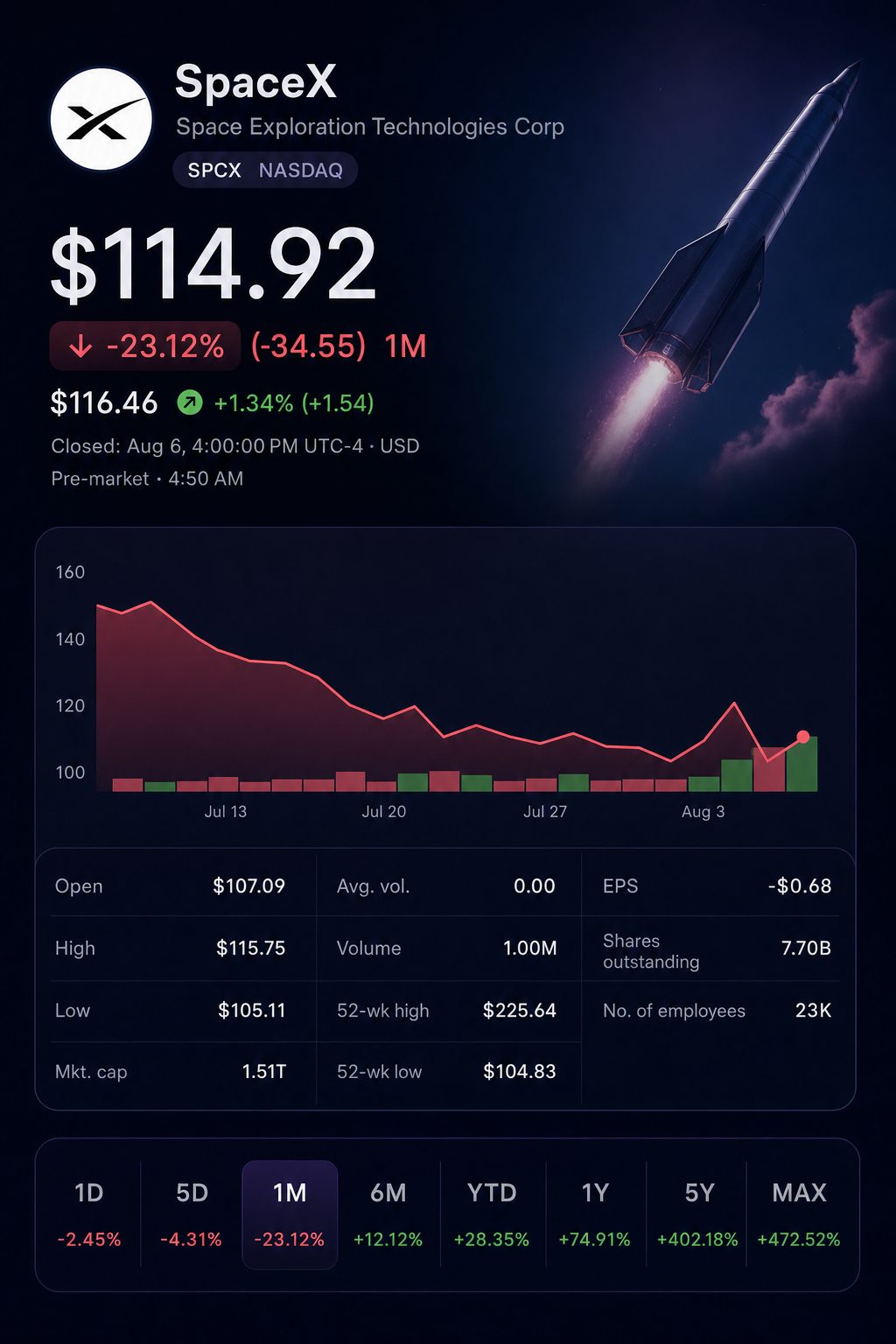
SpaceX ended Thursday with shares at $114.92, a gain of 6.1%. The stock had dropped almost 14% the previous day. SpaceX is still trading 14.9% under its IPO price of $135. Tesla closed down 0.6% at $319.53.
Wall Street sentiment is largely upbeat, though analysts have notably raised their spending forecasts. Target valuations now span a broad range.
Analyst ratings following SpaceX’s second-quarter results
| Firm and analyst | Rating | Target | Latest action | Upside from $114.92 |
|---|---|---|---|---|
| Morgan Stanley NYSE:MS, Adam Jonas | Overweight | $300 | Reaffirmed | 161.1% |
| Oppenheimer (NYSE:OPY) | Outperform | $250 | Reaffirmed | 117.5% |
| Bank of America NYSE:BAC | Buy | $235 | Reaffirmed | 104.5% |
| Piper Sandler NYSE:PIPR, Alexander Potter | Neutral | $140 | Reduced from $156 | 21.8% |
Thursday’s closing price is used for upside calculations. Price targets represent predictions and are not assurances.
Jonas described the insider share unlock as an opportunity for investors to purchase at lower prices. He forecasts $300 by mid-2027. Morgan Stanley contributed as an underwriter on the IPO. Potter noted the lockup overhang will “remain a valuation headwind until Summer 2027.” AP News
The $30 million state grant amounts to just 0.18% of phase-one expenditure, making it more procedural than financial in impact. While it helps meet an incentive requirement, it has minimal effect on the overall funding picture.
Risks: Details on funding allocation, expected production timeline, chip fabrication nodes, and power output have not been shared. Factors such as semiconductor yield rates, permit acquisition, gas output, and water usage restrictions may drive up expenses. The $119 billion total build-out is an early, possible estimate rather than a present pledge.
Related articles: NASDAQ:SPCX