
Published: November 7, 2025
Key facts at a glance
- Launch target:Sunday, Nov. 9, window opens 2:45 p.m. ET (19:45 GMT) from LC‑36, Cape Canaveral Space Force Station. This is New Glenn’s second flight.
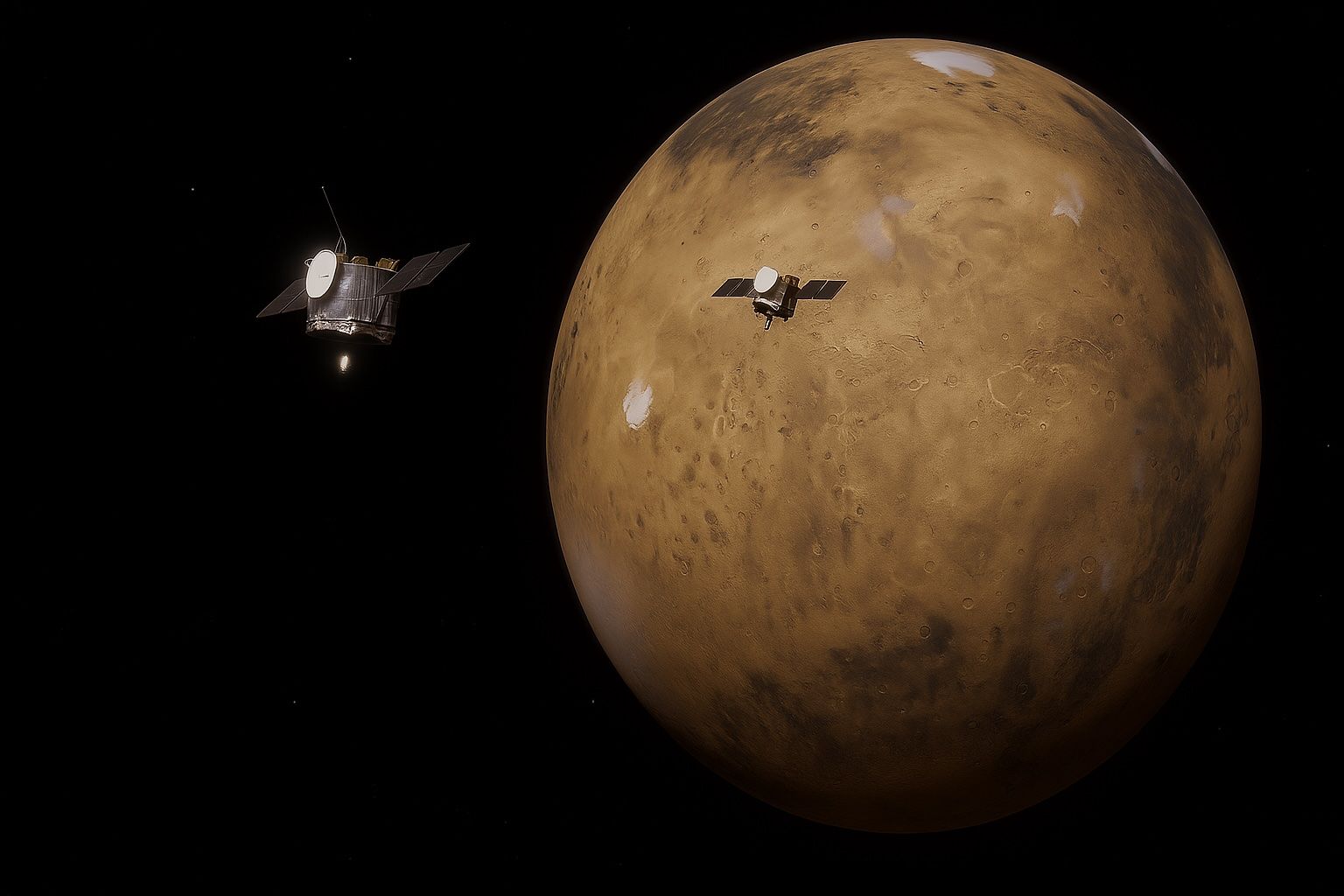
- Payload: NASA’s ESCAPADE twin satellites—“Blue” and “Gold”—a first-of-its-kind dual‑spacecraft Mars mission; spacecraft built by Rocket Lab and operated by UC Berkeley. Estimated mission cost ≈ $80 million. Space+1
- Livestream: Blue Origin will host a live webcast; Space.com plans to carry the feed.
- Booster recovery: Blue Origin is planning an ocean droneship landing attempt after stage separation.
- If scrubbed: Next attempt Monday, Nov. 10, 2:40–4:08 p.m. ET; current forecast shows ~65% “go” conditions from the 45th Weather Squadron. Spectrum News 13
What’s launching and why it matters
Blue Origin’s New Glenn is slated to lift off Nov. 9 carrying ESCAPADE—Escape and Plasma Acceleration and Dynamics Explorers—two identical NASA satellites designed to explain how Mars lost most of its atmosphere and water. The probes will make coordinated measurements to build a 3D, time‑varying picture of Mars’ upper atmosphere and magnetic environment, something a single spacecraft can’t do. It’s NASA’s first dual‑satellite mission to another planet, marking a milestone for low‑cost planetary science.
Each spacecraft carries electrostatic analyzers (UC Berkeley) to track charged particles, a magnetometer (NASA Goddard) to map magnetic fields, plasma sensors (Embry‑Riddle), and student‑built cameras (Northern Arizona University) that may even catch Martian auroras. Together they’ll quantify atmospheric escape—the long‑term leakage of gases to space—key to understanding Mars’ climate history and planning future human missions.
Launch timing, site, and vehicle
- When:Sunday, Nov. 9; 2.5‑hour window opens 2:45 p.m. ET (19:45 GMT).
- Where:Launch Complex 36, Cape Canaveral Space Force Station, Florida.
- Vehicle: Blue Origin New Glenn (Flight NG‑2).
This will be New Glenn’s second mission; the rocket debuted in January 2025. Blue Origin will again attempt to land the first stage at sea after liftoff.
Kennedy Space Center Visitor Complex lists public viewing options and confirms the NET Nov. 9, 2:45 p.m. target and a droneship landing.
How to watch the launch live
Blue Origin will stream the launch live; Space.com intends to carry the webcast. The stream typically starts about 60–30 minutes before the window opens; check Blue Origin’s channels shortly before 2:45 p.m. ET on launch day.
Backup window and weather
Local coverage reports a ~65% chance of favorable weather for Sunday’s attempt. If New Glenn stands down, the next window is Monday, Nov. 10, from 2:40–4:08 p.m. ET. As always on the Space Coast, cumulus cloud and electric‑field rules are the primary watch‑items.
What ESCAPADE will do en route—and why the trajectory is unusual
Instead of a classic direct transfer, ESCAPADE will first cruise to the Earth–Sun L2 region, spend roughly 12 months there collecting space‑weather data, and then use an Earth gravity assist in November 2026 to head for Mars. Arrival is targeted for September 2027, followed by ~7 months of orbit‑tuning and ~11 months of joint science. This “loiter‑and‑slingshot” approach widens launch opportunities and could make future Mars traffic less dependent on narrow planetary alignments. Space+1
Who built and operates the mission
- Spacecraft: Built by Rocket Lab for NASA’s SIMPLEx program, designed for lower‑cost, higher‑agility planetary missions.
- Operations: The twin probes, “Blue” and “Gold”—named for UC Berkeley’s colors—will be operated from the university’s Space Sciences Laboratory in the Berkeley Hills. Berkeley News
UC Berkeley emphasizes that mapping the ionosphere is also practical: it affects radio propagation, a vital consideration for navigation and comms for crews on the surface.
What else is flying on New Glenn NG‑2
Alongside ESCAPADE, New Glenn is carrying a Viasat technology demonstration supporting NASA’s Communications Services Project (CSP)—part of the agency’s strategy to expand commercial space‑to‑ground communications. Blue Origin highlights the Viasat payload in its NG‑2 mission overview; Spectrum News also notes Viasat’s HaloNet demonstrator.
Why this launch is a big deal for Blue Origin
NG‑2 represents another step in maturing New Glenn as a heavy‑lift workhorse. The rocket’s inaugural flight was January 2025; Blue Origin did not nail the booster landing then and will try again on ESCAPADE. A successful ascent and droneship recovery would underscore reusability and cadence ambitions as the company heads into a busier manifest.
What happens after launch (mission timeline)
- Launch & parking orbit (Nov. 9): New Glenn inserts ESCAPADE on its Earth‑escape trajectory.
- Cruise to Earth–Sun L2 (~12 months): Instruments gather heliophysics data while teams check out both spacecraft.
- Earth flyby (Nov. 2026): Gravity assist sends the twins toward Mars.
- Mars arrival (target Sept. 2027): ~7 months to shape matching orbits, then 11 months of synchronized, “stereo” measurements of Mars’ magnetosphere and upper atmosphere. Space
FAQ
What time is liftoff?
The window opens 2:45 p.m. ET (19:45 GMT) on Nov. 9 and runs for 2.5 hours.
Where can I watch?
Via Blue Origin’s livestream (Space.com plans to embed it). Arrive early; streams usually start 30–60 minutes pre‑window.
Why two satellites instead of one?
Simultaneous measurements from different vantage points capture rapid changes in plasma and magnetic fields, enabling a true 3D view of atmospheric escape.
Who leads the science?
UC Berkeley leads ESCAPADE; instruments come from UC Berkeley, NASA Goddard, Embry‑Riddle, and Northern Arizona University.
What if weather or technical issues scrub Sunday?
A backup Monday, Nov. 10 (2:40–4:08 p.m. ET) is on the books; current outlook is ~65% favorable for Sunday with standard Florida concerns.
Sources and further reading
- Space.com: Launch timing, webcast details, NG‑2 context, cost, and trajectory specifics.
- Space.com (mission feature): Instruments, science goals, route via L2, and arrival timeline.
- UC Berkeley (Berkeley News): Team leadership, operations center, ionosphere/communications relevance, and “Blue & Gold” naming. Berkeley News
- Kennedy Space Center Visitor Complex: Public viewing info, NET time, and droneship landing plan.
- Blue Origin (NG‑2 mission page): NOEARLIERTHAN date, Viasat tech demo for NASA’s CSP.
- Spectrum News 13 (Orlando): Weather odds, backup window, and Viasat HaloNet payload note.
This is a developing launch schedule; always confirm same‑day updates with the launch provider or Kennedy Space Center before traveling.
Related articles: NASDAQ:RKLB