Today: 2 July 2026
Browse Category

Satellites 21 June 2025 - 5 July 2025

This Week in Space: Interstellar Visitors, Satellite Breakthroughs, and the Future of Space Policy / Updated: 2025, July 5th, 11:59 CET

This Week in Space: Interstellar Visitors, Satellite Breakthroughs, and the Future of Space Policy / Updated: 2025, July 5th, 11:59 CET

NASA’s ATLAS telescope identified the interstellar comet 3I/ATLAS, currently about 420 million miles from Earth, with closest approach to the Sun on October 30, 2025, and it will pass safely between Mars and Earth as the third confirmed interstellar visitor after 1I/ʻOumuamua and 2I/Borisov. July marks Aphelion Day, when Earth is about 94.5 million miles from the Sun, but axial tilt, not distance, drives seasonal heat, with northern summers lengthened as Earth moves slower in its orbit at aphelion. Earth’s rotation is speeding up, shortening days by milliseconds, with scientists warning that a leap second may be subtracted by 2029,
Space News Roundup: Strategic Satellites, Interstellar Visitors, Quantum Networks, and More / Updated: 2025, July 4th, 12:00 CET

Space News Roundup: Strategic Satellites, Interstellar Visitors, Quantum Networks, and More / Updated: 2025, July 4th, 12:00 CET

Boeing won a $2.8 billion U.S. Space Force contract to develop two Evolved Strategic Satellite Communications (ESS) satellites, with options for two more, for NC3 in geostationary orbit, with first delivery targeted for 2031. MethaneSAT, a $134 million satellite funded by the Environmental Defense Fund and Jeff Bezos’ Earth Fund, was lost after 15 months in orbit, ending methane-emission monitoring that had revealed some regions emit up to 10 times higher than prior estimates. ESA launched MTG-S1, the first geostationary meteorological sounder, alongside Copernicus Sentinel-4 to deliver real-time high-resolution atmospheric data for Europe. NASA’s Mars Reconnaissance Orbiter, in operation since
Space News Roundup: Satellite Internet, Climate Monitoring, and the Expanding Role of Space Technology (June 30, 2025) / Updated: 2025, June 30th, 14:21 CET

Space News Roundup: Satellite Internet, Climate Monitoring, and the Expanding Role of Space Technology (June 30, 2025) / Updated: 2025, June 30th, 14:21 CET

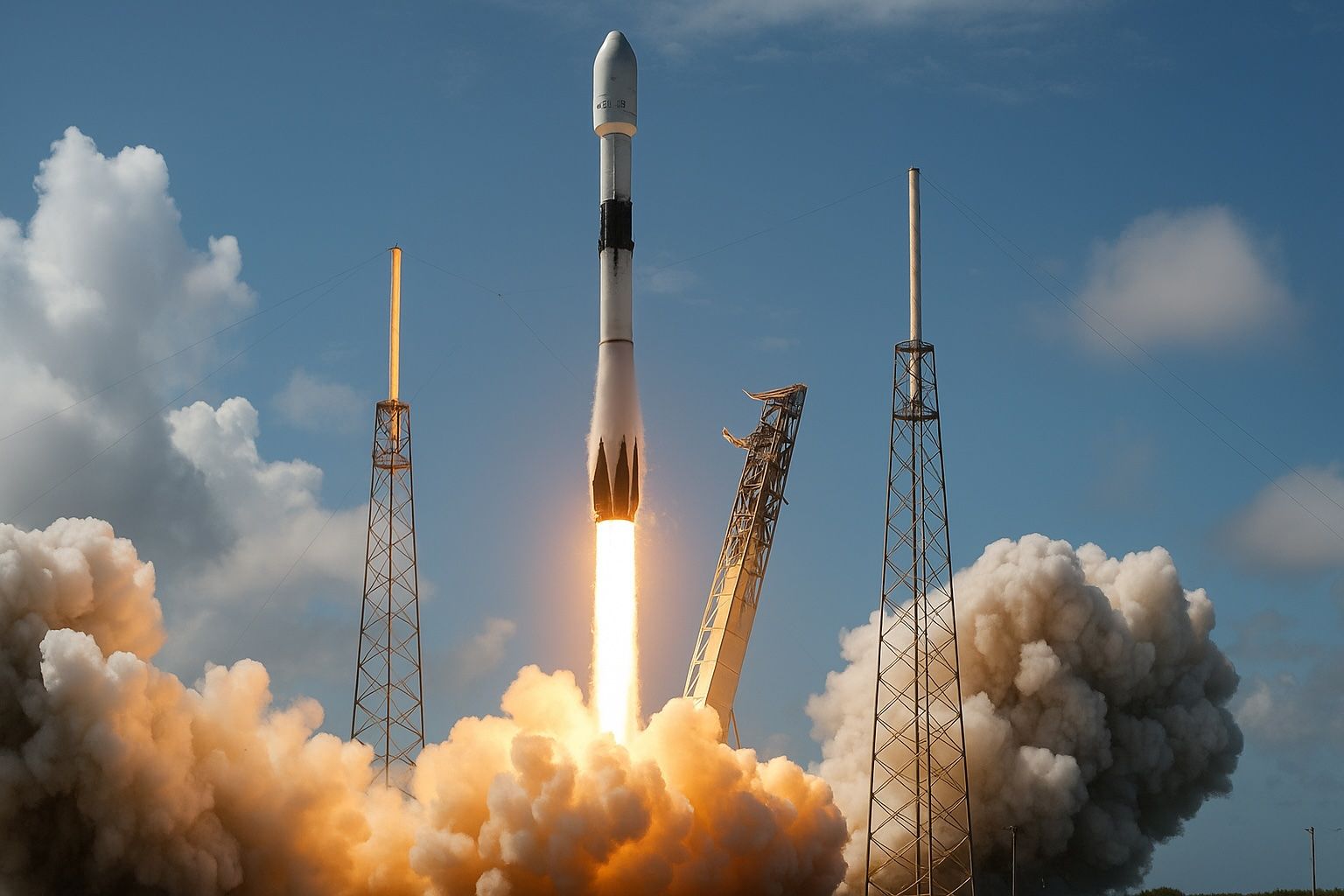
Starlink, SpaceX’s satellite internet constellation, now has over 5 million customers in 125 countries, with rivals including Eutelsat OneWeb, Globalstar, and Amazon’s Project Kuiper and government-led IRIS2 and QianFan programs. Vodafone and AST SpaceMobile formed SatCo, a Luxembourg-based joint venture aiming to deliver direct-to-device satellite connectivity across Europe by 2026, integrating with 4G/5G networks. MTG-S1, Europe’s next-generation Meteosat Third Generation Sounder, carries the Sentinel-4 payload for air quality and atmospheric monitoring over Europe and North Africa, and will launch on a SpaceX Falcon 9 with major European industry partners Thales Alenia Space, Airbus, GMV, and SENER. Japan’s GOSAT-GW climate satellite
Latest Satellite News / Updated: 2025, June 29th, 16:39 CET

Latest Satellite News / Updated: 2025, June 29th, 16:39 CET

Vera C. Rubin Observatory released its first images in Chile, capturing 10 million galaxies in a single frame and previewing the Legacy Survey of Space and Time (LSST) to map billions of galaxies. Curiosity rover on Mars captured a 360-degree panorama of boxwork ridges at Gale Crater using 291 Mastcam images. China’s Tianwen-3 Mars Sample Return mission targets a 2028 launch and a 2031 return. Japan’s final H-2A rocket launch deployed the GOSAT-GW climate satellite, as the country transitions to the H3 rocket with an overall 98% success rate over 50 launches. Amazon launched its second Kuiper internet satellite batch,
Texting From Space: The T-Mobile–Starlink ‘T-Satellite’ Launch Heralds the Direct-to-Device Era

Texting From Space: The T-Mobile–Starlink ‘T-Satellite’ Launch Heralds the Direct-to-Device Era

In August 2022, T-Mobile and SpaceX announced an ambitious partnership called “Coverage Above and Beyond,” aiming to end mobile dead zones by connecting standard smartphones to SpaceX’s Starlink satellitest-mobile.comt-mobile.com. Under this vision, Starlink’s low-Earth-orbit satellites would broadcast using T-Mobile’s cellular spectrum, essentially acting as space-based cell towers. The goal: provide “near complete coverage” in regions previously unreachable by cell signals, from national parks and mountains to remote highwayst-mobile.comt-mobile.com. T-Mobile CEO Mike Sievert framed it as “two industry-shaking innovators challenging the old ways… to create something entirely new”, while SpaceX chief Elon Musk declared it means “no dead zones anywhere in the world for your cell phone”t-mobile.com. The initiative, now branded by T-Mobile as “T-Satellite with Starlink,” targets roughly 500,000 square miles of U.S. territory that lack any cellular coverage geekwire.com. Instead of forcing people to carry special satellite phones, T-Satellite is designed to work with the phone already in your pocket, requiring no extra hardware or attachmentst-mobile.com rcrwireless.com. Most recent smartphones will be compatible, automatically connecting to a satellite when terrestrial signal is lost. This inclusive approach even extends to subscribers of other carriers. T-Mobile opened the service to competitors’ customers during the beta, and “hundreds of thousands” of AT&T
Space Technology News Roundup: Satellites, Launches & Deep Space Updates / Updated: 2025-06-27 16:54

Space Technology News Roundup: Satellites, Launches & Deep Space Updates / Updated: 2025-06-27 16:54

ESA’s Biomass satellite, the first with a P-band SAR, released its initial high-resolution images and enables 3D mapping of forest structure for carbon accounting. Rocket Lab’s 67th Electron launch deployed four satellites—three HawkEye 360 Cluster 12 microsatellites and the experimental Kestrel-0A—marking the ninth Electron mission in 2024. Amazon’s Project Kuiper added 27 satellites to reach a total of 54, launched on an Atlas V, intensifying competition with SpaceX’s Starlink. WISeSat.Space plans a 100-satellite secure LEO constellation by 2027 to deliver encrypted IoT connectivity using post-quantum encryption. Finland acquired its first military SAR satellites from ICEYE, expanding independent reconnaissance and surveillance
Airbus CO3D: AI-Powered, Laser-Linked Constellation for 50 cm Global 3D Mapping

Airbus CO3D: AI-Powered, Laser-Linked Constellation for 50 cm Global 3D Mapping

Airbus’s Constellation Optique 3D is a cutting-edge Earth observation project poised to revolutionize how we map and monitor the planet. Set for launch in July 2025, CO3D is a constellation of four laser-linked, AI-enabled optical satellites that will deliver 50 cm resolution imagery and generate a global 3D map of Earth’s land surfaces airbus.com cnes.fr. Developed in partnership with the French Space Agency, this dual-use system promises unprecedented detail and timeliness in geospatial data. From advanced optical sensors to onboard artificial intelligence and inter-satellite laser communications, CO3D brings a host of innovations that could make it a game changer in Earth observation airbus.com. Below, we delve into the project’s history, technical features, applications, and how it stacks up against other players like Maxar and Planet Labs, as well as analogous missions from NASA. The CO3D program traces its origins to 2019, when CNES selected Airbus Defence & Space to build a new constellation to succeed the stereo imaging capability of the French Pléiades satellites cnes.fr. Pléiades provided high-resolution 2D and limited 3D imagery, but CO3D is designed to take this further by covering the entire globe in three dimensions with much higher fidelity cnes.fr. Under the contract, Airbus is tasked
State of Space and Satellite Technologies in 2025 (Updated: June 27th, 2025)

State of Space and Satellite Technologies in 2025 (Updated: June 27th, 2025)

The Artemis I mission lifts off in a spectacular night launch on November 16, 2022, marking the first flight of NASA’s Space Launch System mega-rocket. Artemis I sent an uncrewed Orion spacecraft around the Moon and back, laying the groundwork for future crewed lunar missions nasa.gov. This milestone exemplifies the rapid resurgence of lunar exploration and the growing capabilities of modern space technology. The global space industry has entered an unprecedented era of growth and innovation as of 2025. What was once the domain of superpower governments is now a vibrant landscape of public agencies and private companies pushing the frontiers of technology. The “space economy” – encompassing everything from rockets and satellites to space-enabled services – reached an estimated $570 billion in annual revenue in 2023, nearly double its size a decade ago pwc.com. Commercial activities account for roughly 80% of this value, reflecting a major shift toward private-sector leadership in space pwc.com. With declining launch costs, smaller and cheaper satellites, and surging demand for space-based data, humanity’s presence in orbit has expanded dramatically. Over 11,000 active satellites now serve Earth spinoff.nasa.gov ndtv.com, a number growing by the day thanks to large “megaconstellations.” This report provides a comprehensive overview
Latest Satellite News & Insights 26.06.2025

Latest Satellite News & Insights 26.06.2025

NASA’s James Webb Space Telescope captured images of exoplanet TWA 7b, a Saturn-mass planet orbiting the young star TWA 7, using high-contrast imaging and a coronagraph. Israeli airstrikes on western Iran targeted military satellites, air defense systems, and missile infrastructure, using around 20 fighter jets and over 30 munitions. ESA’s Biomass satellite, launched in April, released its first images mapping global forests using radar to measure the carbon stored in forests. A transient radio signal from NASA’s long-inactive Relay 2 satellite was detected on Earth, likely caused by an electrostatic discharge. The U.S. Space Force’s FY26 budget includes $277 million
Eyes in the Sky, Data in the Cloud – Satellite Downlink & Cloud Integration Market Skyrockets by 2032

Eyes in the Sky, Data in the Cloud – Satellite Downlink & Cloud Integration Market Skyrockets by 2032

The Satellite Data Downlink & Cloud Integration market is experiencing a boom, driven by surging demand for geospatial data and real-time insights across sectors. Marrying satellites with cloud computing infrastructure has unlocked unprecedented scalability and accessibility for space-derived data. Key highlights of this market outlook include: In summary, the Satellite Data Downlink & Cloud Integration market is on a skyward trajectory, fueled by technological innovation and the insatiable demand for timely, cloud-delivered insights from space. The following report provides a comprehensive analysis of this market’s definition, drivers and restraints, latest trends, segmentation, regional dynamics, competitive landscape, and a forecast through 2032.
Orbital Quantum Leap: First Photonic Edge-Computing Satellite Set to Transform Space Data Processing

Orbital Quantum Leap: First Photonic Edge-Computing Satellite Set to Transform Space Data Processing

Space-Based Quantum Revolution – In a historic milestone for space and quantum technology, a photonic quantum computer no larger than a shoebox has been launched into Earth orbit. Riding aboard SpaceX’s Transporter-14 mission on June 23, 2025, this miniature quantum processor – the first of its kind in space – promises to rewrite how satellites handle data Interestingengineering Dig. Developed by an international team led by physicist Philip Walther at the University of Vienna, the device is designed to withstand the harsh environment of orbit while performing advanced computations on-board. This breakthrough could enable satellites to analyze imagery and sensor information in real-time, beaming down insights instead of raw data, and it foreshadows profound impacts on wildfire monitoring, secure communications, and even deep-space exploration. Designing a quantum computer for space meant shrinking an entire optics lab to shoebox dimensions and ruggedizing it for launch. The result measures about 15 × 15 × 45 cm and weighs ~9.5 kg Ac. Its frame is aluminum, housing an optical circuit made of borosilicate glass, with fiber-optic cables, lenses, mirrors, and even a titanium-mounted single-photon source carefully packed inside Ac. Impressively, the system consumes
Uzbekistan’s Internet Makeover: Blazing Speeds, New Satellites, and Lingering Barriers

Uzbekistan’s Internet Makeover: Blazing Speeds, New Satellites, and Lingering Barriers

Uzbekistan’s internet infrastructure has rapidly evolved from slow dial-up and DSL connections to modern fiber-optic and wireless networks. The state-run operator Uztelecom has extended fiber-optic backbones beyond major cities in recent years budde.com.au, boosting fixed broadband capacity off a historically low base. Today, most urban neighborhoods can access fiber-to-the-building or DSL broadband, while rural areas increasingly rely on mobile networks for connectivity. Mobile coverage is extensive – 2G networks blanket 99% of the population, 3G covers about 90%, and 4G LTE reaches roughly two-thirds of residents as of 2022 freedomhouse.org. In 2023, Uzbekistan began rolling out 5G: thousands of base stations have been upgraded or built, with the first phase aiming for full 5G coverage in the capital Tashkent and partial coverage in provincial centers kun.uz kun.uz. As these upgrades continue, even remote villages are gradually coming online via a mix of fiber links, microwave relays, and cellular towers. Despite this progress, last-mile connectivity in some rural and mountainous areas remains a challenge. Many outlying villages until recently had little to no internet due to sparse infrastructure and electricity shortages freedomhouse.org freedomhouse.org. The government and international donors are targeting this digital divide with projects to extend fiber and power supply
Latest Satellite News & Insights 25.06.2025

Latest Satellite News & Insights 25.06.2025

EarthDaily Analytics launched its first Earth observation satellite, initiating a next-generation ten-satellite constellation to deliver daily AI-ready global imagery and analytics, with the full constellation expected to be operational next year. SpaceX launched 27 Starlink satellites from Cape Canaveral on a Falcon 9 booster (B1080) in its 20th flight, with the first stage successfully recovered, expanding global internet coverage to over 7,800 active relays. James Webb Space Telescope captured its first direct image of exoplanet TWA 7 b about 110 light-years away using a coronagraph on the MIRI instrument. ESA’s Biomass satellite released its first radar images using P-band synthetic
Jeff Bezos vs. Elon Musk: How Amazon’s New Kuiper Satellites Could Disrupt a $100 Billion Space‑Internet Gold Rush

Space Race Frenzy: Exploding Starships, Quantum‑Proof Satellites & Europe’s Billion‑Dollar Constellation Shake‑Up — Everything That Hit Orbit TODAY (24 June 2025)

The past 24 hours delivered a blizzard of space headlines: an explosive Starship test darkened Elon Musk’s Mars timeline; Europe’s “Project Bromo” megaconstellation stalled amid board‑room drama; the U.S. Space Development Agency surprised the Pentagon by lofting a prototype SATCOM bird four months early; T‑Mobile promised Starlink‑powered mobile data for every U.S. dead‑zone; and a shoebox‑sized CubeSat beamed the world’s first post‑quantum–encrypted message from orbit. Below is a curated briefing on the stories that actually matter, why experts say they are consequential, and what to watch next. Airbus, Leonardo and Thales are still wrangling over a joint LEO‑satellite champion:
Space Race 2.0: A Shoebox‑Sized Quantum Satellite Blasts Off—Can It Make Hackers Obsolete?

Space Race 2.0: A Shoebox‑Sized Quantum Satellite Blasts Off—Can It Make Hackers Obsolete?

The maiden flight of QUICK³, a 4 kg CubeSat led by Germany’s Technical University of Munich, has hurled quantum‑secure communications research into orbit. Launched 23 June 2025 on SpaceX’s Transporter‑14 rideshare from Vandenberg SFB, the nanosatellite carries the first true single‑photon source ever flown, a laser‑pumped hexagonal‑boron‑nitride chip that could underpin an unhackable global data network. Over the next few months the mission will verify both the hardware’s survivability and one of quantum theory’s most fundamental postulates—the Born rule—under micro‑gravity. If successful, QUICK³ will shorten the path toward a constellation of hundreds of low‑cost quantum relay satellites and fundamentally new cybersecurity standards. “In this mission we are testing single‑photon technology for nano‑satellites for the first time… The transmission speed is a key advantage of our system.” —Prof. Tobias Vogl, TUM tum.de
“Unhackable from Orbit!” – How a 4 kg CubeSat Just Kicked‑Off the Race for a Global Quantum‑Secure Internet

“Unhackable from Orbit!” – How a 4 kg CubeSat Just Kicked‑Off the Race for a Global Quantum‑Secure Internet

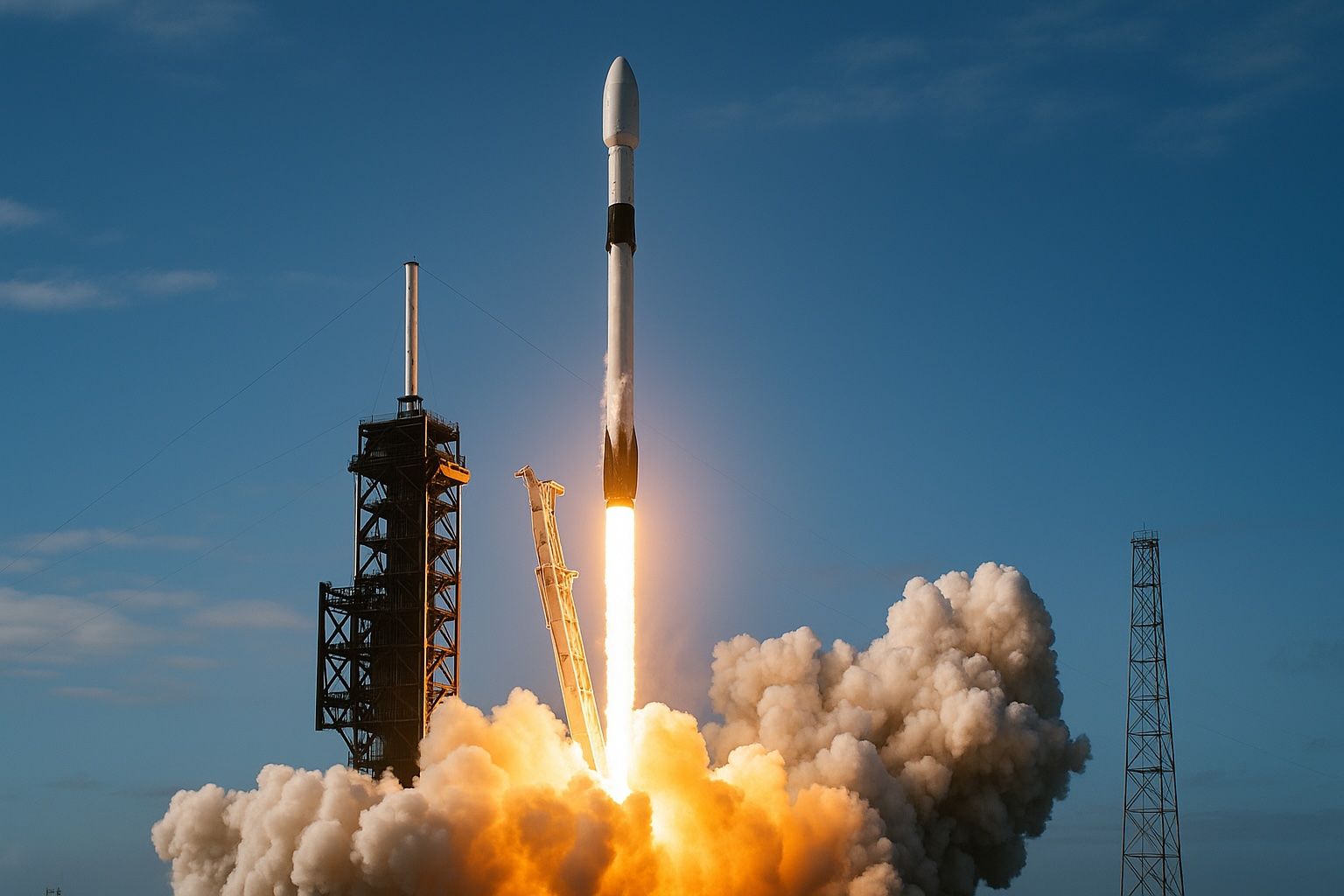
At 07:18 UTC on 23 June 2025, a Falcon 9 lifted the QUICK³ nano‑satellite into a 550 km sun‑synchronous orbit from Vandenberg Space Force Base during SpaceX’s Transporter‑14 rideshare mission. Although low coastal clouds obscured the pad, onboard cameras confirmed successful separation of the shoebox‑sized payload barely nine minutes after booster launch. tum.de Traditional fiber‑based quantum key distribution tops out at ≈400 km because faint laser pulses are attenuated and cannot be amplified without destroying the information encoded in single photons. QUICK³ bypasses that limit by sending true single photons through near‑vacuum upper atmosphere, slashing loss and enabling intercontinental links. tum.deadvancedsciencenews.com
Umbrella in Orbit: ESA’s BIOMASS Satellite Lifts Earth’s Green Veil, Revealing Hidden Carbon Stores and Jaw‑Dropping First Images

Umbrella in Orbit: ESA’s BIOMASS Satellite Lifts Earth’s Green Veil, Revealing Hidden Carbon Stores and Jaw‑Dropping First Images

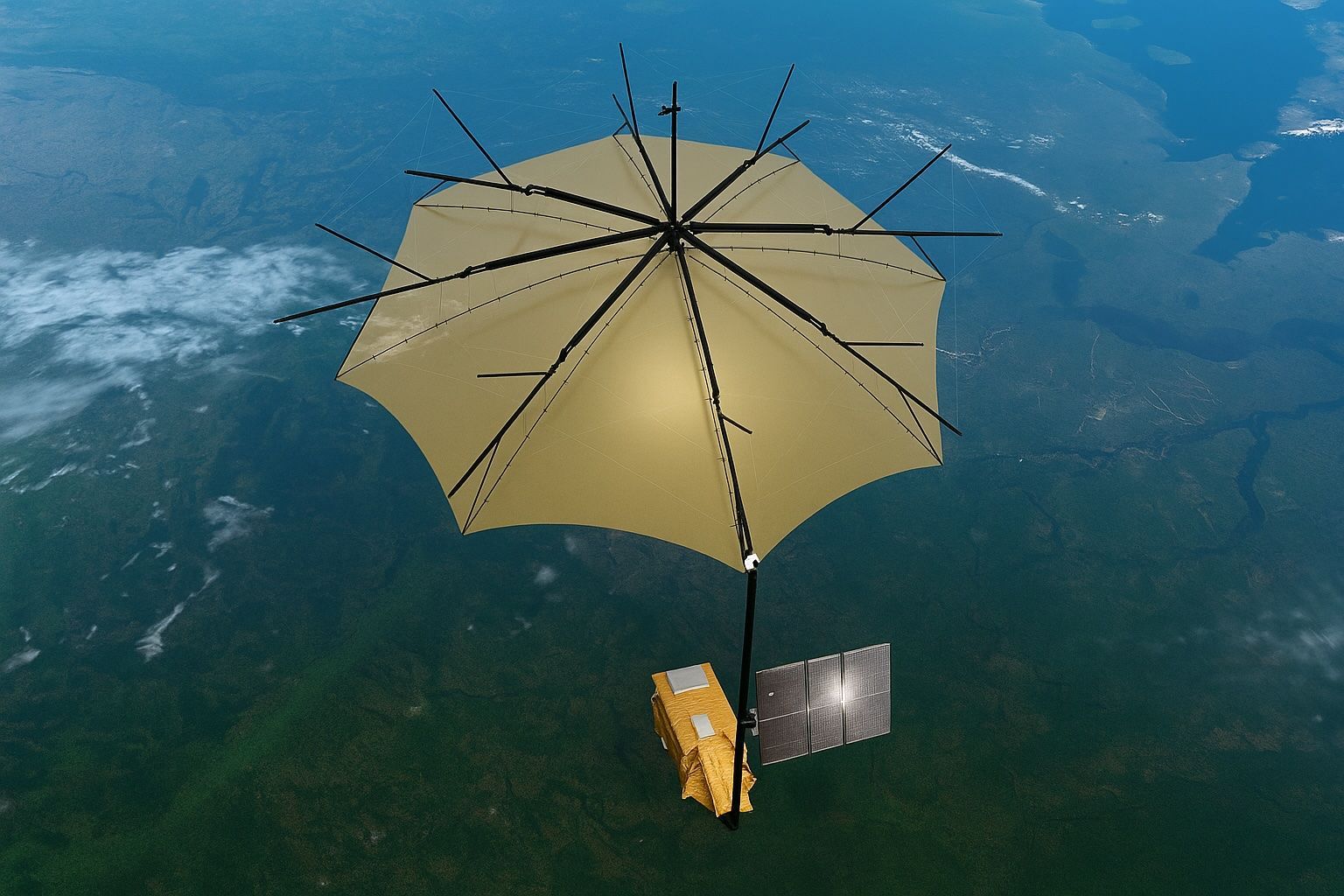
The European Space Agency’s new BIOMASS mission has started to deliver on its dramatic promise: a 12‑metre, umbrella‑shaped radar antenna that peers through dense jungle canopies has sent back its first colour‑coded maps of the Amazon, Indonesia and even the bedrock of the Sahara—offering an unprecedented view of how much carbon the world’s forests really hold, and how fast it is disappearing. phonandroid.com esa.int space.com Michael Fehringer, ESA’s project manager, hailed the commissioning results as “nothing short of spectacular…and only a mere glimpse of what is still to come.” esa.int
24 June 2025
Oceanography and the Eye in the Sky: How Satellites Are Redefining Our Oceans

Oceanography and the Eye in the Sky: How Satellites Are Redefining Our Oceans

Studying the vast oceans from the deck of a ship or a buoy has always been a daunting challenge. Today, fleets of Earth-observing satellites serve as an “eye in the sky” for oceanographers, providing a continuous, planet-wide view of the seas. Unlike traditional ship-based methods that can only cover limited regions at a time, satellites offer synoptic and frequent coverage of nearly the entire ocean surface noc.ac.uk. This revolutionary capability comes at a critical time – from tracking global sea-level rise to monitoring powerful currents and storms, satellites have become indispensable for understanding and managing the oceans in an era of rapid environmental change. In short, modern oceanography has been redefined by satellite technology, which allows scientists to observe the oceans with unprecedented detail and timeliness, transforming how we assess everything from daily weather to long-term climate trends. At the heart of satellite oceanography is radar altimetry, a technique for measuring the height of the sea surface from space. An altimeter is an active microwave radar instrument that sends a pulse of radio waves straight down to the ocean and times how long it takes for the echo to return star.nesdis.noaa.gov. By multiplying this round-trip time by the speed of
23 June 2025
Sky Watchers: The 2025–2033 Boom in Weather & Climate Satellite Constellations

Sky Watchers: The 2025–2033 Boom in Weather & Climate Satellite Constellations

The period 2025–2033 is witnessing an unprecedented boom in satellite constellations dedicated to weather forecasting and climate monitoring. Around the globe, space agencies and private companies are deploying hundreds of new satellites to observe Earth’s atmosphere, oceans, and environment with greater fidelity and frequency than ever before. In fact, forecasts indicate over 5,400 Earth observation satellites will be launched from 2024 to 2033, nearly triple the number from the previous decade Mundogeo. This surge is driven by advances in miniaturization, lower launch costs, and the urgent need for high-quality data on weather patterns and climate change. The result is a rapidly expanding network of satellites – from large next-generation meteorological observatories to swarms of CubeSats – that promise global coverage, faster revisit times, and new environmental insights. This report provides an overview of this landscape, examining major government programs, private-sector constellations, upcoming missions, technological trends, and the market and geopolitical forces shaping this boom. Today’s weather and climate satellite infrastructure is truly global and multi-layered. It includes a mix of geostationary satellites parked 36,000 km above the equator providing continuous regional coverage, and polar-orbiting satellites circling the Earth to scan every latitude in successive swaths. Traditionally, a handful of governmental
Latest News and Developments in Satellites (2024–2025)

Latest News and Developments in Satellites (2024–2025)

The past year has seen an unprecedented surge in satellite launches, serving a wide array of purposes in communications, Earth observation, science, and defense. Global launch rates reached record highs – over 1,200 satellites were launched in just the first four months of 2025, about a 50% increase from the same period a year prior orbitaltoday.com. This boom is driven largely by commercial mega-constellations and new national players joining the space race. Notable recent launches include: In sum, recent launch activity spans megaconstellation deployments for global communications, new Earth-observing missions, and a continuing cadence of military satellites, reflecting the broadening scope of space utilization. Notably, today’s launches often carry dozens of microsatellites at once, enabled by rideshare services, which boosts launch numbers and makes access to orbit more affordable for smaller organizations orbitaltoday.com. Through Q1 2025, SpaceX alone conducted 36 orbital Falcon 9 launches orbitaltoday.com, helping push the world toward an anticipated 3,000+ satellites launched in 2025, an annual record if realized orbitaltoday.com.

Stock Market Today

  • ASX Seen Lower as Oil Falls on US-Iran Talks; Northern Star Resources Holds to Gold Sales Goal
    July 1, 2026, 9:04 PM EDT. Australian stocks look set to open down Thursday with oil slipping over 1% to the lowest since March after progress in US-Iran talks eased concerns over supply. Northern Star Resources kept its fiscal 2026 gold sales target, giving the mining sector a steadier footing while the broader market weakens. Investors remain cautious, watching commodity moves as geopolitical headlines hit sentiment.
Go toTop