
Dow Drops 1,153 Points as Fed Hold and Oil Surge Raise Rate Risk
30 July 2026
2 mins read

Dow Drops 1,153 Points as Fed Hold and Oil Surge Raise Rate Risk

NEW YORK, July 30, 2026, 04:20 EDT

  • The Dow fell 2.19%, while the S&P 500 lost 1.52%.
  • The two-to-10-year Treasury spread widened about 11 basis points.
  • Index futures gained roughly 0.1% before GDP and inflation data.

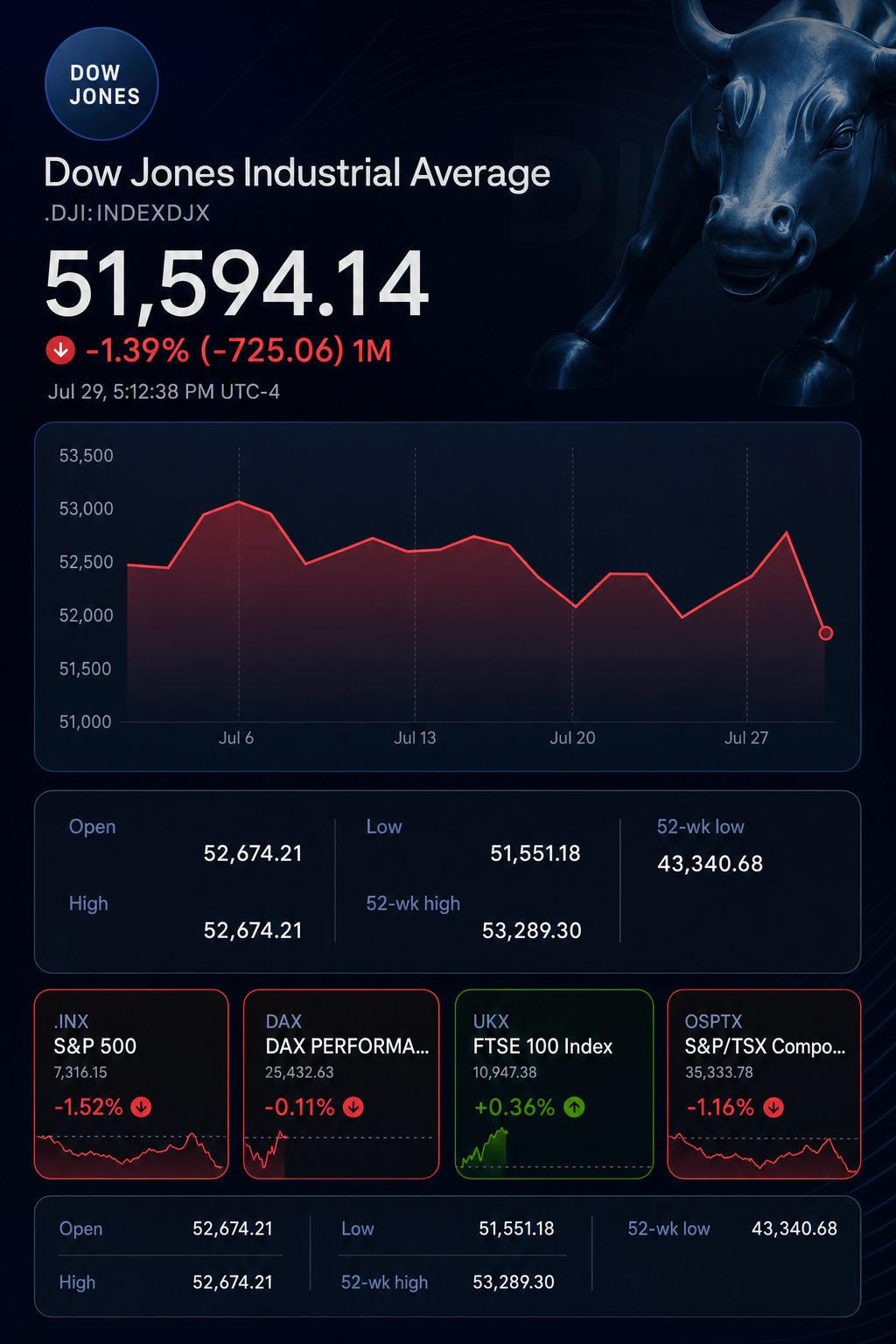
The Dow Jones Industrial Average shed 1,153.18 points Wednesday, closing at 51,594.14. The S&P 500 fell 1.52%. The Nasdaq Composite lost 1.74%. Oil’s 7%-8% jump and the Federal Reserve’s rate hold revived inflation fears.
The bond market gave the clearer warning. The two-year Treasury yield fell 3.52 basis points to 4.242%. The 10-year yield climbed 7.53 basis points to 4.679%.

That widened the two-to-10-year spread by about 11.1 basis points, to 43.7. The pattern suggests less immediate tightening but greater concern about longer-run inflation. Higher long yields raise the valuation hurdle for distant profits.

All four major indexes were lower for the week through Wednesday. Small caps still held the strongest 2026 gain.

Stock chart for INDEXDJX:.DJI
IndexWednesday closeDaily moveWeek to date2026 return
S&P 5007,316.15-1.52%-1.3%+6.9%
Dow Jones51,594.14-2.19%-0.7%+7.3%
Nasdaq Composite24,442.94-1.74%-2.1%+5.2%
Russell 20002,906.31-1.6%-0.8%+17.1%

U.S. cash markets were closed at the dateline. Futures traded slightly higher at 4:05 a.m. EDT. The move recovered little of Wednesday’s decline.

Overnight marketLevelChange
Dow futures51,852+0.17%
S&P 500 futures7,358.50+0.10%
Nasdaq-100 futures27,370.75+0.11%
WTI crude$84.79+0.39%
Gold$4,044.00+0.19%

Futures figures were delayed by at least 10 minutes.

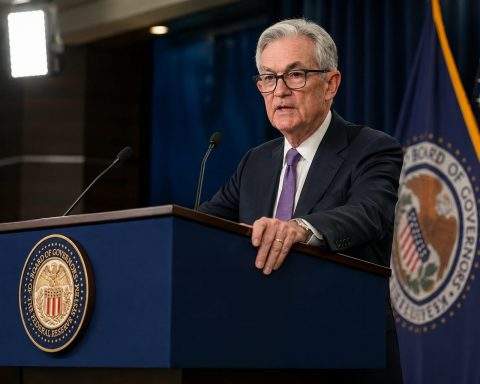
The Fed kept its target range at 3.50%-3.75% by a 9-3 vote. Beth Hammack, Neel Kashkari and Lorie Logan preferred a quarter-point increase. The statement linked elevated inflation partly to energy supply shocks.

Chair Kevin Warsh was blunt. “There is no soft inflation target,” he said in a preliminary opening statement.

Rate markets had assigned a 36% chance of a hike before the decision. The probability briefly reached 77%, then settled near 57% late Wednesday. About 35 basis points of tightening remained priced through year-end.

Ed Al-Hussainy, a Columbia Threadneedle portfolio manager, called persistent inflation “corrosive for returns” when valuations are already expensive. Reuters

The policy repricing was uneven. Previous yield levels and curve spreads below are calculated from reported yields and daily changes.

Policy or market measureBefore or previousLatestChange
Fed target range3.50%-3.75%3.50%-3.75%Unchanged
September hike probability36%57%+21 percentage points
Two-year Treasury yield4.277%4.242%-3.52 basis points
10-year Treasury yield4.604%4.679%+7.53 basis points
Two-to-10-year spread32.7 basis points43.7 basis points+11.1 basis points

The equity backdrop leaves little room for another long-yield increase. The S&P 500 trades near 20 times expected earnings. Its 10-year average is about 19 times. Analysts expect second-quarter index earnings to rise 40%, heavily supported by AI-linked companies. Decliners beat advancers by 1.8 to one.

That turns AI spending into a cash-flow test. Microsoft Corp. and Meta Platforms Inc. both posted strong sales growth. Their free cash flow — cash remaining after capital spending — diverged sharply.

Quarterly measureMicrosoftMeta Platforms
Revenue$90.0 billion$60.8 billion
Revenue growth+18%+28%
Operating-income growth+18%-8%
Capital expenditure$41.0 billion$31.08 billion
Free cash flow$19.6 billion$784 million
Free-cash-flow margin21.8%1.3%

Margins are calculated from company-reported figures. Definitions and lease treatment differ between issuers.

Microsoft’s Azure revenue rose 43%, while operating income increased 18%. Chief Executive Satya Nadella said, “Azure revenue surpassed $100 billion for the first time.” Meta’s operating income fell 8%, despite 28% revenue growth. It narrowed its 2026 capital-spending forecast to $130 billion-$145 billion. Microsoft

Oil remains the fastest link from war to inflation. Brent and WTI settled about 7%-8% higher Wednesday. WTI remained near $85 early Thursday after renewed U.S. attacks on Iran. Actual shipping flows and diplomacy will determine whether the spike persists.

The next test arrives at 8:30 a.m. EDT. The government will release its preliminary second-quarter GDP estimate and June income-and-spending data. Median forecasts call for 1.8% annualized GDP growth. Headline personal-consumption inflation is forecast at 3.7%, with core inflation at 3.3%.

Friday brings the employment cost index, with a 0.8% quarterly increase forecast. Next week includes manufacturing data Monday, job openings Tuesday and July payrolls Friday.

Risks: A diplomatic breakthrough could quickly reverse oil and long yields. Fresh shipping disruption could push both higher. A softer inflation reading could flatten the curve and weaken the cash-flow-first signal.

The Fed left its rate unchanged. Markets did not stand still. The 11-basis-point curve steepening is the key investor marker. If it persists, companies already funding growth internally should command a premium.

TS2 TECH • EXTENDED COVERAGE

Further analysis

How severe was the U.S. stock market decline on Wednesday?

The S&P 500 declined 1.52% on Wednesday to end at 7,316.15. The Dow shed 1,153.18 points, or 2.19%, settling at 51,594.14. The Nasdaq Composite dropped 1.74% to close at 24,442.94. Industrial shares slid 3.24%, with information technology off by 2.5%. Eight of the S&P 500’s eleven sectors finished the session lower. Reuters

What caused stock prices to decline following the Federal Reserve’s decision to keep rates unchanged?

The Federal Reserve left its target range unchanged at 3.50% to 3.75%. Still, three out of twelve policymakers backed a quarter-point hike right away, exposing more concern over inflation than markets anticipated. The yield on the 30-year Treasury climbed to about 5.24%, the highest in 19 years. Fresh worries about oil-fueled inflation emerged. Federal Reserve

How are stock-index futures indicating market direction ahead of Thursday’s open?

Dow futures advanced 0.13% from settlement as of 3:53 a.m. Eastern. S&P 500 futures increased by 0.18%, and Nasdaq 100 futures climbed 0.32%. The uptick signals a modest rebound rather than a widespread recovery. Major economic data is set to be released prior to Thursday’s market open, and these could swiftly alter the initial gains. The Wall Street Journal

Do markets now view a September interest-rate hike as their baseline expectation?

CME data suggested about a 65% probability of a rate hike in September. JPMorgan shifted its forecast to predict a quarter-point increase in December instead of September. Bank of America projects three hikes, the first expected at the September meeting. Goldman Sachs and Barclays see no change in 2026, while Citi continues to predict rate reductions. The policy outlook remains notably split. Reuters

What information did Microsoft and Meta disclose concerning the AI sector?

Microsoft reported revenue of $90.0 billion, an increase of 18%, with Azure rising 43%. GAAP earnings per share were $4.81, up 32%. Meta’s revenue rose 28% to $60.8 billion, but earnings declined 13%. Meta’s quarterly free cash flow dropped sharply to $784 million from $8.55 billion. Shares of Microsoft jumped over 7% premarket, while Meta fell more than 7%. The results highlight a divide: AI revenue gains against heavy AI spending. Microsoft

What economic data releases might influence stock movements today?

Reuters economists expect annualized growth at 2.1%, though projections range from 0.8% to 2.9%. Alternative market calendars indicate 1.8%, highlighting a lack of uniform consensus. Analysts anticipate Core PCE to be around 0.2% month-on-month and 3.3% year-on-year. For initial jobless claims, the consensus figure is 200,000, up from the previous 187,000. The three reports will be released at 8:30 a.m. Eastern. Higher-than-expected inflation is seen as likely to weigh on bonds and technology stocks. Reuters

To what extent is oil influencing the market perspective?

Brent climbed to $92.22, while WTI advanced to $84.89 in early Thursday trade, after increasing 7.91% and 6.56%, respectively, on Wednesday. Energy stocks rose as most other key sectors fell on Wednesday. The rise in fuel prices puts pressure on consumer spending and further complicates the Federal Reserve’s next moves. Oil continues to be the key variable in today’s markets. Reuters

Is the Nasdaq downturn creating more appealing valuations for stocks?

The Nasdaq 100 dropped 2.1% on Wednesday, now trading 11% below its peak in June. The wider Nasdaq Composite is still around 9% under its June high. In the S&P 500, the number of losing stocks outnumbered those gaining by a ratio of 1.8-to-one. On the Nasdaq, 230 stocks hit new lows, while only 121 attained new highs. The S&P 500 currently trades at about 20 times projected forward earnings, compared with a ten-year average of roughly 19 times. The downturn has made valuations more attractive, though the shift has not been substantial. Reuters

What is the probable near-term outlook for the market?

Volatile consolidation appears more probable than a direct rebound. Futures advances of 0.1%-0.3% suggest subdued confidence in buying the dip. A weaker PCE figure may benefit growth stocks and push yields down. However, stronger inflation, climbing oil prices, or sluggish cash flow could prompt renewed selling pressure. Amazon and Apple earnings, reporting after Thursday’s close, introduce another key risk. The outlook is conditional rather than definite. The Wall Street Journal

Jerzy Lewandowski is a senior markets editor at TS2.tech covering stocks, artificial intelligence, semiconductors and global financial markets. He studied economics at the University of Warsaw and previously worked in investment analysis before moving into financial journalism. His daily coverage focuses on the trends and events that matter most to investors worldwide. Follow Jerzy Lewandowski on Google News.

AI PORTFOLIO

Top Stock Picks

Today’s highest-ranked model selections.

#1 BUY IN STAGES

AerCap

NYSE: AER 95 / 100
#2 BUY ON WEAKNESS

Xylem

NYSE: XYL 93 / 100
#3 ACCUMULATE

General Dynamics

NYSE: GD 91 / 100
#4 BUY WITH LIMITS

Visa

NYSE: V 88 / 100
#5 TACTICAL BUY

IDEX

NYSE: IEX 85 / 100
View full portfolio
Editorial model selection. Not personalised advice.
SpaceX Starship Flight 13 advances V3 rollout, but booster landing failure raises questions over cost benefits
Previous Story

SpaceX (NASDAQ:SPCX) NROL-95 Launch Highlights Attention on $8.05 Billion Pentagon Contracts

Amazon (NASDAQ:AMZN) shares decline as almost all operating cash flow goes to capex
Next Story

Amazon (NASDAQ:AMZN) scales back Nova models as $200 billion AI investment put to test