NEW YORK, January 4, 2026, 18:22 ET
- Scientists used SOHO data to estimate how much water interstellar comet 3I/ATLAS released after perihelion.
- A Breakthrough Listen radio search with the Green Bank Telescope reported no candidate technosignatures from the object.
- The findings add to evidence that the rare interstellar visitor is behaving like an ordinary comet as it heads outbound.
Scientists tracking interstellar comet 3I/ATLAS with a Sun-watching spacecraft have estimated how quickly it shed water after its late-October pass around the Sun, before activity eased as it moved outward. A separate radio scan also reported no sign of artificial transmissions from the object. https://ts2.tech/en/soho-spots-water-gushi…
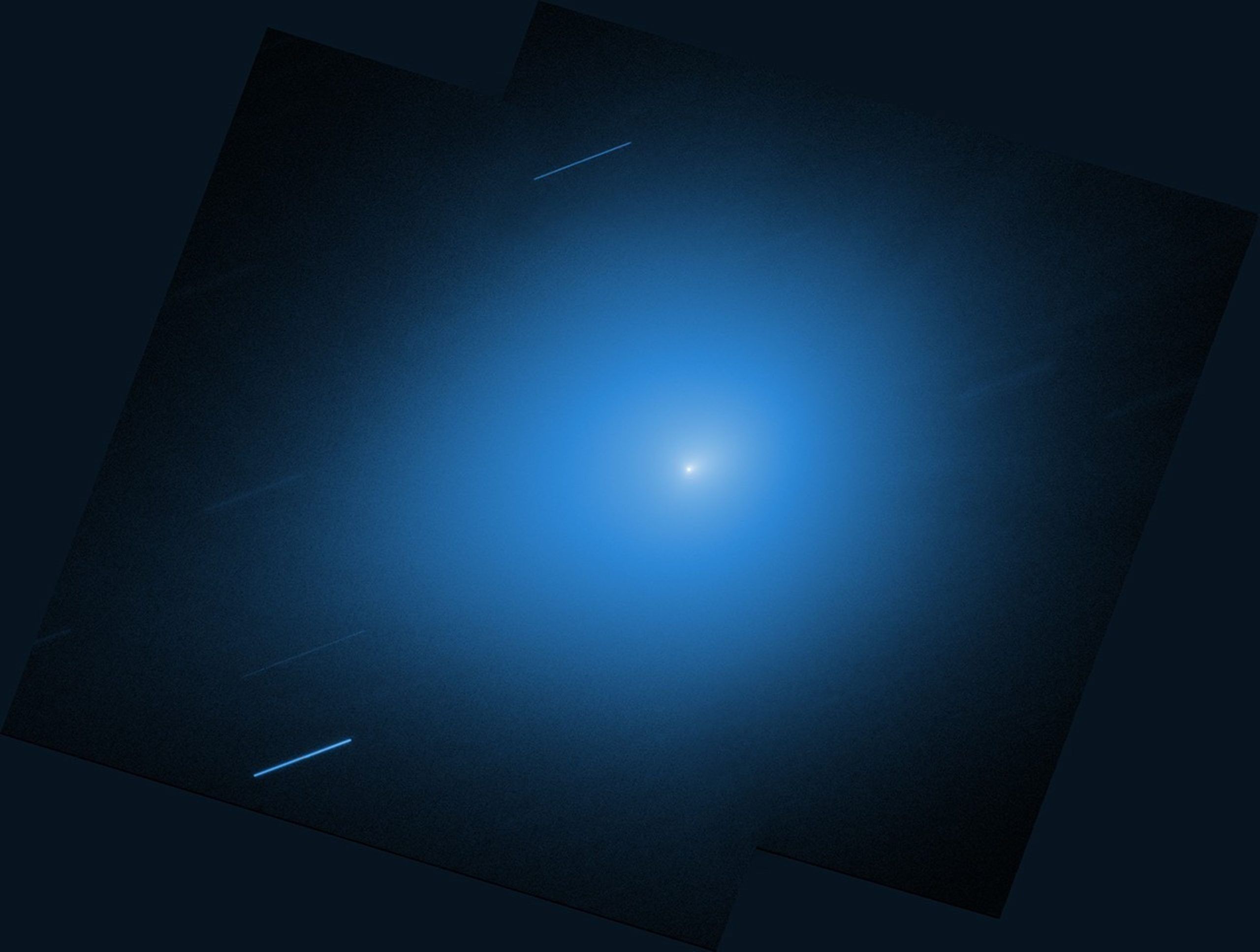
The readings matter because 3I/ATLAS — only the third confirmed interstellar object seen entering the solar system — is a fleeting opportunity to study material formed around another star. The comet is already on its way out, narrowing the window for observations.
Most detailed work on 3I/ATLAS focused on its approach, when sunlight was ramping up comet activity. After-perihelion data are harder to capture because the object fades and recedes, but they help scientists understand how quickly an interstellar comet “winds down” and whether it behaves like familiar solar-system comets.
In a preprint posted on arXiv on Dec. 26 and submitted to The Astrophysical Journal Letters, a team led by Michael Combi said the Solar and Heliospheric Observatory’s SWAN instrument detected the comet’s hydrogen coma starting on Nov. 6, nine days after perihelion. By modeling that ultraviolet hydrogen glow — produced when sunlight breaks apart water molecules — the team estimated a water production rate of 3.17 x 10^29 molecules per second at 1.40 astronomical units (AU) from the Sun, then a decline to 1–2 x 10^28 molecules per second by Dec. 8. Arxiv
NASA has said the comet posed no threat to Earth and passed no closer than about 270 million km (1.8 AU), while moving through the solar system at up to about 210,000 km per hour relative to the Sun. The agency has put the nucleus size somewhere between roughly 440 meters and 5.6 km, a wide range that reflects the limits of remote sensing of a fast-moving, dusty target. Nasa
In another preprint posted on arXiv, Breakthrough Listen researchers led by University of California, Berkeley astronomer Ben Jacobson-Bell said they observed 3I/ATLAS with the 100-meter Robert C. Byrd Green Bank Telescope on Dec. 18, scanning frequencies from 1 to 12 gigahertz. They reported no candidate technosignatures — potential signs of technology such as narrowband radio transmissions — and wrote: “We report a nondetection of candidate signals down to the 100 mW level.” Arxiv
The null result has drawn attention in part because of online chatter about whether the interstellar visitor is something stranger than a comet. A ScienceAlert report said all signals detected in the Green Bank search were traced to radio-frequency interference from human technology. Sciencealert
Some of the speculation has also been fueled by Harvard astrophysicist Avi Loeb, who has argued that processed Hubble images show three roughly evenly spaced inner jets and a prominent sunward “anti-tail,” a feature he said would require unlikely alignment if random. Loeb said the geometry warrants scrutiny, while acknowledging gas dynamics could still account for the pattern. Medium
Still, both lines of analysis come with caveats. SWAN measures ultraviolet hydrogen emission that must be converted into water output using models that depend on solar ultraviolet variability, and the work is in preprint form, before journal peer review.
Radio searches have their own limits: they can miss intermittent transmissions, signals outside observed bands, or non-radio technologies. For now, the latest measurements add to a growing picture of a fast-moving comet shedding water as it heads back toward interstellar space — and no evidence that it is anything else.