Search result

SOMALIA

Internet Access in Somalia: Growth, Challenges, and the Future of Connectivity

Internet Access in Somalia: Growth, Challenges, and the Future of Connectivity

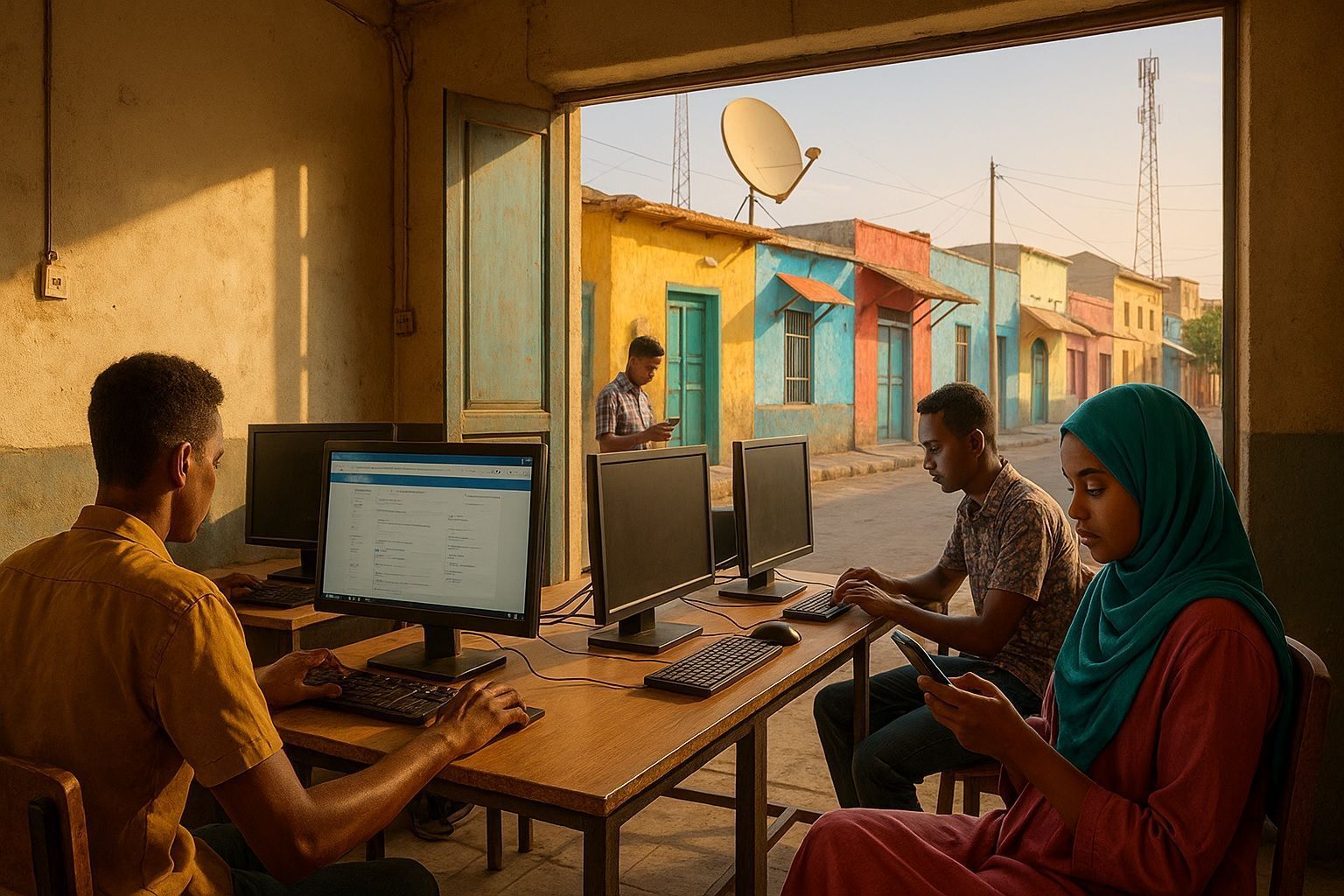
As of early 2024, Somalia had about 5.08 million internet users, a 27.6% penetration, up from around 2% in 2017, with more than 13 million people offline. Internet use is concentrated in urban centers such as Mogadishu and Hargeisa, while fixed broadband remains scarce, with only about 1% of Somalis having a high-speed fixed connection (>256 kbps). There were 10.10 million cellular mobile connections active in early 2024, about 54.8% of the population, and 4G LTE coverage reaches roughly 50–60%. By late 2024, at least three telecoms had launched initial 5G services in major urban centers, with Hormuud planning to

20 March 2025
Internet Access in Somalia: Growth, Challenges, and the Future of Connectivity

Acceso a Internet en Somalia: Crecimiento, Desafíos y el Futuro de la Conectividad

A principios de 2024, Somalia tenía aproximadamente 5,08 millones de usuarios de Internet, con una penetración del 27,6% de la población. Aproximadamente tres cuartas partes de los somalíes, más de 13 millones, seguían desconectados. Las velocidades de descarga móviles promedian 17 Mbps y la banda ancha fija es prácticamente inexistente para consumidores, con solo alrededor del 1% de la población suscrita. En 2024 había 10,10 millones de conexiones móviles activas, que representan aproximadamente el 54,8% de la población. La cobertura 4G LTE alcanza alrededor del 50-60% de la población y, para finales de 2024, al menos tres operadores habían lanzado
22 March 2025
Turkey’s Space and Satellite Industry: 2025 Market Report and 2030 Outlook

Turkey’s Space and Satellite Industry: 2025 Market Report and 2030 Outlook

Key Facts Historical Background: From First Satellites to a National Space Agency Turkey’s foray into space began with modest steps in the late 20th century and has since picked up remarkable speed. The country’s early efforts were focused on satellite communications as Turkey sought to improve telecommunications and broadcast infrastructure for its growing economy. 1994 – First Turkish Satellite: After joining the international Intelsat consortium in the 1980s uydu.turksat.com.tr, Turkey launched its first communications satellite, Türksat 1B, in August 1994 on an Ariane rocket uydu.turksat.com.tr. (An earlier attempt, Türksat 1A in January 1994, failed during launch.) Türksat 1B’s successful deployment to geostationary orbit
24 September 2025
Inside Djibouti’s Digital Frontier: The Rise of Internet Access and Satellite Connectivity

Inside Djibouti’s Digital Frontier: The Rise of Internet Access and Satellite Connectivity

Djibouti hosts about 10–12 international undersea cables on the Red Sea coast, including SMW3, EIG, SEA-ME-WE-5/6, AAE-1, EASSy, WIOCC, Yemeni, and DARE1, linking to Europe, Asia and East/Southern Africa. Djibouti Telecom invested over $200 million in the last decade in landing stations and a protected submarine corridor, reinforcing Djibouti as a regional internet gateway. Terrestrial fiber links connect Djibouti to Ethiopia and Somalia, and AfriFiber serves thousands of homes in Djibouti City. The Djibouti Data Center (DDC) is the first and only carrier-neutral data center in East Africa, co-locating major cable landing points with Tier-3 colocation, peering, and the DjIX
Eritrea’s Digital Desert: Inside the World’s Most Isolated Internet – and the Satellite Lifeline on the Horizon

Eritrea’s Digital Desert: Inside the World’s Most Isolated Internet – and the Satellite Lifeline on the Horizon

As of early 2024, about 26% of Eritrea’s 3.7 million people were internet users. Eritrea is the only coastal African nation with zero submarine fiber-optic cable landings. The telecom sector is entirely state-owned and monopolized by Eritrean Telecommunication Services Corporation (EriTel), with no private ISPs or competing mobile operators. Public mobile data is essentially unavailable; the mobile network runs on 2G GSM with 3G/4G largely disabled for ordinary users. Fixed broadband remains extremely limited, with fewer than 150 subscriptions in the mid-2010s. Internet cafés are the primary access point, with fewer than 10 in Asmara and roughly 100 nationwide. EriTel’s
12 June 2025
Starlink Global Availability and Impact Report

Starlink Global Availability and Impact Report

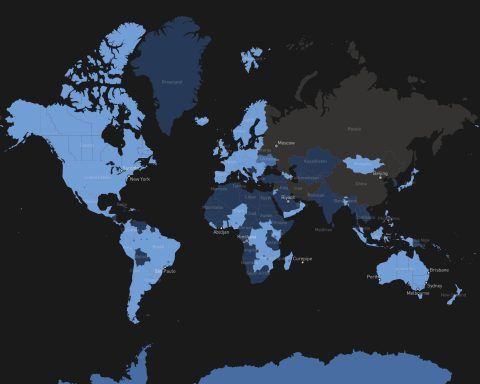
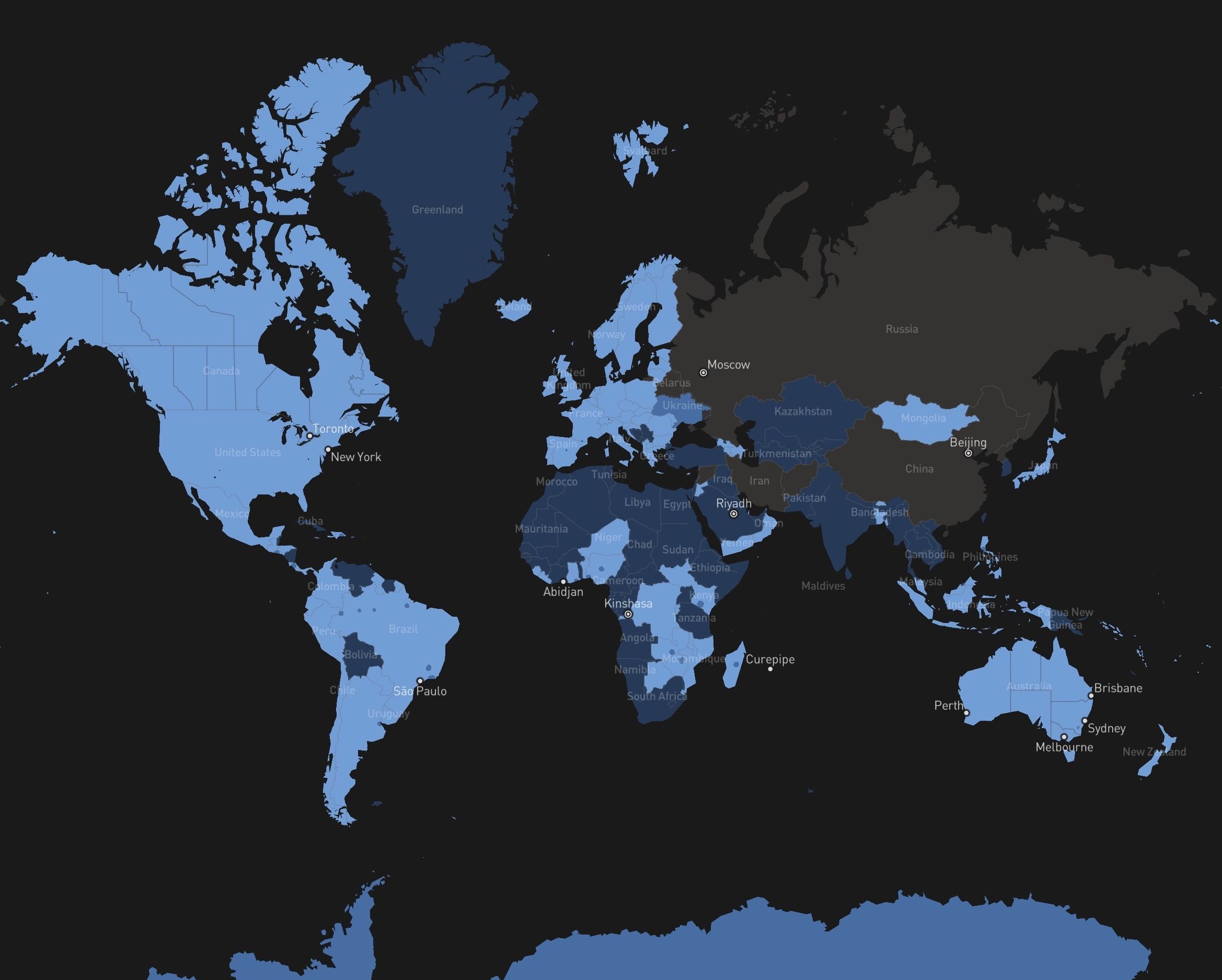
Starlink is available in over 100 countries as of mid-2025, spanning North America, Europe, Asia, Africa, Oceania, and parts of South America. As of late 2024, Starlink had surpassed 4 million subscribers. Starlink offers five service types: Residential, Roam, Business (Priority), Maritime, and Aviation. Typical speeds range from about 50 Mbps to 150+ Mbps, with most users above 100 Mbps under good conditions, and latency around 20–50 ms. Monthly pricing ranges from about $90–$120 in well-connected markets, with discounts to roughly $30–$50 in developing regions. The United States was the first to receive Starlink, with public beta in mid-2020 and
2 June 2025
Starlink Global Availability and Impact Report

Disponibilidad Global de Starlink e Informe de Impacto

Starlink ya está disponible en más de 100 países a mediados de 2025, abarcando América, Europa, Asia, África y Oceanía. Desde su lanzamiento beta en 2020, Starlink ha acumulado más de 4 millones de suscriptores a finales de 2024. Starlink ofrece cinco tipos de servicio: Residencial, Roam, Empresarial (Priority), Marítimo y Aeronáutico. Las velocidades de descarga oscilan entre aproximadamente 50 Mbps y más de 150 Mbps, y la latencia ronda entre 20 y 50 ms. El precio mensual varía por región, alrededor de 90–120 USD en mercados bien conectados, con descuentos de 30–50 USD en regiones en desarrollo como África.
11 June 2025
You Won’t Believe Where the Next Total Solar Eclipse Will Happen – Upcoming Solar Eclipses from 2025 Onward

You Won’t Believe Where the Next Total Solar Eclipse Will Happen – Upcoming Solar Eclipses from 2025 Onward

September 21, 2025 – Partial Solar Eclipse visible mainly from the Southern Hemisphere, with up to 80% Sun obscured over the South Pacific, including Fiji, Tahiti, New Zealand, and parts of Antarctica. February 17, 2026 – Annular “ring of fire” over Antarctica, with annularity lasting about 2 minutes at maximum, while a partial eclipse will be visible across southern South America, southern Africa, and surrounding oceans. August 12, 2026 – Total Solar Eclipse crossing Greenland, Iceland, and northern Spain (plus a small corner of Portugal) with totality up to about 2 minutes 18 seconds. February 6, 2027 – Annular Solar
2 August 2025
Longest Solar Eclipse in 100 Years Coming on August 2, 2027: Path, Timing, Myths and How to Watch Safely

Longest Solar Eclipse in 100 Years Coming on August 2, 2027: Path, Timing, Myths and How to Watch Safely

A once‑in‑a‑century sky show is now dominating science and lifestyle headlines. On August 2, 2027, a total solar eclipse dubbed “the eclipse of the century” will sweep across southern Europe, North Africa and the Middle East, delivering up to 6 minutes and 23 seconds of total darkness — the longest totality visible from land between 1991 and 2114. WIRED+1 On December 8–9, 2025, outlets from WIRED to The Australian Women’s Weekly, SYFY, and international titles like the Economic Times and Times of India all pushed fresh explainers and travel pieces, signaling that global countdown coverage has truly begun. The Times of India+4WIRED+4The Australian Women’s Weekly+4 Below is everything you need to know — from where to
9 December 2025
Starlink Global Availability and Impact Report

Starlink Globaler Verfügbarkeits- und Wirkungsbericht

Stand Mitte 2025 ist Starlink in über 100 Ländern verfügbar, einschließlich Nordamerika, Europa, Asien, Afrika, Ozeanien und Teilen Südamerikas. Ende 2024 zählte Starlink mehr als 4 Millionen Abonnenten. Starlink bietet Residential, Roam, Business (Priority), Maritime und Aviation als Dienste, wobei Roam in manchen Ländern nur im Stand genutzt werden darf. Typische Downlink-Geschwindigkeiten liegen zwischen ca. 50 Mbit/s und über 150 Mbit/s, während die Latenz etwa 20–50 ms beträgt. Die monatlichen Gebühren variieren stark: ca. 90–120 USD in gut erschlossenen Märkten, und deutlich günstiger in Entwicklungsländern, etwa 30–50 USD in Teilen Afrikas. Im Ukraine-Krieg wurde Starlink im Februar 2022 als Notmaßnahme
11 June 2025
Starlink Globaler Abdeckungs- und Verfügbarkeitsbericht

Starlink Globaler Abdeckungs- und Verfügbarkeitsbericht

Mitte 2025 ist Starlink weltweit in über 110 Ländern und Territorien verfügbar. USA: Begrenzte Tests starteten im August 2020, die öffentliche Beta begann im November 2020, und der kommerzielle Vollbetrieb ist landesweit gesichert, mit über 2,5 Millionen Abonnenten Anfang 2025. Kanada startete im Januar 2021 nach einer Beta-Phase Ende 2020 und hat landesweite Abdeckung in allen Provinzen. Mexiko erhielt Mitte 2021 eine Lizenz, der Dienst startete im November 2021, und 2024 zählte Starlink Mexiko über 160.000 Abonnenten, unterstützt durch das Regierungsprogramm „Internet para Todos“. Ukraine – Verfügbar (Sonderfall) seit Februar 2022 als Notfall-Verbindung; zehntausende aktive Terminals für Regierung, Militär und
7 June 2025
Starlink Global Coverage and Availability Report

Starlink Global Coverage and Availability Report

As of mid-2025, Starlink is available in over 110 countries and territories. In the United States, Starlink began with limited trials in August 2020 and the public beta “Better Than Nothing Beta” in November 2020, and now has nationwide commercial coverage including Puerto Rico and the U.S. Virgin Islands, with over 2.5 million subscribers as of early 2025. Canada went live in January 2021 after a late-2020 beta and now has broad coverage across all provinces. Mexico received a license in mid-2021, began service by November 2021, and by 2024 had over 160,000 subscribers, with the federal “Internet para Todos”
7 June 2025
Internet Access Chaos: Blackouts, Crackdowns & Broadband Breakthroughs (Sept 5–6, 2025)

Internet Access Chaos: Blackouts, Crackdowns & Broadband Breakthroughs (Sept 5–6, 2025)

Major Outages and Internet Shutdowns In early September 2025, multiple outages and deliberate shutdowns disrupted internet access for millions across different regions. In the United States, a major Verizon network failure on August 30 demonstrated the fragility of even advanced telecom systems ts2.tech. Starting around midday (Eastern time), Verizon mobile users from California to New York suddenly lost service, with their phones stuck in emergency “SOS only” mode instead of connecting to any network ts2.tech. By mid-afternoon, outage reports spiked above 23,000 as people complained they couldn’t make calls or use mobile data ts2.tech. Verizon attributed the blackout to a
State of Internet Access in Angola: From Urban Hubs to Satellite Lifelines

State of Internet Access in Angola: From Urban Hubs to Satellite Lifelines

As of January 2025, Angola has about 17.2 million internet users (44.8% penetration) with roughly 60% of the population still offline. There are three mobile operators—Unitel (launched 2001), Movicel, and Africell (entered in 2022)—with Unitel and Africell accounting for about 65.7% and 27.8% of mobile broadband subscriptions in 2023, and Movicel the remaining ~6–7%. 3G coverage reaches about 90–92% of the population; 4G coverage was around 34% in 2023 with targets of 48% by end-2023 and 85% by 2027, while 5G launched commercially in December 2022 in central Luanda and had ~2% of the population covered by late 2024. The
30 May 2025
Insane Internet Speeds: The Fastest Connections on Earth and What’s Coming Next

Insane Internet Speeds: The Fastest Connections on Earth and What’s Coming Next

In June 2024, a team led by Japan’s NICT and Aston University achieved 402 Tbps over a single standard optical fiber using six wavelength bands (O, E, S, C, L, and U). In March 2024, the same international team reached 301 Tbps by extending into E-band and S-band with a custom amplifier for those bands. In July 2021, NICT researchers transmitted 319 Tbps over 3,001 km using a 4-core optical fiber with 552 channels across a 120 nm spectrum. In August 2020, University College London set a then-record of 178 Tbps using geometric shaping constellations. In April 2025, NICT with
17 June 2025
Flying Into Trouble? These Are the Drone Laws in Every Country You Must Know in 2025

Flying Into Trouble? These Are the Drone Laws in Every Country You Must Know in 2025

Most countries require registration for drones over 250 g, with examples including the United States, Canada, the United Kingdom, the EU, China, and Japan, and fees typically around $5 for 1–3 years. In the United States, recreational flyers must pass the TRUST test and follow community safety rules, while commercial operators must hold an FAA Remote Pilot Certificate (Part 107); since March 16, 2024, Remote ID is mandatory, and penalties can reach $27,500 civil or $250,000 criminal. The European Union uses a three‑category system (Open, Specific, Certified) under EASA rules, with an Open category limited to 120 m (400 ft)
13 June 2025
Informe sobre la Cobertura y Disponibilidad Global de Starlink

Informe sobre la Cobertura y Disponibilidad Global de Starlink

Starlink está disponible en más de 110 países y territorios a mediados de 2025. Estados Unidos fue el primer país en recibir Starlink, con pruebas limitadas desde agosto de 2020 y la beta pública Better Than Nothing lanzada en noviembre de 2020. Brasil aprobó Starlink en 2021 y el servicio arrancó a principios de 2022, con más de 260,000 suscripciones a finales de 2024. Argentina activó el servicio en marzo de 2024 tras obtener licencias locales. India recibió una licencia clave en junio de 2025 y se espera un lanzamiento comercial para finales de 2025. Ucrania ha utilizado Starlink desde
7 June 2025
Cobertura Global e Relatório de Disponibilidade da Starlink

Cobertura Global e Relatório de Disponibilidade da Starlink

Até meados de 2025, o Starlink está disponível em mais de 110 países e territórios. Os Estados Unidos foram o primeiro país a receber o Starlink, com testes iniciando em agosto de 2020 e beta público “Better Than Nothing Beta” em novembro de 2020, chegando a mais de 2,5 milhões de assinantes no início de 2025. O Canadá foi lançado em janeiro de 2021, após a fase beta de 2020, com cobertura ampla em todas as províncias. O México recebeu licença em meados de 2021, serviço começou em novembro de 2021, com lançamento comercial em até 180 dias após a
7 June 2025

Stock Market Today

Amazon stock (AMZN) slides on $200 billion AI capex plan — what Wall Street watches next week

Amazon stock (AMZN) slides on $200 billion AI capex plan — what Wall Street watches next week

7 February 2026
Amazon shares fell 5.6% to $210.32 on Friday after the company forecast 2026 capital spending would jump to $200 billion, up more than 50% from 2025. The drop came as the Dow closed above 50,000 for the first time. Amazon reported fourth-quarter net sales up 14% to $213.4 billion and operating income at $25 billion. Trading in Amazon was volatile, with 179 million shares changing hands.
Bitcoin price wobbles below $69,000 on weekend — what matters before Monday’s reopen

Bitcoin price wobbles below $69,000 on weekend — what matters before Monday’s reopen

7 February 2026
Bitcoin fell 1.1% to $68,917 Saturday after volatile trading, while Ether held near $2,036. U.S. spot bitcoin ETFs saw $330.7 million in net inflows on Feb. 6, reversing outflows the previous day. Strategy shares rebounded after hitting a low of $111.27 Thursday. Traders are watching Monday’s U.S. market open and the upcoming inflation report for direction.
Go toTop