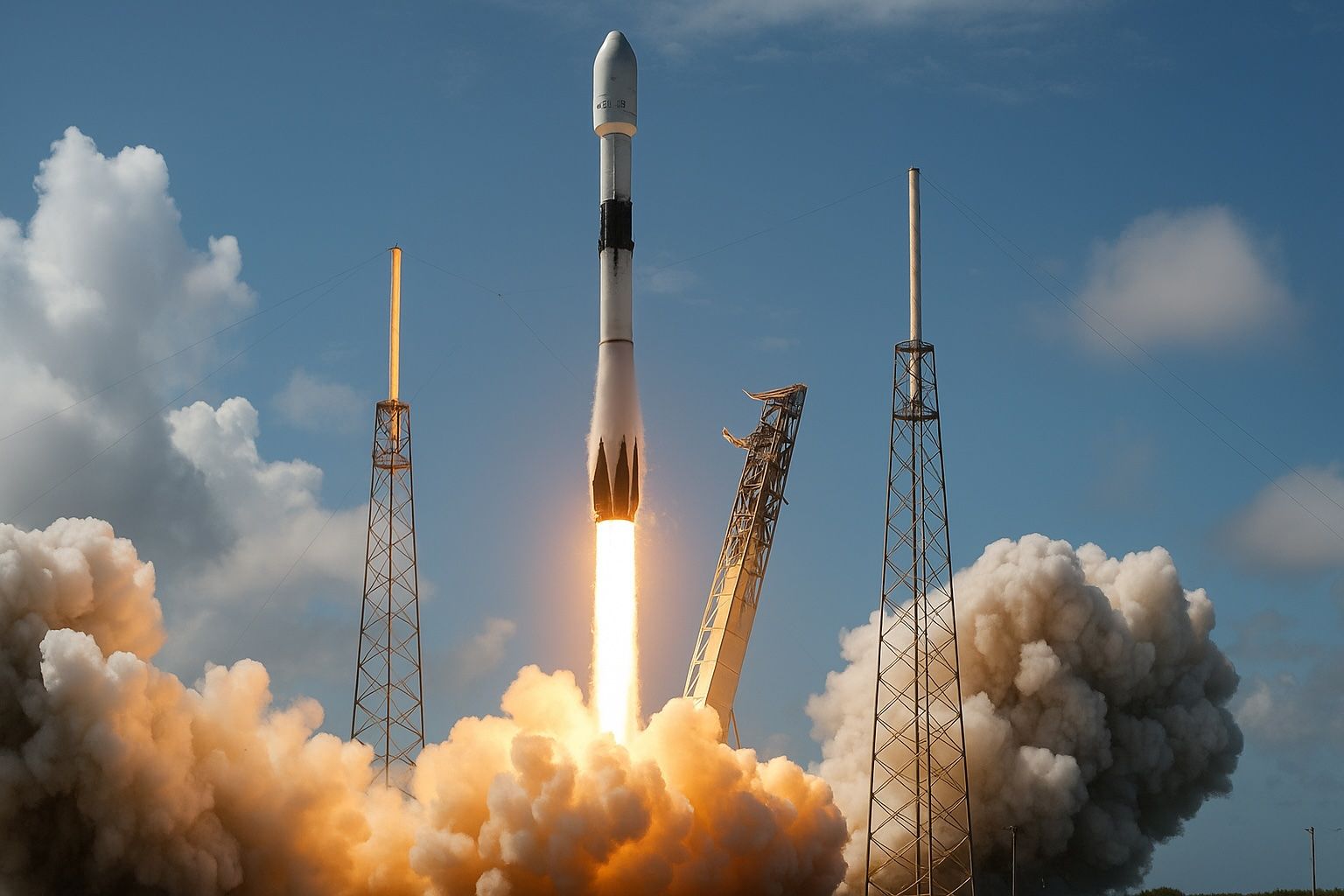

- QUICK³ is a 3U CubeSat weighing 4 kg, led by Germany’s Technical University of Munich, and it launched on 23 June 2025 aboard SpaceX’s Transporter‑14 from Vandenberg SFB.
- It carries the first true single-photon source flown, a laser-pumped hexagonal boron nitride chip on a 10 × 10 × 15 cm photonic chip.
- True single photons are expected to raise secret-key rates 10–100× over weak-laser systems.
- The pump laser is a 698 nm diode module, 45 × 80 × 20 mm, weighing 200 g.
- QUICK³ uses a 3U CubeSat bus with a 4 kg mass budget and rideshare compatibility, with launch costs under $300k.
- It will demonstrate high-rate space-to-ground QKD downlinks using its brighter on-chip photon source.
- It also carries an interferometric circuit to test the Born rule under microgravity, a physics experiment not previously performed outside Earth.
- On launch day, Falcon 9 lifted 70 small payloads including QUICK³ at 21:25 UTC, and the booster reached orbit on the first attempt.
- The mission aims to enable a constellation of hundreds of low-cost quantum relay satellites and set new cybersecurity standards.
- The project is funded by Germany’s Federal Ministry for Economic Affairs and Energy as part of its quantum-technology initiative, with a multinational consortium including TUM, FSU Jena, FBH Berlin, TU Berlin, CNR-IFN, and NUS.
The maiden flight of QUICK³, a 4 kg CubeSat led by Germany’s Technical University of Munich (TUM), has hurled quantum‑secure communications research into orbit. Launched 23 June 2025 on SpaceX’s Transporter‑14 rideshare from Vandenberg SFB, the nanosatellite carries the first true single‑photon source ever flown, a laser‑pumped hexagonal‑boron‑nitride chip that could underpin an unhackable global data network. Over the next few months the mission will verify both the hardware’s survivability and one of quantum theory’s most fundamental postulates—the Born rule—under micro‑gravity. If successful, QUICK³ will shorten the path toward a constellation of hundreds of low‑cost quantum relay satellites and fundamentally new cybersecurity standards.
1. Launch Day Highlights
- Rocket & timeline. Falcon 9 lifted 70 small payloads—including QUICK³—at 21:25 UTC on 23 June during SpaceX’s Transporter‑14 mission, following a 24‑hour weather delay nasaspaceflight.com.
- Foggy but flawless. Despite “poor visibility at the launch pad,” the booster reached orbit on the first attempt tum.de.
- Orbit & first contact. Mission operators confirmed healthy telemetry on the first pass; in‑orbit commissioning is expected to finish within eight weeks fbh-berlin.de.
2. Inside QUICK³: Hardware Made for Quantum Keys
| Payload element | Key specs | Why it matters |
|---|---|---|
| Single‑photon source | Fluorescent center in hBN on a 10 × 10 × 15 cm photonic chip fbh-berlin.de | True single photons raise secret‑key rates 10–100× over weak‑laser systems. |
| Pump laser | 698 nm diode module, 45 × 80 × 20 mm, 200 g fbh-berlin.de | Miniaturization slashes cost and mass, critical for CubeSat constellations. |
| Satellite bus | 3U CubeSat, 4 kg mass budget tum.de | Rideshare‑compatible; launch cost <$300 k. |
2.1 What the experts say
“In this mission we are testing single‑photon technology for nano‑satellites for the first time… The transmission speed is a key advantage of our system.” —Prof. Tobias Vogl, TUM tum.de
“Satellites only have visual contact with ground stations for a few minutes per orbit, so every photon counts.” —Vogl, interview with University of Jena press office uni-jena.de
FBH laser‑team note: the pump module “delivers several milliwatts in an extremely compact form factor,” enabling CubeSat integration fbh-berlin.de.
3. Science Goals
3.1 Space‑to‑Ground Quantum Key Distribution (QKD)
Fiber QKD is limited to ≈300 km because single photons cannot be amplified; above ≈10 km the atmosphere’s low scattering enables intercontinental links tum.deuni-jena.de. QUICK³ will demonstrate high‑rate downlinks using its brighter, on‑chip photon source.
3.2 Fundamental Physics: Testing the Born Rule
The satellite carries an interferometric circuit that will probe whether quantum‑state probabilities behave identically in micro‑gravity—a test never performed outside Earth’s labs tum.de.
4. The Consortium & Funding
| Country | Institution | Contribution |
|---|---|---|
| Germany | TUM | Mission lead, single‑photon source |
| Germany | FSU Jena | Co‑developer, optics integration uni-jena.de |
| Germany | FBH Berlin | Pump‑laser design fbh-berlin.de |
| Germany | TU Berlin | Payload–bus interface and experiment control fbh-berlin.de |
| Italy | CNR‑IFN | Integrated photonic chip fbh-berlin.de |
| Singapore | NUS | Read‑out electronics fbh-berlin.de |
The German Federal Ministry for Economic Affairs and Energy finances the project under its quantum‑technology initiative tum.de.
5. Why This Launch Matters in the Quantum‑Satellite Landscape
| Milestone | Year | Mass | Key achievement |
|---|---|---|---|
| Micius (QUESS), China nature.com | 2016 | 640 kg | First entanglement & QKD over 1,200 km. |
| SpooQy‑1, Singapore cqt.sg | 2020 | 2.6 kg | Entangled‑photon source proven in 3U CubeSat. |
| Jinan‑1, China thequantuminsider.com | 2022 | 23 kg | 0.59 Mbit secure keys in one pass. |
| Eagle‑1, ESA/EC esa.int | 2024 (launch) | 350 kg | Europe’s first in‑orbit QKD testbed. |
| QUICK³, Germany‑led tum.defbh-berlin.de | 2025 | 4 kg | First space test of true single‑photon CubeSat source & Born‑rule physics. |
QUICK³ pushes the state of the art by shrinking the payload another order of magnitude, a pre‑condition for the hundreds‑satellite constellations global operators envision.
6. Market & Security Implications
- Cyber‑resilience. Quantum‑safe key delivery via satellites sidesteps terrestrial fiber taps and future quantum‑computer attacks on RSA/elliptic‑curve crypto space.cominterestingengineering.com.
- Commercial rideshares. Transporter‑style missions reduce launch cost to <$10,000 kg⁻¹, letting universities and SMEs iterate hardware yearly news.satnews.com.
- European autonomy. ESA’s Eagle‑1 and EuroQCI programmes aim to avoid dependence on non‑EU infrastructure esa.int.
7. Obstacles Still Ahead
- Uplink efficiency. Atmospheric turbulence can wipe out >90 % of photons in a ground‑to‑space direction; adaptive optics are not yet CubeSat‑grade.
- Global coverage. Simulations suggest 300–600 satellites are needed for 24 / 7 secure links tum.denature.com.
- Standardization. Competing protocols (BB84, E91, decoy‑state) must converge before government and financial sectors adopt space QKD at scale nature.com.
8. What Happens Next?
In‑orbit checkout → first on‑chip photon statistics (≈September 2025) → cross‑link tests with Bavarian and Singapore ground stations (Q4 2025) → public release of Born‑rule data (early 2026). Interim findings will be published in npj Quantum Information according to mission planners fbh-berlin.de.
Bottom Line
By squeezing a laboratory‑grade single‑photon source into a shoebox, QUICK³ rewrites the cost curve of quantum‑secure networking. If the mission validates both high‑rate QKD and fundamental quantum physics in orbit, it will accelerate the deployment of globe‑spanning constellations and usher in an era where truly unhackable encryption is delivered from space.
Sources used: TUM, FBH, University of Jena, NASA‑Spaceflight, Space.com, SatNews, InterestingEngineering, The Quantum Insider, Nature, ESA, CQT Singapore.
Related articles: Innovation