SEOUL, July 20, 2026, 20:04 KST
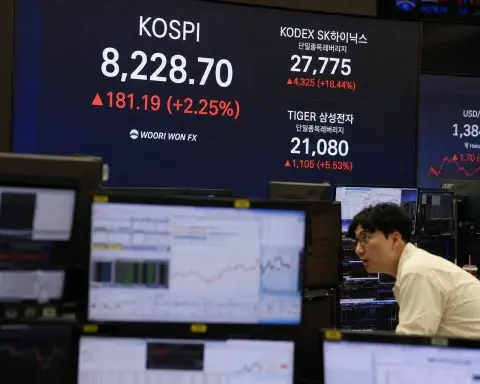
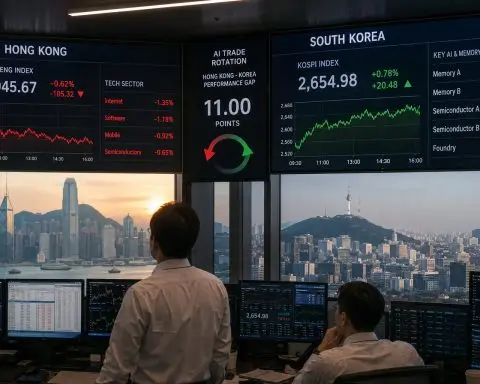
SK hynix finished Monday down 4.23% at 1.764 million won. The KOSPI index fell 4.46%. Markets in Seoul had closed, while Nasdaq was still in premarket trading.
The selloff expanded the notable divide between the company’s dual listings. Each American depositary receipt is equivalent to one-tenth of a common share. With Seoul’s closing rate at 1,481.5449 won per dollar, this matched $119.06 for each ADR.
The Nasdaq finished at $154.03 on Friday, reflecting a 29.4% premium. Premarket signals at $162.36 pushed the premium to 36.4%. The latter is based on early estimates.
| Listing | Latest quote | Session move | ADR-equivalent value | Premium to Seoul |
|---|---|---|---|---|
| Seoul common share | 1,764,000 won | -4.23% | $119.06 | Baseline |
| Nasdaq ADR, Friday close | $154.03 | +1.13% | $154.03 | 29.4% |
| Nasdaq ADR, premarket | $162.36 | +5.41% | $162.36 | 36.4% |
Initial estimates are based on 10 ADRs for each common share and an exchange rate of 1,481.5449 won. The premarket comparison uses non-simultaneous prices and could shift prior to standard U.S. trading.
The spread between the regular and close prices reached 25.6% on July 13. Monday’s figure indicates the gap has widened by nearly four percentage points. This points to continuing robust U.S. access demand compared to price discovery in Seoul.
“ADRs tend to be priced at a premium as they provide U.S. investors with direct access to the stock for the first time,” said analyst Nic Puckrin. He mentioned that heavily trafficked arbitrage trades generally cause prices to converge over time. Reuters
Local shares dropped 15.5% from July 10 to July 16. On Monday, the slide since July 10 widened to 19.1%. The stock is currently trading 40.9% below its intraday peak from June 25.
Domestic leverage could maintain uneven price discovery. The value of assets held in Korean and foreign leveraged funds dropped from $53 billion on June 22 to $28 billion by Thursday. Onshore vehicles continued to account for two-thirds of all assets.
The business fundamentals continue to outperform share price trends. According to Counterpoint Research, SK hynix captured 58% of high-bandwidth-memory revenue during the first quarter. Both Samsung Electronics Co. KRX:005930 and Micron Technology Inc. NASDAQ:MU recorded 21% shares each.
However, analyst Ryu Young-ho noted that HBM4 shipments have yet to ramp up significantly. He added that SK hynix is less impacted by traditional DRAM price rises, as its revenue is more concentrated in HBM.
Recent remarks from executives introduced a valuation pause. SK Group Chairman Chey Tae-won stated, “Memory prices are currently at an abnormally high level.” He maintained that increasing supply is necessary to curb rising chip prices. 조선일보
The outlook for supply over the long term is still constrained. CEO Kwak Noh-jung stated that customer demand continues to increase, but capacity is still restricted. He anticipates the industry’s most severe supply shortage will occur in 2027.
The near-term focus shifts to routine U.S. market activity this week. If Seoul sees a recovery, the discrepancy could lessen even if ADR selling remains moderate. SK hynix is set to report its next earnings on July 29 at 09:00 KST.
Risks continue to be elevated. The premium could narrow if ADRs decline, Seoul markets recover or there are shifts in the exchange rate. Further volatility may be triggered by slower HBM4 deliveries, decreasing AI expenditure or required deleveraging.
The gap between the two markets now provides investors with more insight than each price individually. Upcoming results on July 29 will show if earnings, instead of leverage, become the key factor.
Related articles: KRX:005930